
A shorter animation isn’t automatically a simpler or less costly project. In Malaysia, animation video production rates depend on what the story needs to communicate, the visual approach and the work behind each finished second, not runtime alone. Comparing headline figures can be misleading when pr...

A shorter animation isn’t automatically a simpler or less costly project. In Malaysia, animation video production rates depend on what the story needs to communicate, the visual approach and the work behind each finished second, not runtime alone.
Comparing headline figures can be misleading when proposals describe different deliverables. One quote may include a script, custom visual development and defined feedback rounds, while another assumes your team will supply finished materials. Compare the work and outputs in each proposal, not just the total.
This 2026 buying guide explains what shapes an animation quote, from visual style and message complexity to scripting, voiceover, revisions and final formats. You’ll learn how to compare proposals against the same scope, spot gaps that may affect planning and prepare a focused brief for a project-specific proposal. Start with the communication goal, audience and message, then assess which creative approach can make them clear.
• Animation video production rates Malaysia depend on the agreed creative and production scope, not runtime alone.
• Compare motion graphics, 2D animation and 3D animation by their visual purpose, design detail and production complexity.
• Use the same project brief to assess concept development, script, visual design, animation and final deliverables.
• Define your communication goal, audience, message and format, then separate essential requirements from optional ideas.
• VISIOLAB combines strategic planning and production discipline to turn complex organisational messages into clear visual stories.
A production rate reflects a defined scope, not runtime alone. An animation quote sets out the proposed creative and production work needed to turn a communication goal into a finished video. Two projects with the same duration can require very different amounts of development and design.
When comparing animation video production rates Malaysia, separate three influences: creative complexity, production scope and project requirements. Creative complexity covers the visual thinking and detail needed to explain the message. Production scope describes the stages and outputs. Project requirements specify the audience, intended use and formats for the finished animation.
A simple sequence of titles and shapes may need less visual development than an animation explaining a process, system or organisational change. Scene count, custom illustrations, visual detail and movement all affect the work. The audience matters, too: internal training may need a different pace and level of explanation from a public-facing overview.
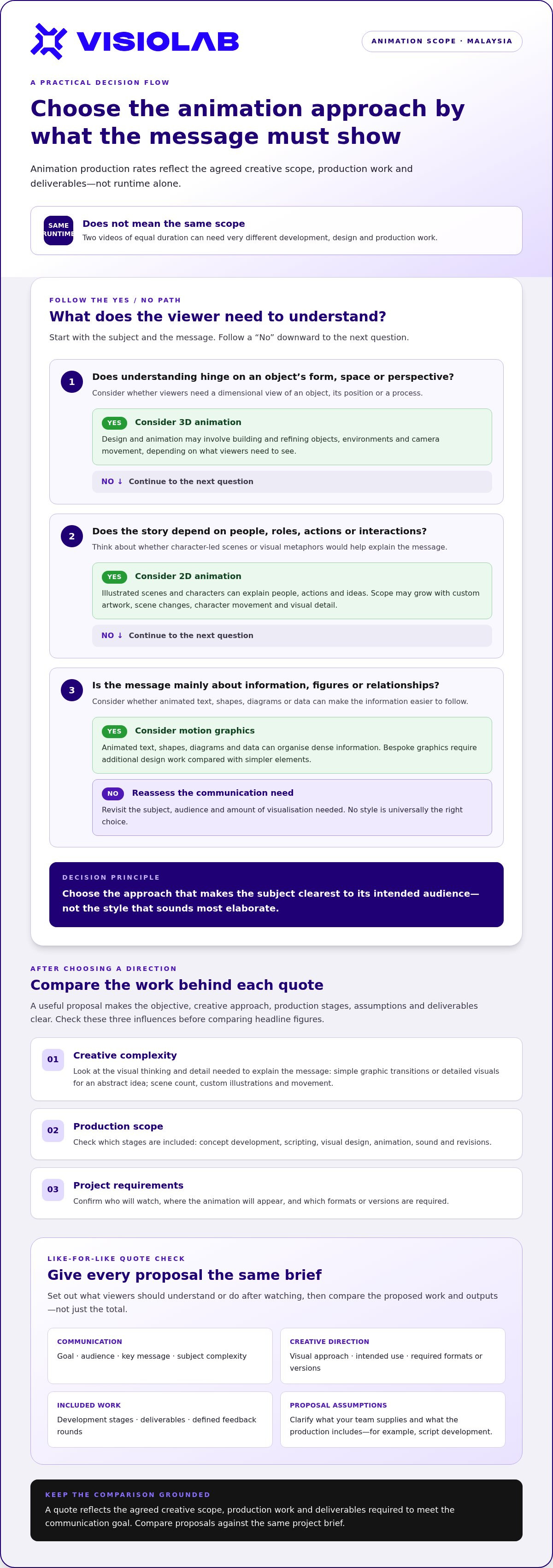
Animation includes a range of techniques, as outlined in this overview of types of animation. Choose an approach based on what the message needs to show, not on which style sounds most elaborate.
Is the concept built around simple graphic transitions, or does it need detailed visuals to make an abstract idea easier to grasp?
Which stages are included, such as concept development, scripting, visual design, animation, sound and revisions?
Who will watch the video, where will it appear, and which formats or versions are needed?
A useful quote creates a shared understanding of the objective, creative approach, production stages and agreed deliverables. It should state the assumptions behind the proposal so you can compare like with like. For example, one proposal may include script development, while another may expect your organisation to supply the script.
An animation quote depends on the agreed creative scope, production work and deliverables required to meet the project’s communication goal.
Before reviewing proposals, write down what viewers should understand or do after watching. Describe the key message, the subject’s complexity and where the animation will be used. That brief gives the creative team a basis for recommending a visual approach and gives your organisation a consistent way to assess proposals.
Choosing an animation approach is a creative decision with practical consequences for the work involved. Motion graphics, 2D animation and 3D animation solve different visual problems. The right fit depends on the subject, audience and amount of visualisation the message needs, not on one format being universally cheaper or more effective.
That’s why animation video production rates Malaysia can’t be compared by style label alone. A data-led corporate update and a character-led explanation may both use 2D visuals, yet require different design development and movement. For more context on how an explainer can organise a complex message, explore explainer video production in Malaysia.
| Approach | Visual purpose | Design detail and production complexity |
|---|---|---|
| Motion graphics | Organises information through animated text, shapes, diagrams and data. | Effort depends on the number of scenes, the visual system and whether the graphics use straightforward elements or bespoke design. |
| 2D animation | Builds illustrated scenes, often using characters or visual metaphors to explain people, actions and ideas. | Complexity grows with custom artwork, scene changes, character movement and the detail needed to support the story. |
| 3D animation | Shows form, space, perspective or processes that benefit from a dimensional view. | Design and animation may involve building and refining objects, environments and camera movement, depending on what viewers need to see. |
Animated text, shapes and data can organise information that might otherwise feel dense. A training video could use labels and diagrams to guide viewers through a procedure; an explainer could use a visual comparison to make a business concept easier to follow. Bespoke graphics can make the treatment more specific to the organisation, but require additional design work compared with simpler elements.
Character-led 2D visuals can make a human-centred explanation more relatable, especially when the story involves roles, decisions or interactions. 3D can help viewers understand an object’s form, position in space or place in a process. Choose the approach that makes the subject clearest to its intended audience.
Start with the idea that needs to land. If the message is mainly about figures or relationships, motion graphics may provide a direct visual structure. If it depends on human behaviour, 2D characters may help. If understanding hinges on shape or spatial relationships, consider 3D. MDEC’s discussion of Malaysian government support for animation offers broader industry context, but it isn’t a guide to the scope of an individual production.
VISIOLAB develops 2D and 3D motion graphics for organisational communication, matching visual choices to the message and audience. If you’re shaping a corporate animation, explore VISIOLAB’s strategic video approach to consider how creative direction and production can work together.
Start with a shared brief. If proposals describe different videos, creative processes or deliverables, their headline figures won’t show which is the better fit. Review each against the same communication objective and scope. Identify what’s included, what’s assumed and what falls outside the proposal.
Use this checklist to compare proposals line by line:
Does the proposal state what the animation should communicate and who it is for?
Does it explain how the core idea and visual direction will be developed?
Is scriptwriting included, supplied by your organisation or treated as a separate requirement?
Does it describe the design approach and level of custom artwork or graphics?
Does it explain the planned animation work and how it supports the message?
Are the video files and requested formats or versions clearly named?
Are voiceover, music and language versions described, including what each involves?
Does it explain how feedback rounds and approvals are handled?
This makes animation video production rates Malaysia easier to assess in context. One proposal might include visual development, while another assumes your team will supply finished materials. Neither scope is automatically better. The important thing is to understand the difference before comparing value.
Look for a clear description of the video’s purpose, audience and creative stages, along with the final files. Check assumptions and exclusions, such as client-supplied scripts or artwork. These details show who is responsible for each part of the work and what the agreed project covers.
Check how each proposal handles feedback rounds, who consolidates comments and which stages require approval. If stakeholders review the concept, script and design at the right points, they can resolve direction before detailed animation work proceeds. Agreeing on who gives feedback and who approves it helps keep comments focused and avoid conflicting instructions.
Consider future use as well. The animation may need language versions or adaptations for different channels, audiences or screen formats. These changes can involve more than replacing text: voiceover, timing, graphics and layout may also need adjustment. Include likely requirements in the brief so the proposal can account for them.
For broader context on aligning creative capability with organisational goals, see choosing a strategic video production agency. Compare objectives, responsibilities, approvals and deliverables first. Similar headline figures mean little if the assumptions differ.
A focused brief turns an organisational need into a defined creative scope. It also gives VISIOLAB the context to shape a project-specific proposal instead of relying on a runtime estimate alone. Start with the communication goal, then work through the choices that determine what the animation needs to do.
State the challenge the video should address, such as explaining a change, supporting staff training or making a complex initiative easier to understand.
Identify the main group of viewers and what they already know. A message for employees may need different language and context from one intended for customers or stakeholders.
Write down the one idea viewers should retain, then specify what they should understand, feel or do after watching.
Say where the video will appear, such as in an internal presentation, on a website or on a social channel. The context can shape pacing, framing and how much information appears on screen.
Note the finished video, intended formats, language versions and channel-specific adaptations needed for launch.
Keep the brief centred on one primary audience and one central idea. If the video has several audiences, identify the priority group and explain which other viewers it must also serve. Be specific about the intended response: should people understand a process, feel confident about a change or take a particular next step? This gives creative decisions a clear purpose.
Describe the viewing context, too. A video shown during a staff briefing may rely on a presenter for context, while one viewed independently needs to communicate clearly on its own. For broader guidance on aligning communication with audience needs, explore strategic visual communication in Malaysia.
Summarise the subject, preferred visual direction and relevant brand materials, such as logos, guidelines or existing communication assets. Include practical requirements such as languages, voiceover preferences and essential adaptations. If you’re open to creative direction, say so. A clear objective can guide the approach without locking the project into a style too early.
Separate must-haves from optional ideas. Required language versions or final formats belong in the core scope. Additional creative treatments or secondary adaptations can be considered separately if they support the goal. This helps proposals show what is essential and what can remain flexible.
A strong brief doesn’t need to settle every creative question. It needs to make the objective, audience and priorities clear. To turn those priorities into a project-specific animation scope, share your animation brief with VISIOLAB.
An animation project needs more than a visual style. It needs a clear connection between the communication challenge, creative choices and final production. VISIOLAB combines strategic planning with production discipline, helping organisations define what an animation needs to explain before deciding how it should look and move.
This approach supports corporate, GLC, MNC and government organisations communicating about processes, policies, services or organisational priorities. Keeping the core idea in view helps make detailed subjects easier to follow and gives the creative work a clear purpose.
Let the audience guide the visual direction. Viewers who are new to a subject may need context and a steady progression of ideas. An internal audience familiar with the organisation may need a different emphasis, such as a process, a change or a specific action. Define these needs early to decide what to show, what to simplify and what to leave out.
VISIOLAB produces 2D and 3D motion graphics, as well as explainer and training videos. Motion graphics can organise key points, relationships or data into a visual sequence. 2D or 3D elements can represent a process or concept that is difficult to capture with words alone. The format should serve the message and make information easier for the intended audience to follow.
A safety communication, for example, may need to distinguish steps and responsibilities clearly, while an ESG video may need to bring related themes into a coherent narrative. These challenges call for different creative decisions. The most elaborate style isn’t automatically the right one, nor is the simplest treatment.
Start with the essentials: your audience, the message they need to understand and where the animation will be used. Share relevant brand materials, required languages, preferred visual direction and essential deliverables. These details help shape a scope around the communication need rather than assumptions based on runtime alone.
That clarity also makes animation video production rates Malaysia more meaningful to assess. A project-specific proposal can reflect the creative and production work required and align the scope with your priorities. Identify optional ideas as optional, so the central objective stays in focus while there is room to consider enhancements.
Bring your audience, message and intended use into the discussion. Discuss your animation project and communication goals with VISIOLAB.
A worthwhile animation investment gives the message a clear purpose and your team a shared direction. Use the communication goal as a decision filter: does the proposed creative scope help the intended audience understand what matters? This keeps the project focused as ideas move from brief to production.
With the audience, key message and intended use in hand, you’re ready to shape a project-specific conversation. VISIOLAB brings strategic thinking and production discipline to animation for organisational communication, connecting the story you need to tell with the way it takes shape. That clarity makes animation video production rates Malaysia easier to assess against your objectives.
Discuss your animation project with VISIOLAB to explore how a focused visual story can support your communication goals. Start with a purposeful brief.
Project scope shapes a proposal because it defines the creative and production work needed, not simply the video’s length. An organisation introducing an internal process may need each step explained in sequence, while a short announcement may need only a few key points brought to life. When comparing animation video production rates Malaysia, assess how the proposed scope supports your communication goal rather than relying on a generic figure.
Videos with equal runtime can involve very different creative tasks. A restrained sequence using text and a few graphic elements differs from one that explains several stages of a process through distinct scenes. Voiceover, language versions and intended channels can also affect the work. Compare how each proposal handles a challenging scene or message, not just the total duration.
A useful quote explains the project’s purpose, proposed creative work and expected outputs. Check whether responsibilities are clear. For example, will your team supply approved wording, or is script development part of the proposal? Look for assumptions about assets, approvals and feedback, too. These details help everyone understand what “finished” means, particularly when several teams will review or use the video.
No. The format label alone doesn’t determine the work involved. A 3D sequence showing one straightforward object may require less development than a 2D animation with many custom scenes and character actions. Compare the design detail, movement and level of visual finish described in each proposal. Then consider what the audience needs to see. The best-fit format is the one that explains the subject clearly within the agreed scope.
Production timing depends on scope, approval flow and whether materials such as approved wording, brand assets and technical information are ready. Identify who will review each stage and who can consolidate feedback into one response. This gives the production team clear decisions to work from. Align proposed milestones with your launch date and internal review process.
Yes, adaptations can be planned as part of the project, but the work depends on what changes between versions. A language version may need revised text timing, voiceover or subtitles, while a channel adaptation may need a different layout or aspect ratio. List the intended audiences and uses before production begins so the creative structure can account for them.
Prepare a short project note covering the communication challenge, main audience and one idea viewers should retain. Include useful source material, such as approved facts, brand guidance or process documents. Note who provides feedback and who gives final approval. You don’t need to settle every visual decision; clear priorities help the team develop a suitable creative direction and scope.
Let’s create and collaborate
We’re versatile multitaskers, and we thrive on a lot of projects. You've seen a few of our works that we are most proud of, and your project could be next in line.

Empowering brands with captivating visual stories, creating strong connections and growth.
