
What if your strongest brand story isn’t the one with the most messages, but the one that tells the truth with focus? When an organization has competing priorities and stakeholders want a video to say everything, the central story can disappear. This brand story video production guide starts with a...

What if your strongest brand story isn’t the one with the most messages, but the one that tells the truth with focus? When an organization has competing priorities and stakeholders want a video to say everything, the central story can disappear. This brand story video production guide starts with a clearer question: what should your audience understand, feel, or do after watching?
A compelling video needs more than polished visuals. It needs an authentic point of view, a format that fits the objective, and a production plan that keeps the story intact from brief to final delivery. You’ll learn how to find a narrative within complex organizational messages, align stakeholders around it, and choose whether a corporate film, documentary, or commercial is the right approach. Then we’ll map the key stages, from story development and approvals to distribution, so your team can move from uncertainty to a confident plan. VISIOLAB combines strategic messaging with production discipline to help turn organizational truth into a story people can follow.
• Start with the audience and communication objective, then identify the organizational truth that can anchor a focused story.
• Use this brand story video production guide to distinguish the story you need to tell from the format you use to tell it.
• Choose a brand film, corporate documentary, commercial, or stakeholder story according to its purpose and the depth of connection the audience needs.
• Align stakeholders at each approval stage, from the brief and message to the script and final cut, to keep production focused.
• Connect strategy, storytelling, and production to the communication need, whether it calls for a corporate film, ESG story, documentary, motion graphics, or launching video.
An organization can have a long list of messages to share: its history, services, values, milestones, and plans. But audiences need a clear reason to care. A meaningful brand story doesn’t squeeze every message into one video. It finds the human truth that connects the organization’s identity to something viewers need, value, or want to understand.
A brand story video is a narrative that reveals an organization’s identity, purpose, people, or meaningful change. It might show how a team responds to a challenge, why a service exists, or what a commitment looks like in practice. In organizational storytelling, narratives help communicate values and shape how people understand an organization. The same principle applies on screen: a story gives facts context and viewers a perspective to follow.
A slogan can state a promise. A story makes that promise credible through evidence, human perspective, and specific details. Instead of saying “we put people first,” for example, show a real decision, interaction, or change that demonstrates what the phrase means. Specificity earns trust; spectacle alone cannot. A polished production can strengthen a clear story, but it can’t supply one.
A company overview commonly presents facts, services, milestones, or organizational structure. A brand story uses a central perspective to connect selected facts with meaning. Imagine a fictional manufacturer introducing a new production facility. An overview might list its equipment and capabilities; a story might follow a technician adapting a process to reduce material waste, showing how the organization’s priorities guide everyday work. This is a hypothetical example, not a VISIOLAB project.
Neither format is inherently more useful. An overview helps viewers understand what an organization does. A story helps them see why it matters through a particular person, choice, or change. Choose details because they support that point of view, not simply because they’re available.
Before drafting a concept, identify what viewers already know and what they’re likely to ask. Employees, prospective customers, and community stakeholders may approach the same organization with different questions. Define the intended audience precisely enough to shape the story’s language, evidence, and point of view.
Then set one primary takeaway and one intended response. Keep them distinct: the takeaway is what viewers should understand; the response is what they should feel, consider, or do next. A focused brief might frame them like this:
The organization’s sustainability commitment is reflected in specific operational choices.
Viewers see the commitment as tangible and want to learn more.
A brand story video uses a focused narrative to show what an organization stands for through its people, choices, or change. Use that as a test for every concept: does it make the intended meaning clearer to this audience? In this brand story video production guide, relevance comes before visual scale. The right story may be intimate or expansive, but it should give viewers a reason to stay with it.
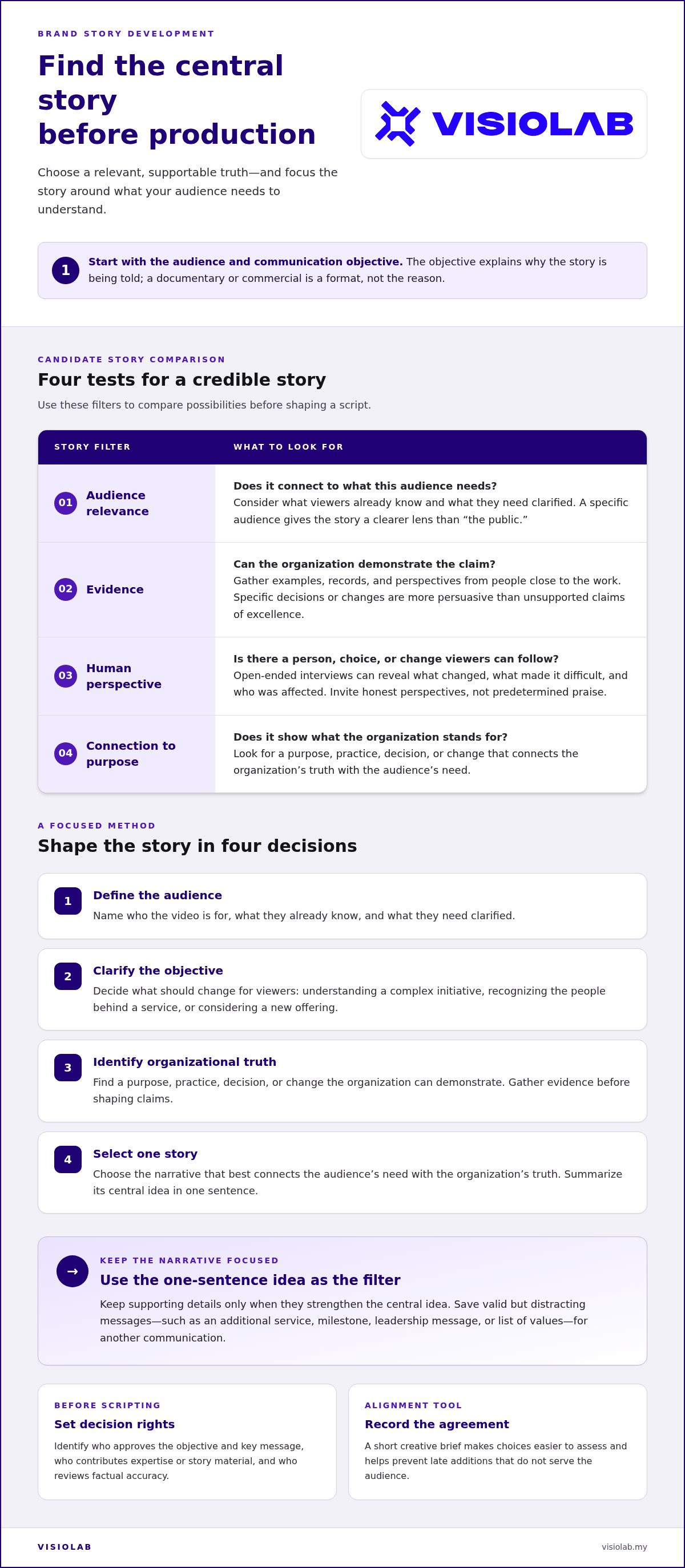
The central story usually isn’t the organization’s biggest claim. It’s the most relevant, supportable truth that helps a particular audience understand why the organization matters. Use this four-step method before choosing a format or drafting a script:
Name the people the video is for, what they already know, and what they need clarified. “The public” is too broad to guide story choices; a specific group gives you a clearer lens.
Decide what should change for viewers. Should they understand a complex initiative, recognize the people behind a service, or consider a new offering? The communication objective is not the format. A documentary or commercial is a way to tell the story, not the reason for telling it.
Look for a purpose, practice, decision, or change the organization can demonstrate. Gather evidence before shaping claims, including examples, records, and perspectives from people close to the work.
Choose the narrative that best connects the audience’s need with the organization’s truth. Summarize its central idea in one sentence. Use that sentence to decide what belongs in the script and what should be saved for another communication.
That final filter matters. Stakeholders may want to include a new service, a milestone, a leadership message, and a list of values. Each point may be valid, but together they can pull attention away from the story. Keep supporting details only when they strengthen the central idea.
Compare candidate stories against four tests: audience relevance, evidence, human perspective, and connection to purpose. A specific decision or change is often more persuasive than an unsupported claim of excellence because viewers can see what happened and why it mattered. Internal research and open-ended interviews can uncover useful detail. Ask what changed, what made it difficult, and who was affected. Invite honest perspectives, not predetermined praise.
Set decision rights before scripting. Identify who approves the objective and key message, who contributes expertise or story material, and who reviews factual accuracy. Record the agreement in a short creative brief. A focused brief makes choices easier to assess and helps prevent late additions that don’t serve the audience.
Who needs this story?
What should viewers understand or do?
What is the central idea, and what supports it?
What should viewers think, feel, or consider next?
When priorities conflict, return to the audience’s need and the agreed central idea. That discipline gives your team a stronger starting point for the next stages of this brand story video production guide. For more on how strategy informs corporate video planning, read VISIOLAB’s strategic corporate video production guide.
Let the story determine the format, not a trend, a preferred visual style, or the approach that seems most impressive. Start with the audience’s need and the communication objective. Then consider how much context the story requires, whose perspective should carry it, and where viewers will encounter it.
These formats can share visual treatments, but they serve different purposes. Use this comparison to identify the strongest fit:
| Format | Primary objective | Story depth | Audience relationship | Suitable use |
|---|---|---|---|---|
| Brand film | Express identity, purpose, or perspective | Develops a central idea with selected supporting detail | Invites viewers to understand the organisation more deeply | Introducing an organisation’s values, direction, or role |
| Corporate documentary | Explore real people, events, or change | Allows context and lived experience to unfold | Builds understanding through observation and personal accounts | Showing how a significant initiative or transformation takes shape |
| Commercial | Communicate a focused proposition or prompt an action | Concentrates on a concise message | Moves viewers towards a specific consideration or response | Supporting a product, service, or campaign message |
| Customer or stakeholder story | Present an experience or perspective from someone connected to the organisation | Centres on an individual account, supported by relevant context | Lets viewers encounter the organisation through another person’s point of view | Illustrating how a programme, service, or partnership is experienced |
A customer or stakeholder story describes the narrative lens rather than a fixed production style. It could be shaped as a concise commercial or developed as a documentary-led piece, depending on the communication goal and the story material. The distinction matters: a format is a structure for delivery, while the central story is the meaning that structure carries.
Choose a brand film when viewers need to grasp an organization’s identity, purpose, or perspective. Choose documentary storytelling when the meaning depends on real people, events, or change unfolding with enough context to feel grounded. The right choice depends on what the story needs to reveal, not on a promise of a particular business result. Explore corporate documentary storytelling for a closer look at this approach.
A commercial is a stronger fit when the communication centres on a focused proposition and a clear audience action. Campaign needs can shape the message, pacing, duration, and versions for different placements. A brand story may provide the larger context, but it doesn’t replace a campaign’s distinct call to action. Give each asset a clear job: build understanding or prompt a specific next step.
Use this decision point in your brand story video production guide: choose the format that helps the audience receive the story in its intended context. The strongest approach carries the message clearly without asking one video to do every job.
A clear production plan connects the original message to the final screen. It also gives stakeholders defined moments to shape the work, rather than leaving every decision until the edit. Use this sequence to keep the story, approvals, and delivery requirements aligned:
Agree on the audience, objective, central message, evidence, stakeholders, and intended distribution.
Gather background information and perspectives that ground the story in real organizational detail.
Review the proposed angle and story structure before investing in script development.
Align on narration, interview themes, key facts, tone, and mandatory information.
Confirm contributors, locations, schedules, visual approach, and practical requirements.
Capture the agreed story, including relevant interviews, activity, and supporting visuals.
Shape the footage into a coherent narrative and check that the central message remains clear.
Consolidate feedback, resolve factual or editorial issues, and approve the final cut.
Prepare the agreed versions and files for their intended channels and audiences.
A useful brief gives the creative team direction without prescribing every shot. Record the audience, communication objective, central message, supporting evidence, key stakeholders, intended response, and planned distribution. Add the desired tone, mandatory information, practical constraints, and who owns each approval. If the project serves multiple audiences or channels, strategic visual communication can help connect the story to how different viewers will encounter it.
Keep the brief focused on what the video must communicate and why. Leave room for the concept and script to find the clearest way to express it.
Set review points around meaningful decisions: concept, script, rough cut, and final delivery. At each stage, name the approver and the kind of feedback needed. Concept feedback should address story direction; script feedback should check the message and accuracy; rough-cut feedback should focus on clarity, pacing, and essential changes. One consolidated set of notes helps prevent conflicting instructions and avoidable revision cycles.
Plan distribution early. Identify the channels, intended viewers, aspect ratios, and required versions before filming, so framing and visual choices reflect how the video will be used. If the project needs captions, accessibility considerations, or language versions, include them in the brief and schedule. For multilingual audiences in Malaysia, decide which languages each version needs to serve rather than treating translation as a last-minute edit.
A well-built brand story video production guide carries decisions from brief to delivery without losing sight of the audience. Learn more about VISIOLAB’s connected approach to strategy and production.
A brand story takes shape through connected decisions: what the organization needs to communicate, which story can carry that message, and how production can make it clear to the intended audience. VISIOLAB brings strategic messaging and production discipline to corporate communication, helping teams move from an initial challenge to a considered creative approach and delivery plan.
Strategic framing gives creative choices a purpose. It connects the audience and communication objective to the story angle, interview approach, visuals, and final edit. Production discipline helps teams carry those decisions forward, with shared expectations at each handoff from concept through delivery. VISIOLAB SDN BHD was founded in 2016 and works across corporate video and related communication content.
The format and craft can vary with the story. A corporate film may express an organization’s identity or direction; a documentary can give real people and change room to unfold. ESG stories, motion graphics, and launching videos offer other ways to communicate, depending on what viewers need to understand. The aim is not to make every project look the same. It is to make creative and production decisions serve the communication purpose.
This approach is useful when the subject is complex. For example, an organization explaining a sustainability initiative may need to clarify the central message, identify evidence that supports it, and decide which people or visuals can make the explanation tangible. The creative treatment follows from those choices rather than being selected before the story is understood. That is the strategic thread at the heart of this brand story video production guide.
You don’t need a finished script to begin a useful project discussion. Bring a concise outline of the audience, communication challenge, intended takeaway, and likely distribution channels. Add the people who can contribute relevant knowledge, the person responsible for approvals, and any essential evidence or sensitivities the story should respect.
A short preparation list can help your team arrive aligned:
Who needs to hear this, and what do they already know?
What is unclear, misunderstood, or important to communicate?
What should viewers remember after watching?
Which people, decisions, evidence, or changes could make the message credible?
Where will viewers encounter the video, and are different versions needed?
Keep the objective firm, but stay open to how it can be expressed. Research may reveal a more compelling perspective, or the story may point towards a different format than the team first imagined. Clarity about the purpose creates room for better creative choices without turning the brief into a shot-by-shot instruction.
With an audience, objective, story direction, and distribution context in view, your team can move from broad intentions to a focused production conversation. Read about discussing a strategic brand story video with VISIOLAB.
A brand story doesn’t have to be frozen at the moment it’s filmed. As your organization changes, revisit whether the story still reflects what audiences need to understand and whether its context has shifted. That doesn’t mean changing the central idea every time a new message appears. It means recognizing when a new chapter deserves its own story.
Use this brand story video production guide as a starting point, then bring your team around one question: what is the next meaningful truth your audience needs to see? A clear answer can shape a story that feels grounded now and leaves room for what comes next.
VISIOLAB connects strategic messaging and production to help organizations shape that story. Discuss your brand story video with VISIOLAB and take the next step with a focused production plan.
A brand story video uses a focused narrative to make an organization’s identity, purpose, people, or meaningful change relevant to a particular audience. Unlike a company overview that may catalogue departments and services, it follows a point of view. Unlike a sales-led advertisement, it doesn’t need to centre on an immediate purchase. The subject might be a founding decision, a team’s shared commitment, or a change that illustrates the organization’s values. A brand story video production guide can help teams develop that subject around a clear communication objective.
There’s no single ideal duration; let the story, audience, and viewing context determine its length. A website film may have room for background and interviews, while a short social cut may need to reach its point faster. A longer edit should earn each extra moment with useful context, a new perspective, or evidence that deepens the story. Decide where the video will appear before scripting, then consider whether concise versions would make the same central idea easier to use across channels.
Yes. Employees can provide first-hand perspective when their experience is genuinely connected to the story. Their contribution might come through an interview, footage of ordinary work, or a prepared explanation of a process. Avoid asking people to deliver praise that doesn’t sound like them; specific examples and natural language feel more credible. Explain the purpose of filming, how their contribution may be used, and who reviews the content. Clear expectations help participants feel prepared without making their stories feel overly rehearsed.
The terms can overlap, but they often signal a different emphasis. A brand story video is organized around what an organization stands for or why it exists. A corporate documentary may give more space to real people, events, and change over time, allowing viewers to follow a process or experience in greater detail. Neither format is automatically more credible. Choose based on the evidence available, what the audience needs to understand, and how much context the story requires.
Measure it against the communication objective, not views alone. For a video intended to build understanding, you might gather audience feedback or test whether viewers can explain its central message. For a video placed on a website, page behaviour may offer useful context; for a campaign, relevant engagement measures may matter. Decide what success means and record a baseline before release. Treat each metric as one signal, not proof that the video alone caused a business outcome.
One central story can guide several channel versions, but the same edit may not suit every placement. A horizontal website film and a vertical social cut can need different framing; captions, opening pace, and duration may also change. Plan likely uses before filming so interviews and key visuals can support those edits. Keep the core message consistent while adapting how it appears. Confirm each channel’s delivery specifications during planning, then prepare versions that fit the intended viewing context.
Let’s create and collaborate
We’re versatile multitaskers, and we thrive on a lot of projects. You've seen a few of our works that we are most proud of, and your project could be next in line.

Empowering brands with captivating visual stories, creating strong connections and growth.
