
Common challenges in ESG communication include protecting sensitive data, keeping pace with changing disclosure rules, choosing meaningful metrics, and maintaining consistent messages across cultures. Collecting and reporting ESG data can take more than a year, leaving information less current for d...

Common challenges in ESG communication include protecting sensitive data, keeping pace with changing disclosure rules, choosing meaningful metrics, and maintaining consistent messages across cultures. Collecting and reporting ESG data can take more than a year, leaving information less current for decisions and stakeholder engagement. More disclosure is not automatically better: too much can invite greenwashing concerns, while too little can look like neglect.
It is understandable to focus first on what to report, but how the message lands matters just as much. This article explains practical ways to address the challenges, from setting clear data methods and selecting material measures to adapting communications for different stakeholders without losing a consistent core message. You will see where ESG communication can falter and how to make it more credible, relevant, and coherent across markets and cultures.
• Shape ESG updates around what employees, investors, communities, and other stakeholders need to understand, then create ways for them to respond.
• Build trust through accurate, consistent data while protecting confidential information and clarifying what can be shared publicly.
• Keep disclosure processes adaptable so reporting can respond to changing requirements without losing clarity or continuity.
• Choose metrics that reflect the issues most relevant to the organisation and its stakeholders, rather than reporting numbers without context.
• Keep core ESG messages consistent across markets, while adapting language and examples to local cultures and audiences.
Common challenges in ESG communication include choosing relevant information, earning stakeholder trust, and keeping updates clear and consistent. Vague, selective, or misleading claims can prompt greenwashing concerns, while silence can create perceptions of negligence. For example, a company that highlights a sustainability target but omits delays leaves readers without the context they need to assess progress.
Start by identifying who needs each update and what decisions they make. Employees may need practical guidance about workplace initiatives, while investors may focus on risks, targets, and performance. Communities may care most about local impacts. Tailoring reporting to these expectations helps people understand how ESG priorities connect to their concerns, rather than receiving one broad message designed for everyone.
Stakeholder engagement should involve more than publishing a report. Invite stakeholders to contribute to decisions, ask for input, provide progress updates, and create clear channels for questions and feedback. Then explain how their input influenced a priority or action. A multi-stakeholder approach can build trust, create shared value, and support joint action on complex ESG issues.
Listen to employees and frontline teams before setting communication priorities. They often encounter operational barriers and stakeholder concerns directly. For example, a team responsible for waste handling may identify a gap between a published target and the process used at a worksite. Use that insight to refine the initiative, explain the gap, and give employees a way to raise further concerns.
Build trust by connecting ESG initiatives to organisational values and communicating goals, obstacles, and plans from the outset. Set clear goals and report progress against them to help stakeholders follow the organisation’s efforts. If a target is delayed, explain the cause, the response, and the next milestone. This gives stakeholders a clear account of achievements and setbacks alike.
Materiality helps keep that account focused. Identify the issues that matter to stakeholders and the organisation, then choose measures that reflect them. Review KPIs alongside wider processes and intended outcomes: a number can improve while the underlying objective suffers. For example, reducing one measured waste stream should not obscure a rise in another. Keep the reporting methodology clear, and track which channels and messages prompt useful engagement.
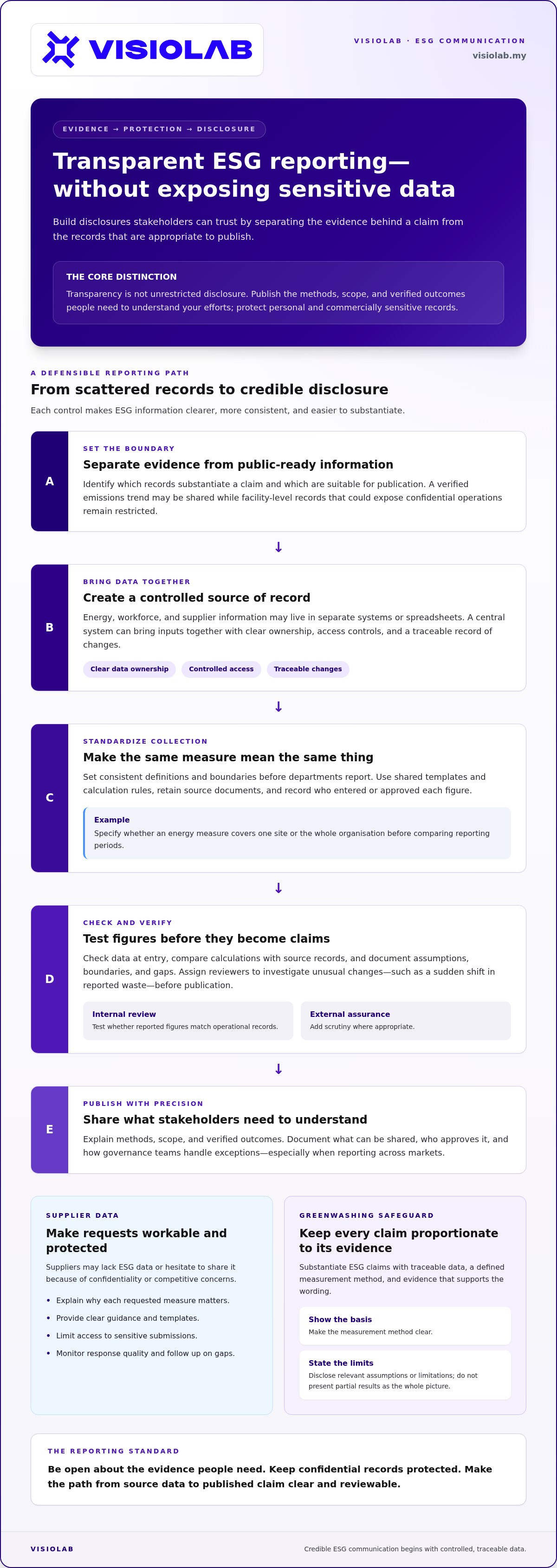
Credible sustainability reporting depends on evidence, but not every underlying record belongs in a public disclosure. Supplier production data, employee records, and commercially sensitive operating details may need protection. Separate information used to substantiate a claim from information suitable for publication. For example, report a verified emissions trend while restricting access to facility-level records that could expose confidential operations.
Fragmented systems make that distinction harder. Energy figures may sit with facilities teams, workforce information with human resources, and supplier data in separate spreadsheets. A central system of record can bring these inputs together with clear ownership, access controls, and a traceable record of changes. Set consistent definitions first, so departments do not report the same measure using different boundaries.
Manual entry creates another risk: a misplaced decimal or copied figure can distort a result. Inconsistent measurement methods can make comparisons unreliable, even when each department takes care. Use shared templates and calculation rules, retain source documents, and record who entered or approved each figure. For example, specify whether an energy measure covers one site or the whole organisation before comparing reporting periods.
Technology can streamline collection, but a tool cannot fix unclear governance. Choose sustainability systems that support controlled access, consistent fields, and an audit trail. Connect data sources where practical, then assign a person or team to review unusual changes. A sudden shift in reported waste, for instance, should prompt a check of the source, units, and calculation method before publication.
Verification turns collected information into defensible evidence. Establish checks at entry, review calculations against source records, and document assumptions, boundaries, and data gaps. Internal reviewers can test whether a reported figure matches operational records; external assurance can add scrutiny where appropriate. These methods help prepare disclosures for audits and support confidence in regulatory reporting.
Third-party data collection brings a separate challenge. Suppliers may lack ESG data or hesitate to share it because of confidentiality or competitive concerns. Explain why each requested measure matters, provide clear guidance and templates, and limit access to sensitive submissions. Monitor response quality and follow up on gaps. This makes the request more workable without treating confidential details as public material.
To avoid greenwashing, substantiate each ESG claim with traceable data, a defined measurement method, and evidence that supports its wording. Keep claims proportionate to the evidence, and disclose relevant assumptions or limitations rather than presenting partial results as the whole picture.
Transparency is not the same as unrestricted disclosure. Publish the methods, scope, and verified outcomes stakeholders need to understand sustainability efforts, while protecting personal and commercially sensitive records. For global reporting, document what information can be shared, who approves it, and how governance teams handle exceptions. This process makes openness precise, not indiscriminate.
For Malaysian companies, ESG disclosure requirements depend on the rules that apply to their organisation, industry, and markets. There is no single mandatory ESG reporting standard for every business across all regions and industries. Start by identifying applicable obligations, then distinguish them from voluntary frameworks used to organise broader reporting.
The challenge is keeping that map current. More than 1,255 new ESG regulations were introduced worldwide between 2011 and 2023. Requirements can differ across jurisdictions: the European Union’s Corporate Sustainability Reporting Directive (CSRD), proposed United States Securities and Exchange Commission requirements, and emerging Asian standards do not impose identical reporting obligations. Malaysian organisations with international operations or stakeholders may therefore need to account for several frameworks and audiences.
Frameworks may also request similar information in different ways. GRI, SASB, and TCFD can require companies to collect or present information differently. Build a cross-reference that records each disclosure, its definition, its data owner, and the frameworks that use it. This helps teams spot overlap, avoid duplicate collection, and explain why a figure appears differently across reports.
Systems need to keep pace as requirements evolve. Assign an owner to monitor relevant changes and translate each update into specific tasks: revise data fields, adjust calculations, update approval steps, or change report language. A digital platform can support collection and version control, but teams still need to check that its categories match current reporting needs. Keep an audit trail of changes and approvals.
Review communication strategies regularly, not only when a reporting deadline approaches. Compare the latest disclosure requirements with existing procedures, then record gaps, responsibilities, and completion dates. For example, a framework update might require a different boundary for a reported measure. Trace the change from source data through calculation and sign-off to final publication.
Use a living compliance calendar to connect regulatory monitoring with reporting milestones. Review it when a company enters a new market, changes its operations, or adopts another framework. For Malaysian businesses, do not assume that a global standard automatically replaces applicable local or market-specific requirements. Separate mandatory disclosures from voluntary commitments, and state the basis for each clearly.
A useful ESG metric connects an organisation’s impacts and risks to decisions stakeholders actually make. A corporate report crowded with unrelated figures can obscure performance instead of clarifying it. Start with a materiality assessment: identify relevant environmental, social, and governance issues, then select measures that show the organisation’s exposure, response, and progress.
Include both stakeholder perspectives and business considerations. Double materiality considers how sustainability issues affect the organisation and how the organisation affects people and the environment. Nearly half of the largest companies had adopted double materiality assessments, according to KPMG’s 2024 survey of sustainability reporting. The result can help teams distinguish issues needing detailed disclosure from those requiring less attention.
Turn each priority into a measurable question. For energy, ask how much the organisation consumes and whether consumption is changing. For waste, define which streams are tracked and how disposal is measured. Social measures might examine human rights in supply-chain labour, workforce diversity, codes of conduct, or whistleblowing policies. A metric becomes meaningful when its boundary, unit, period, and owner are clear.
Choose indicators that reflect the issue, not simply the data easiest to collect. Reporting the number of employee training sessions, for example, shows activity, but not necessarily whether conduct improved. Pair activity measures with outcome indicators where reliable evidence exists. For supply-chain labour, a company could distinguish the number of supplier reviews from the findings and corrective actions those reviews produced.
Align KPIs with relevant reporting standards and the organisation’s disclosure needs. Established frameworks can help structure collection and make information easier to compare, but no framework makes every metric material to every business. Record why each measure was selected, which stakeholders it serves, and how it links to strategy. Investors may need risk exposure; employees may need measures tied to workplace practices.
Before publication, document the calculation method, assumptions, data sources, and limitations for every reported indicator. If one site uses a different measurement method, explain the difference and avoid presenting its result as directly comparable. Consistent definitions help the board, operational teams, and external readers interpret the same figure without confusion.
Review materiality and KPIs regularly. Changes in operations, supply chains, stakeholder expectations, or business priorities can make yesterday’s measure less useful. Check whether a KPI still reflects the intended outcome, whether data collection remains reliable, and whether a strong result hides a wider trade-off. For example, improved energy efficiency should be read alongside total consumption, not treated as the whole environmental picture.
Finally, present metrics with context: baseline, target, current result, and an explanation of any gap. That structure supports transparency and helps readers assess progress rather than decode isolated figures. Keep the dashboard focused, define technical terms, and connect each measure to the decision or impact it is meant to illuminate.
A global ESG message needs a stable factual core and a locally relevant expression. Keep commitments, definitions, reporting boundaries, and performance figures consistent across markets. Adapt examples, language, and emphasis to local context. This distinction matters: consistency protects meaning, while thoughtful adaptation helps stakeholders understand how environmental initiatives relate to their lives.
For a Malaysian company communicating with audiences at home and abroad, language choice is one practical consideration. A Malay-language update and an English-language report should describe the same target and progress, even when examples differ. Translation alone may miss cultural context or technical nuance. Have local teams check whether terms such as “responsible sourcing” or “community impact” carry the intended meaning.
Use a message guide to keep local teams aligned. It can state approved descriptions of each ESG commitment, the evidence behind claims, and wording that requires explanation. For example, if a company reports reduced water use at one facility, teams should preserve that boundary. They should not turn a site-specific result into a claim about the entire organisation.
Keep data collection definitions aligned across locations. A global dashboard becomes misleading if offices classify waste differently or use inconsistent reporting periods. Set common instructions for each metric, identify local variations, and explain them alongside the results. If a country team uses a different method, disclose the distinction rather than presenting the figures as directly comparable.
Local engagement can reveal where a shared message needs clearer framing. Ask employees, suppliers, and community representatives what they understand from an initiative, then record recurring questions. A conservation programme, for example, may be understood differently by a headquarters team and people living near an affected site. Use feedback to clarify the explanation without changing the underlying commitment.
Review local communications before publication. A practical workflow is to confirm the claim against approved data, check the translation and cultural references, then obtain sign-off from relevant local and central teams. Revisit the process when an initiative changes or new evidence alters the message. This keeps global strategy connected to local practices and helps prevent conflicting announcements.
Environmental updates can also appear in different channels, including sustainability reports, social posts, and infographics. Match the format to the audience, but keep the central claim, period, and evidence consistent in each version. For example, a short social post can highlight one result while pointing readers to a fuller explanation in the report, without suggesting broader progress than the data supports.
To turn complex ESG commitments into clear stories for audiences across markets, shape ESG messages for diverse audiences.
VISIOLAB creates Corporate Video content to help organisations explain ESG priorities, progress, and commitments through a clear narrative. Use this format when a written report needs a visual companion for employees, stakeholders, or wider audiences. An ESG Video can bring environmental initiatives and governance priorities into one accessible story, while Explainer and Training Video content can clarify processes and responsibilities for internal teams.
The message still needs to match the evidence: define the claim, use approved data, and keep the wording consistent with formal disclosures. A focused brief can identify the audience, key points, and intended use, giving production a clear foundation. To discuss a Corporate Video for your ESG communication, contact VISIOLAB or visit visiolab.my.
Treat common challenges in ESG communication as design constraints, not reasons to retreat into technical language. Decide what each audience needs to understand, what evidence supports the message, and what action or conversation should follow. That gives every format a clear purpose, whether the goal is to orient employees, explain a programme, or make a complex commitment easier to grasp.
VISIOLAB can shape that story through Corporate Video, ESG Video, and Explainer and Training Video. The right format depends on the audience, the message, and where people will encounter it. A strong creative brief can bring those decisions together before production begins, keeping communication connected to the organisation’s own evidence and priorities.
Start with the message you most need people to understand, then map the audience and context around it. Contact VISIOLAB to discuss ESG communication and take the next step toward clearer, more purposeful storytelling.
The biggest challenges are making claims understandable, evidence-based, and relevant to different audiences. For example, a headline about lower emissions means little unless readers can tell which operations it covers and what comparison supports it. Teams also need to communicate uncertainty without obscuring progress. A useful test is whether a reader can identify the claim, its evidence, its scope, and its practical significance.
Companies commonly struggle with fragmented ownership, inconsistent definitions, and messages that promise more than the evidence supports. A procurement team might classify suppliers differently from a sustainability team, producing mismatched summaries. Another challenge is translating technical reporting into plain language without losing essential context. A shared glossary and clear approval responsibilities can help teams spot these issues before releasing a report, presentation, or public statement.
Companies should report measures relevant to their impacts, risks, and stakeholder decisions, rather than treating every available data point as equally important. Depending on operations, useful information may include energy use, waste, workforce composition, supplier labour practices, or governance controls. Define each measure’s unit, boundary, reporting period, and calculation. For example, distinguish the percentage of suppliers assessed from the percentage of total purchasing represented by those suppliers.
Address inconsistent data by tracing each reported figure to its source and documenting how it was calculated. If two departments report different totals, compare their definitions, time periods, and included sites before combining them. Keep a record of corrections and approvals. Where assurance is limited, describe the scope of the review accurately and distinguish reviewed information from information that has not undergone the same process.
Give each audience the detail it needs while keeping the underlying facts consistent. Investors may need to understand business risks and performance trends; employees may need to know how a policy changes daily work. Customers may value clear information about products or sourcing, while communities may focus on local effects. Use audience-specific formats, then check that each version preserves the same scope, definitions, and evidence.
In Malaysia, begin by mapping the organisation’s operations, stakeholders, reporting obligations, and markets, then assign clear responsibility for each disclosure. Invite local employees and community representatives to flag unclear terms or missing context. Keep a record of questions and responses, and make updates accessible through suitable channels. Before publication, ask an independent internal reviewer to trace key claims to supporting records and confirm that the wording matches the evidence.
Let’s create and collaborate
We’re versatile multitaskers, and we thrive on a lot of projects. You've seen a few of our works that we are most proud of, and your project could be next in line.

Empowering brands with captivating visual stories, creating strong connections and growth.
