
A corporate video can look polished and still miss its purpose. Common mistakes in corporate video production often begin before filming: unclear objectives, competing stakeholder opinions and creative choices that put visual impact ahead of audience understanding. By the time these problems appear...
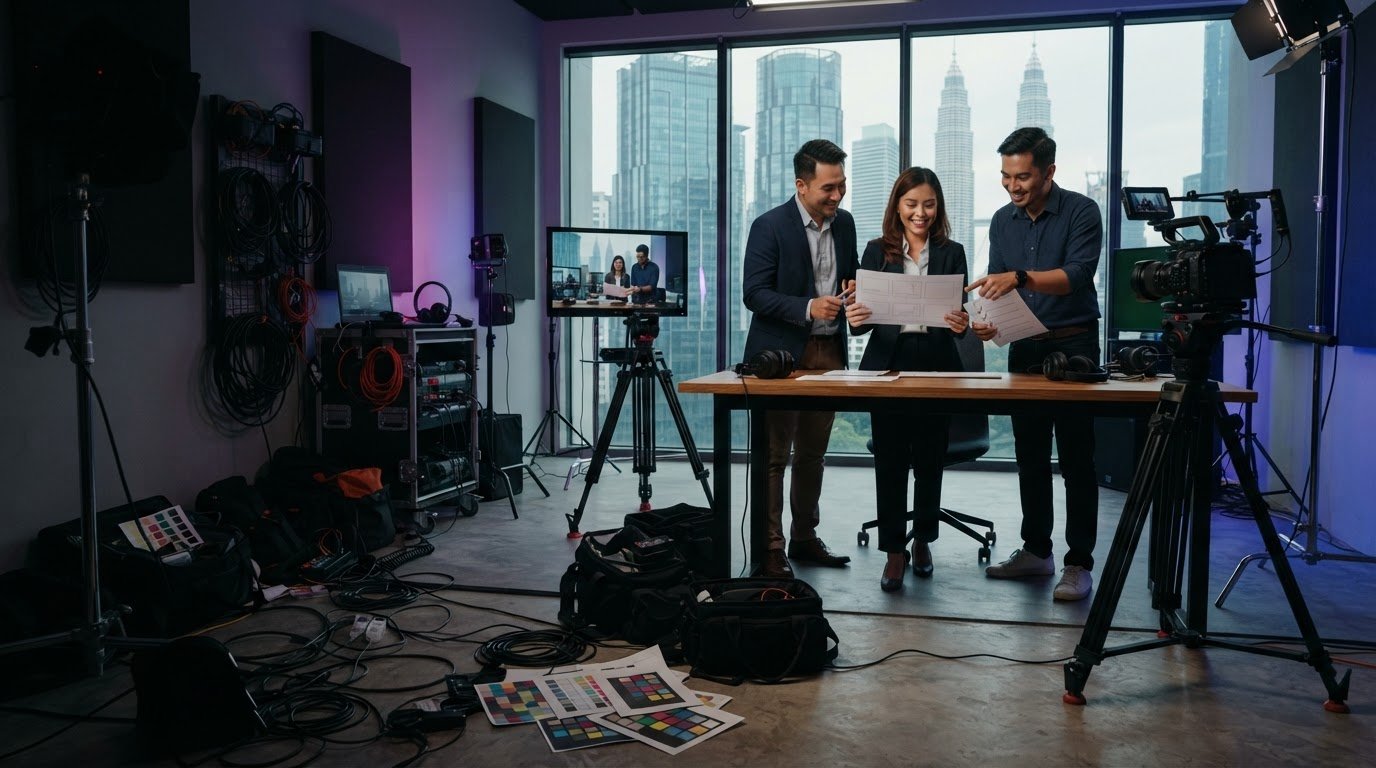
A corporate video can look polished and still miss its purpose. Common mistakes in corporate video production often begin before filming: unclear objectives, competing stakeholder opinions and creative choices that put visual impact ahead of audience understanding. By the time these problems appear in the edit, fixing them can mean more revisions and a weaker message.
Strong production starts with clarity. Decide who the video is for, what viewers should understand or do, and where they’ll watch it. When the team agrees on those points early, stakeholders can work towards one message instead of pulling the story in different directions.
This practical checklist will help you spot avoidable risks across strategy, production and delivery while there’s still time to address them. You’ll learn how to align stakeholders, connect creative choices to audience needs and prepare a video for its intended channels. The goal isn’t polish for its own sake. It’s a purposeful video that communicates clearly and earns attention.
• Define the communication problem, audience and objective before production planning begins.
• Shape the story around one core message, supported by relevant evidence and a clear next step.
• Make visual choices that aid understanding, and prepare interviews, sound and lighting to support the message.
• Prevent common mistakes in corporate video production with clear review roles and a final check against the brief and intended channel.
• Use a step-by-step checklist to align approvals, filming and delivery with the message and audience needs.
Weak objectives, an unclear audience, stakeholders brought in late and planning rushed until the shoot date is near can turn a promising video into a cycle of rewrites and reshoots. Common mistakes in corporate video production often start in the brief. Production can’t rescue a project that hasn’t defined the communication problem it needs to solve.
A corporate video might inform employees, explain a complex service or build understanding among external audiences. As the overview of Corporate film notes, these films can serve different communication purposes. The format should follow the need, not replace it. Before choosing a film, animation or another approach, agree on what the audience needs to understand, feel or do after watching.
“We need an animation” describes a deliverable, not a business purpose. Start with the challenge: perhaps people need to understand a new process, recognise an organisation’s work or take a specific next step. Then choose the format that best supports that outcome. Give the video one primary objective, and include secondary aims only when they support it. Trying to explain everything at once can leave viewers unsure what matters most.
A useful video brief defines the objective, audience, core message and action the viewer should take. Use that as a test. If the team can’t complete each part clearly, pause scripting and resolve the gaps first.
Late alignment can turn review into a contest of opinions. A subject-matter expert may flag an accuracy issue after the script is approved, while a decision-maker introduces a new message during editing. The result is conflicting feedback and avoidable revision cycles. Before scripting, identify the decision-makers, subject-matter experts, reviewers and final approver. Agree who consolidates comments, resolves disagreements and approves the final direction.
Keep feedback tied to the brief: does the change improve accuracy, clarity or relevance for the intended audience? Preferences that don’t serve those goals can distract from the message. For more on shaping a project before production begins, see this strategic corporate video production guide.
Rushed planning creates risks such as missing information, uncertain approvals and shoot decisions made without a shared direction. Make time to confirm the objective, audience, message, decision-makers and review process before filming. This gives creative choices a clear purpose and helps the team move forward together.
A clear brief can still become a confusing video if the script tries to carry too much. Competing messages, internal jargon and claims without evidence can make it harder for viewers to see why the story matters. These mistakes affect more than the wording: they make the message harder to understand and trust.
A focused narrative connects an audience need to one core message, supports it with relevant evidence, then leads to a clear next step. A focused corporate video narrative helps the intended audience understand one central idea, see why it matters and know what to do next.
Including every service, milestone and supporting detail can bury the point. Separate what viewers need to know now from information that belongs on a webpage or in another supporting asset. Let one main message lead, and make every supporting point reinforce it. Check the opening, too: does it quickly show the intended viewer why they should keep watching?
For example, a video introducing a new workplace process might focus on what employees need to do differently. Background detail can support that message, but a long history of the change may distract from it. A storyboard helps test the sequence before filming. Each scene should advance the story, clarify evidence or connect to the next step.
Scripts often inherit language from internal presentations: acronyms, specialist terms and phrases familiar only within the organisation. Replace them with plain language, or explain a term the audience genuinely needs. Make abstract ideas tangible with an interview, a relevant example or a visual that demonstrates the point instead of simply repeating it.
For instance, rather than saying a process “improves cross-functional alignment,” show how teams share information and what changes for the viewer. In a documentary-style corporate story, real perspectives and specific moments can give complex ideas a human frame. Explore the corporate documentary storytelling guide for more on that approach.
Treat the script and storyboard as practical review tools, not creative paperwork. Ask reviewers whether the story is clear, claims are supported, terminology suits the audience and visuals add meaning. If a line can’t be tied to the audience’s needs or the core message, revise or remove it. Teams developing a corporate video can also explore VISIOLAB’s corporate video work for context on strategic storytelling.
Production choices should make the message easier to understand, not compete with it. Dramatic camera moves, elaborate effects or striking locations can look impressive, but they become distractions if viewers can’t follow the story. One common mistake in corporate video production is treating equipment as a strategy. A camera, animation or drone shot earns its place when it helps explain, reveal or reinforce something the audience needs to understand.
Choose the visual approach for its communication value. Motion graphics, for example, may clarify a process with several connected stages, while a straightforward interview may better convey a personal perspective. More advanced technology doesn’t guarantee more impact. Ask of every shot or effect: what does this help the viewer see or understand? If there’s no clear answer, simplify.
Adding dramatic camera movement to every scene. Better choice: Use movement when it guides attention or reveals meaningful detail.
Relying on music and visuals to cover unclear speech. Better choice: Capture usable sound and make every spoken point easy to follow.
Choosing lighting for atmosphere alone. Better choice: Light the subject so viewers can see expressions and important details.
Sound and lighting aren’t finishing touches. Poorly captured speech can obscure important information, while distracting shadows or a hard-to-see subject can pull attention away from it. Set up these elements to support comprehension, whether the video features an interview, a process demonstration or a message delivered directly to camera.
Good interviews need preparation without making every answer sound rehearsed. Prepare open prompts that invite specific examples, such as “What changed for the team?” or “Can you describe a moment when this process mattered?” These questions can draw out useful detail more naturally than asking someone to repeat a slogan.
Before filming, confirm access, participants, schedules and practical requirements with the relevant people. This matters especially in complex, sensitive or operational environments, where filming may need to account for activity, privacy or restricted areas. Don’t assume what’s permitted. Establish expectations with the appropriate contacts in advance.
Plan supporting visuals as well as interviews. If someone describes a process, capture relevant steps, tools or interactions where appropriate. This gives the edit material to illustrate the explanation and helps avoid gaps that would otherwise be filled with repetitive talking-head footage. Keep the shot plan flexible enough to reflect real conditions, but focused enough to serve the story.
A strong shoot can still lose direction in the edit. When reviewers send separate, conflicting notes or reopen approved decisions, the editor may end up balancing personal preferences instead of protecting the video’s purpose. These common mistakes can lead to avoidable revisions and delivery delays.
Set the review process before editing begins. Agree on review stages, ask reviewers to send consolidated comments, and name the person who resolves conflicting feedback and approves the final cut. Keep a clear record of the approved script, requested edits and final version so the team can distinguish a current decision from an outdated note.
Give reviewers criteria, too. Ask them to check whether the edit meets the agreed objective, speaks clearly to the intended audience and represents information accurately. Creative preferences may be useful, but they shouldn’t outweigh the brief without a clear reason.
A video prepared for a presentation may not work equally well on a mobile screen or another platform. Confirm intended channels, aspect ratios, runtime expectations, caption needs and file requirements early. Check that framing still includes the important subject and that on-screen text remains legible in each planned format. Captions support access and comprehension, so check their accuracy, timing and readability during editing, not as a last-minute extra.
Quality control means checking that every version serves its audience, matches the brief and works in its intended channel. Use this final-review sequence before delivery:
Does the video deliver its objective and core message?
Is the story clear, accurate and easy to follow?
Are captions accurate, timed well and readable?
Are framing, text and sound suitable for every planned channel?
Is this the signed-off version, with the agreed exports ready?
That final pass catches issues that can be missed when the team focuses only on whether the edit looks polished. If you’re assessing a production partner, this video production agency selection guide offers further context on evaluating strategic fit and execution.
Need a corporate video shaped around a clear message and a defined audience? Explore VISIOLAB’s corporate video work.
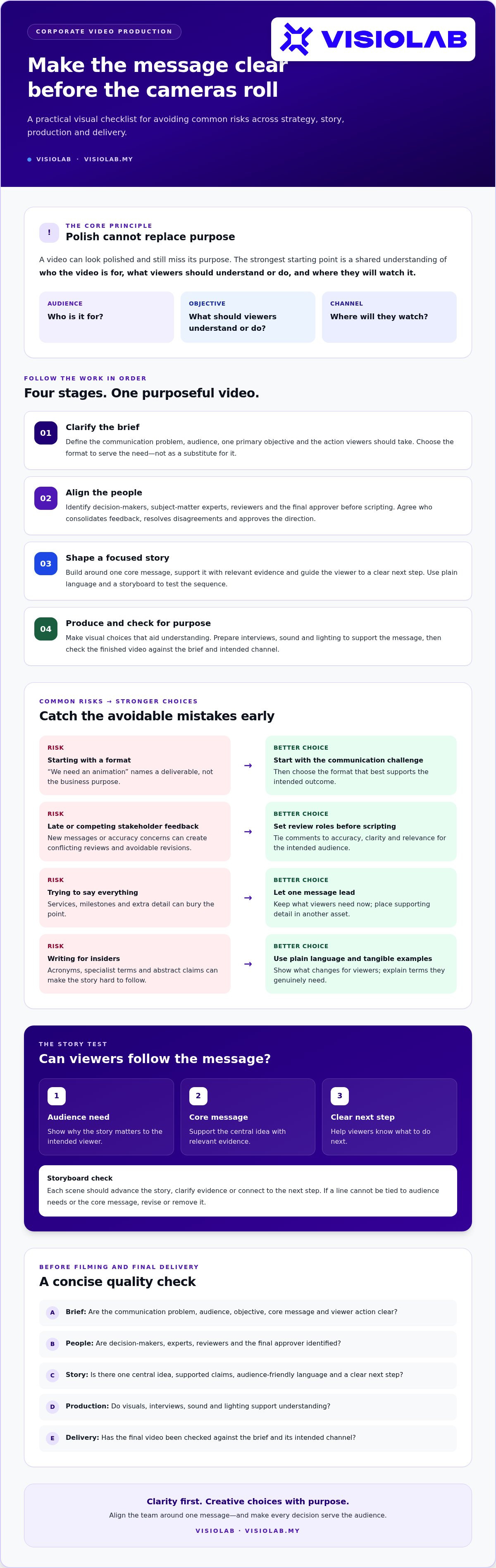
A reliable process carries the message from the first decision to final delivery. Use this checklist to catch common mistakes in corporate video production before they lead to confusion, conflicting approvals or a video that doesn’t fit its audience.
State the communication objective, intended audience, core message, desired viewer action and how the team will assess whether the video has done its job.
Name decision-makers, subject-matter experts, reviewers and the final approver. Approve the brief and agree on review stages before production begins.
Check that the script focuses on the audience’s needs, uses clear language and supports important claims. Confirm that the planned visuals help explain the message.
Confirm participants, access, schedules and practical requirements. Identify sensitive or operational considerations with the appropriate contacts.
Confirm accessibility needs, captions, versions, aspect ratios and distribution requirements. Review the final files in their intended formats before sign-off.
Match the production approach to the message. A straightforward announcement may need a simple, direct treatment; a complex process may benefit from animation or carefully structured interviews. For corporate, ESG or safety communication, specialist support can help translate detailed information into a clear story without losing accuracy or audience relevance.
Look beyond a polished showreel. Ask how a production team will clarify the brief, turn complex information into an audience-ready narrative and manage stakeholder feedback. Review relevant work for clarity and purpose: can you follow the message, understand why it matters and see who it’s for? Strong visuals matter, but they should serve the story.
VISIOLAB is a Malaysia-based strategic video agency working with corporate, GLC, MNC and government sectors. Its work includes corporate, ESG, safety and training videos, where clear messaging and disciplined production can help teams communicate complex subjects with focus.
If you’re planning a video and want to explore an approach grounded in strategy as well as execution, explore VISIOLAB’s corporate video services.
Common mistakes in corporate video production are easier to prevent when teams stay focused on the audience, agree on one clear message and plan approvals and delivery before filming. A strong video isn’t defined by polish alone. Its story, production choices and final formats should all support the same purpose.
For complex corporate, ESG or safety communication, that alignment can help turn detailed information into a story people can follow. VISIOLAB is a Malaysia-based strategic video agency founded in 2016, serving corporate, GLC, MNC and government sectors.
If you’re planning a video, explore VISIOLAB’s strategic corporate video services to discuss an approach that supports your message. With a clear foundation, your team can move from scattered ideas to a video built for its audience and purpose.
The most common mistakes in corporate video production include starting without a clear objective, trying to speak to too many audiences, crowding the story with messages and letting stakeholder feedback arrive without a clear approval process. Production can also lose focus when visual effects take priority over understanding. Before work begins, agree on the viewer, central message and intended outcome, then use those decisions to guide scripting, filming and review.
Reduce avoidable work by defining the project’s purpose and boundaries before production starts. Identify the essential message, intended audience, planned deliverables and decision-maker, then confirm what is outside scope. Choose a production approach suited to the subject rather than adding elements for appearance alone. A focused brief and planned review process can help prevent late changes, unnecessary edits and footage that doesn’t contribute to the final video.
A clear brief gives everyone one reference point for creative and practical decisions. It explains who the video is for, what they need to understand, the main message and the intended next step. It also helps reviewers distinguish necessary corrections from personal preferences. Without that shared direction, a script can become crowded, filming can capture irrelevant material and edits can drift away from the communication need.
There’s no fixed ideal number. Include the people needed to check accuracy, audience relevance and approval, without inviting a wider group to make unstructured creative changes. This may mean a subject-matter expert, a communications representative and a final decision-maker, depending on the project. Assign each reviewer a clear role, collect feedback in one place and give one person responsibility for resolving conflicting comments before the next review stage.
Involve an agency while the communication problem and audience are still being defined, not only after the script is locked. Early input can help assess the right format, identify filming needs and shape a workable review and delivery plan. This is especially useful when a subject is complex or several internal teams need to align. VISIOLAB is a Malaysia-based strategic video agency founded in 2016, serving corporate, GLC, MNC and government sectors.
Make the viewer’s perspective the centre of the story. Start with a relevant question, challenge or situation, then use clear examples and credible evidence to explain why the subject matters. Let interviewees speak in specific, natural language rather than relying on slogans. A corporate video can build interest by being useful and human: explain what the audience needs to know instead of making every moment a sales pitch.
Check that the approved version matches the brief, presents claims accurately and makes sense to its intended audience. Review speech and sound, confirm captions are accurate and readable, and test the framing and on-screen text in each planned format. Verify that the correct final file has been approved and meets the intended channel’s requirements. A final review by someone who hasn’t been immersed in the edit can also reveal unclear moments.
Let’s create and collaborate
We’re versatile multitaskers, and we thrive on a lot of projects. You've seen a few of our works that we are most proud of, and your project could be next in line.

Empowering brands with captivating visual stories, creating strong connections and growth.
