
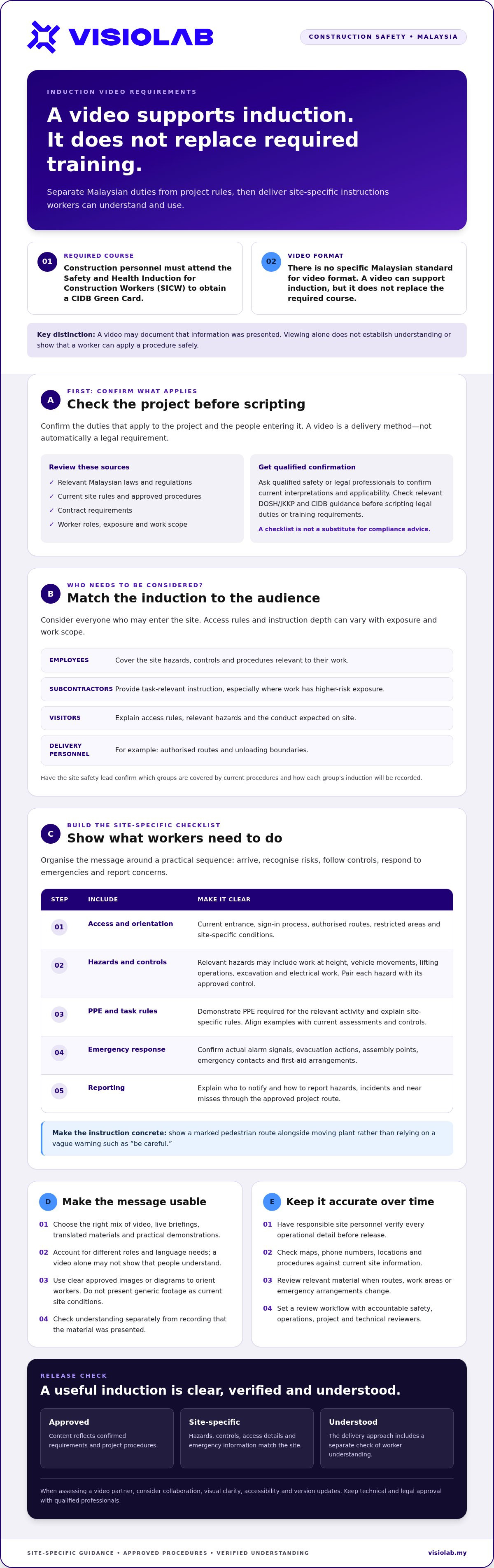
Does Malaysian law require a construction site safety induction video, or is the priority making sure workers receive the right training? The distinction matters. There’s no specific Malaysian standard for video format, but construction personnel must attend the Safety and Health Induction for Const...
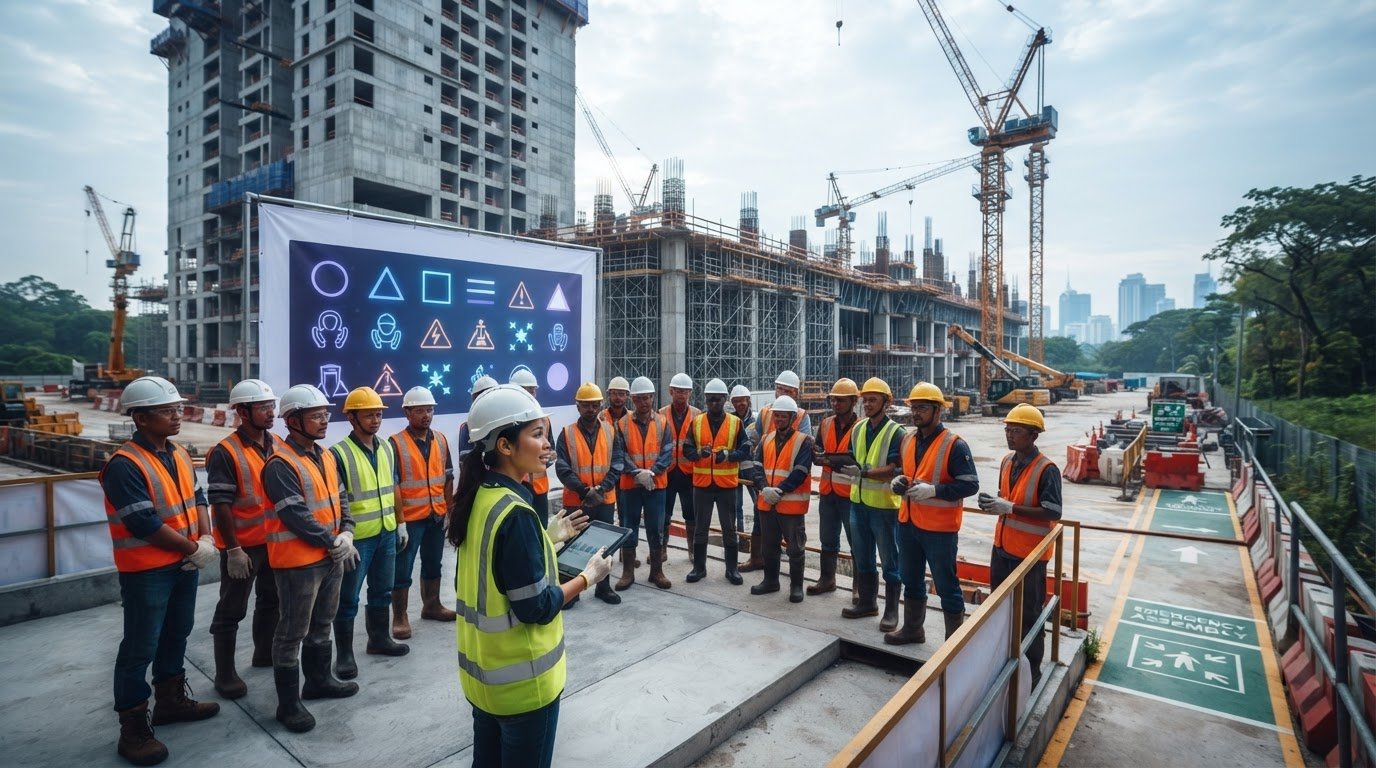
Does Malaysian law require a construction site safety induction video, or is the priority making sure workers receive the right training? The distinction matters. There’s no specific Malaysian standard for video format, but construction personnel must attend the Safety and Health Induction for Construction Workers (SICW) to obtain a CIDB Green Card. A video supports induction; it doesn’t replace the required course. Understanding the construction site safety induction video requirements also means separating legal duties from the practical rules for each project.
Turning complex hazards into clear guidance can be challenging, especially when workers have different roles and language needs. Showing a video alone may not demonstrate that people understand what to do. This checklist will help you plan focused, site-specific content, identify key hazards and emergency procedures, and check which Malaysian requirements apply. You’ll also learn when to reinforce the video with live instruction, how to check understanding, and how to keep content current. The aim is a consistent message workers can put into practice on site.
• Use the construction site safety induction video requirements checklist to separate applicable legal duties from project rules and worker-specific instructions.
• Plan content around site access, hazards, controls, emergencies and reporting, using procedures confirmed by the project’s responsible safety personnel.
• Choose the right mix of video, live briefings, translated materials and practical demonstrations, then check that workers understand the information.
• Build a review workflow with accountable safety, operations, project and technical reviewers, and keep approved content current as site conditions change.
• Assess a video partner’s approach to collaboration, visual clarity, accessibility and version updates, while keeping technical and legal approval with qualified professionals.
Start by confirming the duties that apply to the project. Check relevant Malaysian laws and regulations, site rules, contract requirements, and each worker’s role before deciding what the induction must cover. A video is a way to deliver information; it is not automatically a legal requirement. Ask qualified safety or legal professionals to confirm current interpretations and applicability rather than treating a video checklist as compliance advice.
An induction is a site-specific orientation that helps people understand the hazards they may encounter, the controls they must follow, emergency arrangements, and expected conduct. It should connect general safety principles to the conditions workers will actually face. For broader context on topics such as personal protective equipment, fall protection, and excavation hazards, see this overview of fundamental construction safety principles. Use it as general background, not as a substitute for Malaysian requirements or project-approved procedures.
Induction content explains what workers need to know; a separate check is needed to show whether they understood it. A completed video may document that material was presented, but viewing alone doesn’t establish comprehension or demonstrate that someone can apply a procedure safely.
Consider everyone who may enter, including employees, subcontractors, visitors, delivery personnel, and other site entrants. Access rules and the depth of instruction can vary according to a person’s exposure and work scope. A delivery driver may need directions on authorised routes and unloading boundaries; a subcontractor doing higher-risk work may need more detailed, task-relevant instruction. Ask the site safety lead to confirm which audiences are covered by current procedures and project requirements, and how each group’s induction will be recorded.
Make the location unmistakable. Identify actual site hazards, restricted areas, approved access routes, and emergency arrangements, using details checked against current site information. Reusable company-wide material can explain shared expectations; project-specific content should show what changes from one location to another. If a route, work area, or emergency arrangement changes, review the relevant material. Don’t present generic footage or illustrative examples as if they show current site conditions. Use approved live-action images or clear diagrams to orient workers, and have responsible site personnel verify every operational detail before release. These checks turn a broad safety message into practical guidance for the site in front of the worker.
Build the video around what people need to do, not a generic list of hazards. A useful checklist moves from arriving on site to recognising risks, following controls, responding to emergencies, and reporting concerns. Its core purpose is simple: help workers recognise hazards and follow the site controls that apply to their work.
The construction site safety induction video requirements for a project should reflect its approved procedures and the people who will use the information. Include only instructions confirmed by responsible site safety personnel. Before scripting legal duties or training requirements, ask qualified professionals to check current Department of Occupational Safety and Health (DOSH/JKKP) and CIDB guidance, including its applicability to the project. A video can help communicate approved content and record what was presented; by itself, it doesn’t prove comprehension or replace any required training.
Show hazards workers may actually encounter, such as working at height, vehicle movements, lifting operations, excavation, and electrical work where relevant. Pair each hazard with the approved control. For example, show a marked pedestrian route alongside moving plant instead of merely warning viewers to “be careful.” Demonstrate the PPE required for the relevant activity and explain any site-specific rules. Use HIRARC terminology only when it matches the project’s documented risk process, and have the safety team confirm that examples align with current assessments and controls.
Make critical actions easy to see and hear. Confirm the actual emergency contacts, alarm signals, assembly points, and first-aid arrangements. Explain how to sign in, pass access controls, identify restricted zones, and report an incident or near miss through the project’s approved route. A site map or motion graphic can show where to go, but verify every detail with the responsible team.
Show the current entrance, sign-in process, authorised routes, and restricted areas.
State confirmed alarm and evacuation actions, assembly locations, and first-aid arrangements.
Identify who to notify and how to report hazards, incidents, and near misses.
Before release, check every map, phone number, location, and procedure against current site information. Assign an accountable reviewer to approve the final version, then make sure workers know where to find any instructions they must follow in person. To turn approved procedures into clear visuals, explore safety video production as one way to support the wider induction process.
No. Watching a video alone doesn’t prove that a worker understood the information, can apply it, or has completed any instruction required for the task. Treat video as one layer in a wider induction process. Match other instruction and checks to the risk, language and literacy needs, work scope, and site conditions. Confirm any training obligations with the responsible safety professional against current project requirements and applicable guidance.
Each format has a different role. A video gives workers a consistent explanation they can revisit. A live briefing allows questions about current site conditions. Toolbox talks can focus on a particular activity or emerging concern. Translated materials can support workers who are more comfortable in another language, while a supervised practical demonstration lets someone show how they carry out a task or use equipment. Choose the mix according to what workers need to understand and demonstrate.
Use video to standardise repeatable messages across shifts, contractors, or locations, not to flatten important differences between them. Real site footage can orient workers to a route or work area; animation can make a sequence or hazard easier to understand when verbal explanation alone is unclear. Keep details that may change, such as active work zones or temporary access arrangements, in a live briefing or controlled update layer. This keeps the core message consistent while the instruction stays current.
The construction site safety induction video requirements should define what the video covers and what must still be explained in person. A polished presentation isn’t a substitute for discussion when workers need to clarify a task, confirm a control, or respond to site-specific changes.
Choose checks that fit the subject. Ask workers to explain a key instruction in their own words, discuss how they would respond to a scenario, or complete a supervised demonstration when practical performance matters. If an answer reveals confusion, clarify the point and follow up before the worker proceeds with the relevant activity, according to site procedure.
A quiz, signature, or completion record can document participation or responses, but none alone proves competence or legal compliance. Keep records in line with the site process, and ask the responsible safety professional to confirm what the project requires and how long information should be retained. Useful fields may include:
• Worker attendance and induction date
• Content version and language used
• Understanding checks or practical demonstrations completed
• Questions raised and follow-up actions assigned
Good records connect the material shown to the instruction and follow-up provided. Review them with the site team so gaps lead to clearer communication, not just another tick on a form.
A reliable workflow keeps content accurate from the first brief through every update. The construction site safety induction video requirements should come from approved project information, not production assumptions. Assign reviewers from site safety, operations, project management, and relevant technical teams, with clear responsibility for checking and approving their areas.
Collect approved site rules, risk assessments, emergency plans, procedures, and any relevant contract or training requirements.
Identify the work areas, risks, controls, and worker groups the induction needs to address.
Turn verified information into direct instructions, separating reusable company-wide messages from project details.
Ask site personnel to verify terminology, PPE, signage, visuals, and depicted work practices before production.
Use approved footage or clear animation to explain procedures and sequences accurately.
Check audio clarity, readable captions, language needs, and whether the video works on the devices and screens used on site.
Make the current file easy to identify and available through the project’s controlled process.
Assign an owner and review the video when site information or requirements change.
Build each instruction from current, approved documents. Before filming, confirm that locations, signs, PPE, and work practices shown match what workers will encounter. If emergency contacts, access routes, or work zones may change, consider keeping those details in a controlled update layer or live briefing instead of embedding them permanently in footage. For broader guidance on explaining complex procedures clearly, see this explainer video production guide.
Keep the message usable for its audience. Captions should be legible on the playback screen, narration should be clear in the intended setting, and language choices should reflect the workforce. Test the final version on the equipment and in the conditions where workers will view it. A video that looks clear in an editing suite may be difficult to follow on a small screen or in a noisy induction area.
Give each approved file a named owner, approval date, version identifier, and review schedule. Reassess it after significant site changes, incidents, procedure revisions, or regulatory updates. Withdraw obsolete copies and retain approval and version records under the organisation’s document-control process. This creates a traceable review path without treating the video itself as proof of legal compliance.
For a safety training video shaped around approved procedures and clear visual communication, discuss your induction video project with VISIOLAB.
A strong production partner should make complex information easier to understand without taking ownership of safety decisions. Assess how the team handles briefing, collaboration with site reviewers, visual clarity, accessibility, version control, and revisions. Use the construction site safety induction video requirements you’ve gathered to guide the project scope, while qualified client-side or independent safety professionals retain responsibility for technical approval and legal interpretation.
Look for a process that brings the right people into review early. Clear live-action footage or animation can explain a procedure, but an informed site reviewer must confirm whether the details are accurate for the project. The construction progress video guide offers related context on project-specific visual documentation.
Ask how the production team gathers source procedures and works with site safety reviewers. Clarify who reviews and approves the script, filming plan, translations, captions, and final version. Discuss how feedback is tracked, how revisions are handled, and what process would apply if site conditions or procedures change. Confirm these expectations in the project scope rather than assuming future updates are included.
How will approved site rules, hazards, and audience needs inform the content?
Who checks accuracy at each stage, and who gives final approval?
How will the team check audio, captions, language choices, and playback on site?
How will approved files be labelled, updated, and withdrawn when obsolete?
Before briefing production, assemble the current site rules, hazard assessments, emergency details, and information about the intended audiences. Ask a qualified reviewer to confirm which Malaysian requirements and project obligations apply. This preparation gives the creative team a reliable foundation and keeps production focused on clear communication rather than unverified interpretation.
Set success measures around whether the message is clear to its intended audience, whether relevant workers complete the induction, whether understanding checks identify gaps, and whether updates remain controlled. Views alone tell you little about what workers understood or can apply. Pair video with the site’s instruction and follow-up process, then review feedback to improve the next version.
For support shaping approved procedures into a clear safety training video, discuss a strategically planned safety training video with VISIOLAB.
A strong induction starts with verified site information and ends with workers who know how to act on it. Use the construction site safety induction video requirements checklist to shape content around real hazards, controls, access rules, and emergency procedures. Then pair the video with live instruction and suitable understanding checks. A viewing record alone can’t show that someone understood or can apply what they’ve seen.
Keep the process defensible: have qualified safety or legal professionals confirm applicable Malaysian requirements, ask responsible site teams to approve operational details, and maintain clear versions as conditions change. Video can make complex procedures easier to grasp, but it works best as one consistent layer within a wider induction system.
VISIOLAB is a Malaysia-based agency producing safety training and explainer content. Its 2D and 3D motion graphics can help clarify complex procedures for audiences across corporate, GLC, MNC, and government organisations. Discuss a strategically planned safety training video with VISIOLAB and take the next step toward clearer, more actionable site communication.
No. Don’t assume Malaysian law universally requires a construction site safety induction to be delivered by video. Applicable duties depend on the work, site, workers, and project requirements. Check current DOSH/JKKP and CIDB guidance, contract specifications, and client rules, then ask qualified safety or legal professionals to confirm what training and records apply. Treat video as a communication format unless a verified requirement specifically says otherwise.
Include the site’s actual hazards, access rules, required controls and PPE, emergency arrangements, restricted areas, and incident-reporting process. The construction site safety induction video requirements for a project should be based on current risk assessments and procedures, not copied from a generic template. Before release, have responsible safety personnel verify maps, contact details, signs, visuals, and depicted work practices. Make sure workers can ask questions about instructions they need to follow.
Not necessarily. A video can deliver consistent information, but watching it doesn’t show by itself that a worker understood the material, can perform a task safely, or has completed every applicable training requirement. Depending on the worker’s role and exposure, the site may also need a live briefing, discussion, supervised demonstration, or another documented check. Ask the responsible safety professional to confirm what instruction and checks apply before work begins.
Use the organisation’s approved process to record who attended, the date, the induction version and language, and any follow-up required. A signed acknowledgement or completion record can document participation, but shouldn’t be presented as proof of competence on its own. Confirm record-retention and evidence requirements against current law, contract terms, and project procedures with qualified advisers. Keep records clear enough to show what information was provided and what follow-up occurred.
Set a documented review schedule, then update the video when important details change. Triggers may include revised access routes, emergency arrangements, hazards, work methods, procedures, or relevant legal requirements. Assign an owner to verify changes, approve the replacement version, remove obsolete copies, and tell workers when updated instruction is needed. The project’s responsible safety team should define the review frequency and update process to suit site conditions and applicable requirements.
Choose languages and formats based on the workforce’s communication needs and the site’s induction process. Clear narration, accurate subtitles, simple visuals, and translated supporting materials can make instructions easier to access, but translations should be reviewed for technical meaning. Give workers a suitable way to ask questions and show understanding. Don’t rely on subtitles alone if they can’t communicate critical site-specific instructions or if workers need another form of explanation.
Yes, for stable company-wide principles, but a shared video shouldn’t imply that every project has the same hazards, routes, contacts, or emergency arrangements. Separate reusable material from site-specific instruction, and ensure workers receive current project information before access or work begins. Use controlled versions and ask each site’s responsible team to approve any material presented as specific to that location. Review local details whenever site conditions or procedures change.
Let’s create and collaborate
We’re versatile multitaskers, and we thrive on a lot of projects. You've seen a few of our works that we are most proud of, and your project could be next in line.

Empowering brands with captivating visual stories, creating strong connections and growth.
