
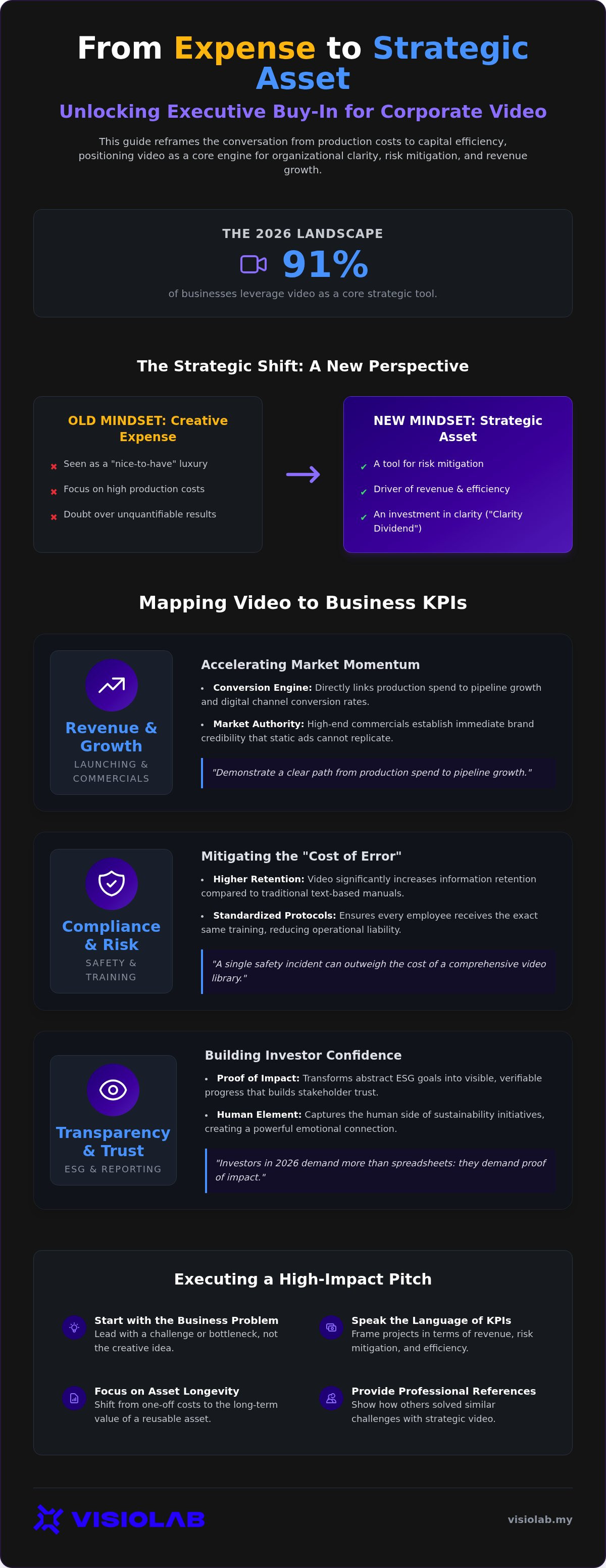
What if your most expensive creative luxury was actually your most powerful risk mitigation tool? In 2026, 91% of businesses leverage video as a core strategic tool, yet many leaders still face the exhausting challenge of convincing stakeholders to invest in video. The board often looks at a product...
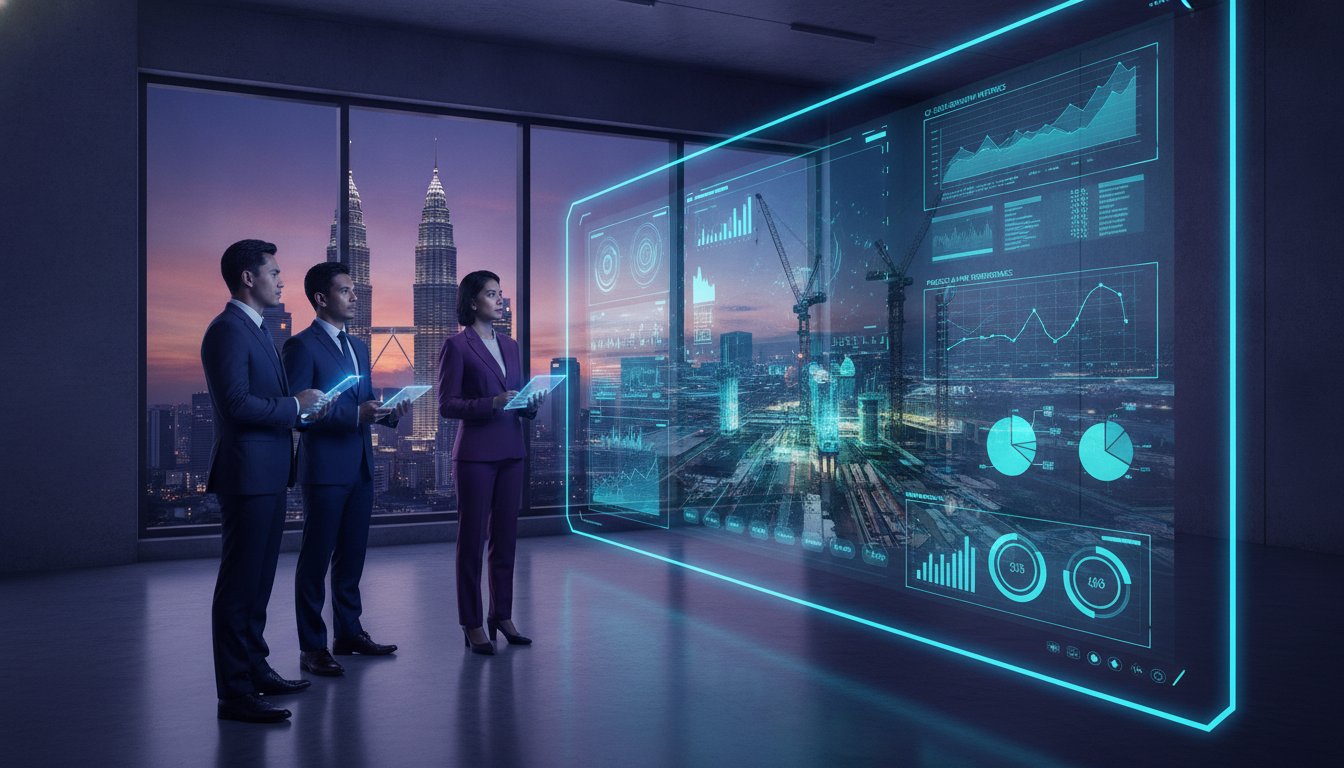
What if your most expensive creative luxury was actually your most powerful risk mitigation tool? In 2026, 91% of businesses leverage video as a core strategic tool, yet many leaders still face the exhausting challenge of convincing stakeholders to invest in video. The board often looks at a production budget and sees a creative expense rather than a catalyst for transformation. They fear high costs; they doubt unquantifiable results. This hesitation often leaves high-impact projects like ESG storytelling or safety training on the cutting room floor.
We understand the frustration of seeing a powerful narrative dismissed as a "nice-to-have" asset. This guide provides the blueprint to master the art of securing executive buy-in by transforming video into a high-impact strategic asset. You'll learn how to align every frame with business KPIs and position yourself as a strategic thinker who delivers tangible results. We'll explore how to quantify the impact of internal communications, navigate 2026 budget approvals, and turn creative vision into a documented driver of revenue growth.
• Reframe video as a strategic engine for organizational clarity: move beyond the creative expense mindset to unlock genuine executive support.
• Align visual narratives with specific business KPIs; map Launching videos to revenue and Safety videos to operational efficiency.
• Leverage specialized documentation, including long-term timelapse and construction progress visuals, as indispensable tools for project management and legal protection.
• Master the art of convincing stakeholders to invest in video by shifting the conversation from production costs to capital efficiency and asset longevity.
• Execute a high-impact pitch that starts with the business problem: use professional references to demonstrate how video solves complex organizational challenges.
The boardroom doesn't care about "viral" content. They care about value. For years, creative teams have struggled with convincing stakeholders to invest in video because they pitched it as an aesthetic luxury. In 2026, this perspective is obsolete. High-impact video isn't just a marketing tool; it's an organizational engine for clarity and risk mitigation. It's a tool for alignment. When you're convincing stakeholders to invest in video, you must highlight how these assets reduce the cost of confusion and accelerate decision-making cycles.
Understanding what is corporate video in a modern context requires looking past basic execution. There is a wide chasm between a standard recording and strategic production. Basic execution captures an event. Strategic production solves a business problem. When a project is built with editorial clarity, it generates a "Clarity Dividend." This dividend is the measurable reduction in internal friction that occurs when every employee, investor, and stakeholder understands the mission at a glance. Visual-first communication is no longer an alternative; it's the corporate standard for high-performing organizations.
Executives ignore creative flair if it lacks commercial substance. They look for solutions to communication bottlenecks that slow down progress. For MNCs and GLCs, video serves as a bridge between abstract strategy and tangible execution. It builds a brand legacy that survives leadership transitions. By positioning video as an asset that protects operational continuity, you transform the conversation from a cost center to a capital investment. You aren't asking for a budget to make a film. You're asking for a budget to secure organizational buy-in and protect your narrative.
Attention is the most precious currency in the modern office. In the 2026 workplace, stakeholders have no time for dense manuals or endless slide decks. Visual-first communication caters to shrinking attention spans while delivering incredible depth. High-end corporate films do more than inform; they build investor confidence through professional sophistication. They translate complex ESG data or intricate 3D motion graphics of technical procedures into actionable insights that stick. This psychological impact is precisely what turns a skeptical board member into a project champion during budget reviews. Clear visuals don't just show the work. They prove the vision.
To bridge the gap between creative vision and executive approval, you must speak the language of the balance sheet. Stakeholders don't buy "videos": they buy solutions to operational friction. Success in convincing stakeholders to invest in video relies on your ability to map visual assets to three primary drivers: revenue, compliance, and efficiency. When you align production with these KPIs, the budget conversation shifts. You are no longer asking for permission to be creative: you are offering a roadmap for growth.
Market momentum is fragile. High-impact visuals accelerate it. A Launching Video isn't just a debut: it's a conversion engine. By linking commercial production directly to digital channel conversion rates, you demonstrate a clear path from production spend to pipeline growth. High-end commercials create immediate market authority that static ads cannot match. For a deeper look at the local landscape, explore The Definitive Guide to Commercial Video Production in Malaysia (2026) to see how regional MNCs are scaling their reach through strategic visual campaigns.
In industrial and safety sectors, the "Cost of Error" is catastrophic. A single safety incident can outweigh the cost of a comprehensive video library. Strategic training videos utilize 3D motion graphics to visualize invisible risks: gas leaks, structural stress, or electrical hazards. The value lies in "Information Retention." Traditional manuals have a low retention rate; video increases this significantly by engaging multiple senses. Standardized training across national operations ensures that every site follows the exact same protocol, reducing liability and protecting your human capital. When you're convincing stakeholders to invest in video, use the "Cost of Error" argument to highlight the financial risk of staying with text-based training.
Static reports often fail to capture the human element of sustainability. Investors in 2026 demand more than spreadsheets: they demand proof of impact. Transparent visual storytelling builds trust that text cannot replicate. It transforms abstract ESG goals into visible progress. Learn more about ESG Video Production Malaysia: Translating Sustainability into High-Impact Visuals to understand how to present your corporate social responsibility initiatives with editorial authority. Building investor trust through visual proof isn't just good PR: it's a strategy for long-term capital stability.
By mapping every project to these essential business drivers, you simplify the executive decision-making process. You're no longer presenting a cost: you're presenting a strategic asset. If you're ready to define your own framework, consider how a strategic video partnership can translate your complex requirements into clear, impactful results.
Large-scale infrastructure projects are exercises in complexity and risk. For executives managing national development, the challenge isn't just building; it's monitoring. Traditional reporting often lags behind reality, leaving a gap where miscommunication can thrive. By convincing stakeholders to invest in video through the lens of project management, you offer them a "God's eye view" of the site. Drone visuals and fixed-position cameras provide real-time clarity that no spreadsheet can replicate. This visual oversight allows for rapid intervention before minor delays become multi-million dollar liabilities. It transforms a distant construction site into a transparent, manageable asset.
Long-term timelapse documentation serves as an indisputable digital twin of the construction timeline. It allows project managers to verify milestones against scheduled deadlines with surgical precision. This isn't just about aesthetics; it's about accountability. According to the Construction Progress Video Malaysia: The 2026 Strategic Documentation Guide, visual data is becoming a legal and insurance necessity. It provides a frame-by-frame record that protects against litigation and false claims. Additionally, high-quality visual updates reduce the need for frequent site visits by high-level stakeholders. This saves hundreds of hours in executive travel and logistics, allowing the board to stay informed from the headquarters.
The value of a project doesn't end at completion. It lives on in the visual archive. For GLCs and government sectors, technical mastery must be visible to be rewarded. High-impact montages and industrial documentaries serve as powerful proof-of-concept assets for future tenders. When convincing stakeholders to invest in video, emphasize that these films are the portfolio of the nation's progress. They showcase the ability to handle complex engineering feats, making the case for the next round of funding far more persuasive. A visual archive of national development isn't just a record; it's a strategic asset for winning the next billion-dollar contract. It proves you've done the work, and you're ready for more.
Visualizing progress ensures that every stakeholder, from the site engineer to the prime minister, is aligned. Documentation is defense. By capturing the evolution of infrastructure, you're not just making a video; you're securing the legacy of the project. This level of clarity is the ultimate tool for risk mitigation in the 2026 construction landscape.
Resistance is often a mask for a lack of perceived value. When convincing stakeholders to invest in video, the most common hurdle is the belief that production is simply "too expensive." This perspective treats video as a sunk cost rather than a strategic asset. To bypass this, you must pivot the conversation toward capital efficiency. High-quality video assets don't just exist for a single event; they are evergreen tools. By adopting a "Modular Content" approach, you maximize every ringgit spent. One comprehensive shoot can yield multiple deliverables: a high-level montage, short-form safety clips, and internal training snippets. This efficiency turns a one-time expense into a multi-year resource.
Another common fear is the perceived "Time Drain" on internal teams. Stakeholders worry that a video project will consume hundreds of man-hours in coordination and revisions. You can mitigate this fear by highlighting an agency-led strategy. A sophisticated partner doesn't just film; they architect the process. They handle the heavy lifting of scripting, logistics, and post-production, requiring only high-level guidance from your team. This ensures the project moves at a high-energy pace without stalling your daily operations.
What is the price of a misunderstood directive? Miscommunication costs large organizations millions annually in lost productivity and operational friction. When you compare the price of a professional film to the high cost of ineffective, repetitive meetings, the ROI becomes clear. Video ensures a single, perfect version of the truth is delivered to every stakeholder simultaneously. For a deeper dive into how this fits into a broader corporate strategy, see Strategic Corporate Video Production in Malaysia: A 2026 Visionary Guide. A well-executed video pays for itself by reclaiming thousands of hours of employee time that would otherwise be wasted in information silos.
Fear of a massive, failed rollout often keeps budgets locked. You can mitigate this by proposing a "Proof of Concept." Start with a high-impact pilot project, such as an ESG highlight or a specific safety procedure. Use the internal feedback and engagement data from this pilot to justify larger-scale rollouts. This phased approach reduces perceived risk while demonstrating immediate value. A specialized visual communication agency manages the technical execution, ensuring the project aligns with business KPIs from day one. You provide the vision; the agency provides the architectural execution.
If you are ready to transform your communication strategy from a creative experiment into a documented business win, partner with a strategic video expert who understands the intricacies of the 2026 corporate landscape.
The pitch is the final hurdle in convincing stakeholders to invest in video. You don't win the boardroom by talking about cameras or lighting; you win by presenting a solution to a documented business problem. Start with the friction point. If the organization is struggling with ESG reporting clarity or safety compliance, lead with the cost of that failure. Once the problem is established, you can introduce the creative solution as the bridge to the desired outcome. This sequence positions video as a strategic necessity rather than a discretionary spend.
To reduce perceived risk, you must present a clear roadmap from strategy to execution. Define your success metrics before you ever mention the budget. Whether it's a percentage increase in information retention or a reduction in site visit logistics, having concrete KPIs shows that you are thinking like an executive. Finally, introduce VISIOLAB as your strategic partner. By bringing in a specialist agency with a proven track record in GLC and MNC sectors, you signal that the project will be handled with professional precision. You are not just hiring a crew; you are engaging an architect for your corporate narrative.
The C-suite speaks in terms of "Clarity" and "Perspective." Your narrative should align the video strategy with the organization's 5-year plan. If the goal is national expansion, explain how a visual archive of construction progress supports that trajectory. Don't just pick a vendor; pick an architect of your brand's future. For more insight on this distinction, read Choosing a Video Production Agency in Malaysia: Strategic Impact vs. Basic Execution. This alignment ensures that the board sees the production as a long-term investment in organizational intelligence.
In the 2026 corporate landscape, visual communication is a competitive necessity. Your final ask should emphasize that staying with text-based communication is a risk to the brand's authority. Position the investment as a way to deliver tangible value across multiple departments. The goal isn't just to get a "yes" for one project; it's to establish a new standard for how the company communicates. Your next step is to move from theory to action. Schedule a strategic discovery session to map out your specific requirements and translate them into a high-impact visual strategy. Success in convincing stakeholders to invest in video comes down to this: prove the problem, show the solution, and name the partner who can deliver.
The transition from creative expense to strategic asset is more than a budget shift; it's a leadership evolution. We've explored how mapping video to business KPIs and leveraging high-stakes documentation can protect your organization's interests while driving growth. You've learned to pivot the conversation from production costs to long-term capital efficiency. Success in convincing stakeholders to invest in video depends on your ability to present a documented roadmap for clarity and risk mitigation.
The 2026 corporate landscape demands a partner who understands both the lens and the ledger. Partner with VISIOLAB to transform your corporate communication into a strategic asset. As national leaders in construction timelapse and specialized ESG storytelling, we are the preferred choice for GLCs and MNCs seeking editorial clarity. We don't just film projects; we architect narratives that deliver tangible value and secure your brand's legacy. The future of corporate communication is visual. It's time to lead with confidence.
ROI is calculated by comparing production costs against measurable business outcomes like reduced training hours or increased conversion rates. For 2026, 82% of marketers report positive ROI according to Wyzowl. Success in convincing stakeholders to invest in video involves highlighting these "Clarity Dividends." You track metrics like information retention in safety protocols or the acceleration of sales cycles. These tangible results transform a creative expense into a documented financial win.
A vendor focuses on basic execution; a strategic agency focuses on business impact. Vendors follow instructions to film what you ask. A strategic agency like VISIOLAB acts as a visionary architect, analyzing your KPIs and crafting narratives that solve complex communication bottlenecks. They specialize in editorial clarity for GLCs and MNCs. This partnership reduces project risk by ensuring every frame aligns with your five-year organizational plan rather than just looking good.
Video transforms static ESG data into transparent visual storytelling that builds deep investor trust. In the 2026 reporting landscape, Malaysian PLCs use high-impact visuals to prove sustainability claims rather than just stating them. By showcasing actual community impact or green infrastructure through documentary-style films, you provide the visual proof stakeholders demand. This approach moves beyond compliance; it positions your organization as a transparent leader in national development and social responsibility.
Professional production is essential when the "Cost of Error" is high. In sectors like construction or energy, amateur videos fail to engage or clearly explain complex procedures. High-end training videos use 2D/3D motion graphics to visualize invisible risks, significantly increasing information retention. This standardization ensures every employee across national operations receives the same high-quality protocol. It's a cost-saving measure that protects your human capital and reduces insurance liabilities across the board.
Production timelines vary by scope, but a high-impact project typically spans four to eight weeks. This schedule includes strategic discovery, scripting, filming, and post-production. For large GLCs, the process requires meticulous alignment with multiple stakeholders to ensure editorial clarity. A phased approach allows for thorough pre-production, which is the most effective way to prevent costly changes. This deliberate pace ensures the final asset meets the sophisticated standards required for the boardroom.
Yes, long-term timelapse serves as an indisputable digital record of site evolution. It provides frame-by-frame evidence that protects against litigation and verifies milestone completion for insurance claims. This visual archive acts as a project management tool, allowing for remote oversight of national infrastructure. By capturing every stage of development, you create a digital twin that safeguards the project's legacy and provides technical proof of mastery for future government tenders.
The primary KPIs include conversion rates, market momentum, and audience engagement depth. A launching video is a revenue engine designed to accelerate the sales cycle. You should track how the video impacts landing page conversions; 2025 research from EyeView shows up to an 86% increase. Measuring the play-through rate reveals how effectively the narrative holds stakeholder attention. These metrics provide the data-driven evidence needed for convincing stakeholders to invest in video.
Emphasize that video provides a single version of the truth that never tires or omits details. Unlike live sessions, a safety video ensures every worker sees identical, high-standard protocols without human error in delivery. You can use animations to show dangerous procedures from angles that are impossible or unsafe to demonstrate in person. This consistency reduces site incidents and ensures compliance across national operations, making it a more reliable risk management tool.
Let’s create and collaborate
We’re versatile multitaskers, and we thrive on a lot of projects. You've seen a few of our works that we are most proud of, and your project could be next in line.

Empowering brands with captivating visual stories, creating strong connections and growth.
