
Your brand has a story worth telling. But here's the uncomfortable truth: most organizations struggle to translate their values, mission, and impact into visuals that actually move people. A corporate documentary Malaysia production isn't simply a filming exercise. It's a strategic act of narrative...
Your brand has a story worth telling. But here's the uncomfortable truth: most organizations struggle to translate their values, mission, and impact into visuals that actually move people. A corporate documentary Malaysia production isn't simply a filming exercise. It's a strategic act of narrative architecture, where every frame, every interview, and every edit works together to communicate something real and lasting about who you are.
You already know the challenge. Complex organizational messages get lost in boardroom decks. Annual reports sit unread. And the nuanced culture your team has built over years? Nearly impossible to capture in a two-minute brand video. That frustration is valid, and it's exactly why more forward-thinking companies are turning to documentary-style production to do the heavy lifting.
This guide cuts through the uncertainty. From understanding the full production process to managing budgets and crafting narratives that genuinely resonate, you'll walk away with a clear, actionable framework for creating a corporate documentary that elevates your brand and earns its audience's attention. Consider this your blueprint, from the first concept conversation to the final cut.
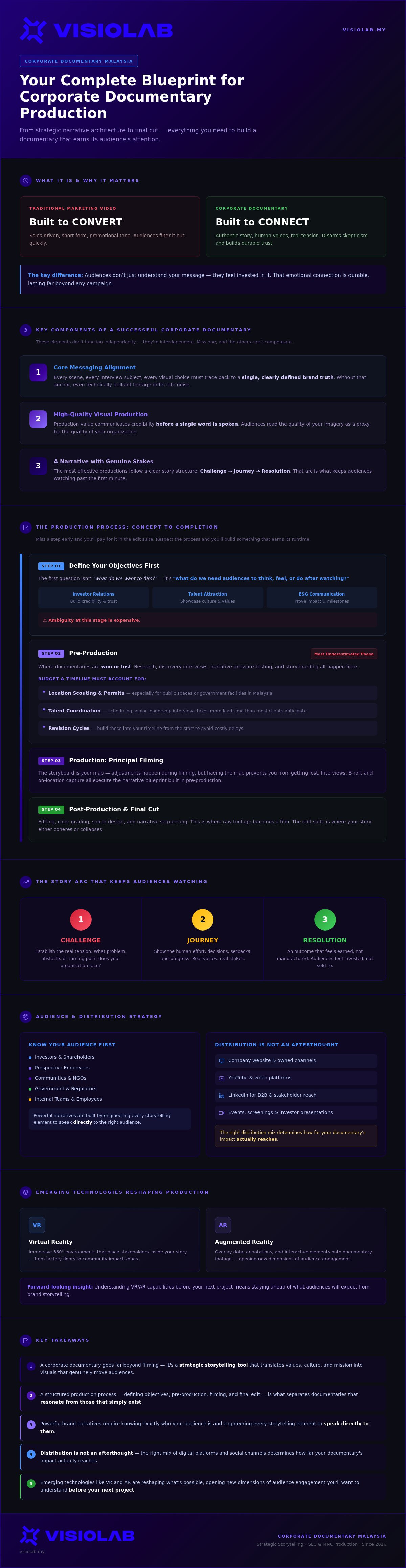
• A corporate documentary Malaysia production goes far beyond filming — it's a strategic storytelling tool that translates your brand's values, culture, and mission into visuals that genuinely move audiences.
• A structured production process — from defining clear objectives to script development and final edit — is what separates documentaries that resonate from those that simply exist.
• Powerful brand narratives are built on knowing exactly who your audience is and engineering every storytelling element to speak directly to them.
• Distribution is not an afterthought — the right mix of digital platforms and social channels determines how far your documentary's impact actually reaches.
• Emerging technologies like VR and AR are reshaping what's possible in corporate documentary production, opening new dimensions of audience engagement you'll want to understand before your next project.
A corporate documentary is not a polished sales pitch dressed up with cinematic lighting. It's a structured, long-form visual narrative that explores the deeper truth of an organization: its people, its purpose, its process, and the impact it creates in the world. Where traditional marketing videos are built to convert, documentaries are built to connect. That distinction matters enormously when you're trying to earn genuine trust from stakeholders, investors, employees, and communities.
The format works because it operates on a different emotional register. Audiences are conditioned to filter out promotional content. But a well-crafted documentary disarms that skepticism. It invites viewers into an authentic story, one where the tension is real, the voices are human, and the outcome feels earned rather than manufactured.
Complex organizational messages, think ESG commitments, cultural transformation, or long-term social impact, resist compression. A two-minute brand video can gesture at these ideas. A documentary can actually prove them. Through interviews with real stakeholders, behind-the-scenes footage, and carefully sequenced narrative arcs, documentaries give abstract values a face and a timeline. The emotional connection this creates is durable. Viewers don't just understand your message; they feel invested in it.
Malaysian companies across sectors have recognized this. Government-linked companies (GLCs) and multinational corporations operating locally have used documentary-style production to communicate sustainability milestones, workforce development stories, and community engagement programs to audiences who demand more than glossy claims. The format signals transparency, and in a market where institutional trust is hard-won, that signal carries real weight.
Three elements separate documentaries that resonate from those that simply exist:
Every scene, every interview subject, every visual choice should trace back to a single, clearly defined brand truth. Without that anchor, even technically brilliant footage drifts into noise.
Production value communicates credibility before a single word is spoken. Audiences read the quality of your imagery as a proxy for the quality of your organization.
The most effective corporate documentary Malaysia productions follow a story structure, there's a challenge, a journey, and a resolution. That arc is what keeps audiences watching past the first minute.
Agencies like VISIOLAB, operating in the Malaysian market since 2016 with a track record across corporate, GLC, and MNC sectors, understand that these components don't function independently. They're interdependent. Get one wrong, and the others can't compensate. Get all three right, and you've built something that outlasts any campaign.
A compelling corporate documentary Malaysia production doesn't happen by accident. It's the result of a disciplined, phase-by-phase process where strategic thinking precedes every creative decision. Miss a step early, and you'll pay for it in the edit suite. Respect the process, and what emerges is a film that earns its runtime.
The first question isn't "what do we want to film?" It's "what do we need audiences to think, feel, or do after watching?" Your answer shapes everything downstream. A documentary built around investor relations demands different storytelling choices than one designed to attract talent or communicate ESG milestones. Lock in your primary objective and your two or three core messages before a single camera is booked. Ambiguity at this stage is expensive.
Pre-production is where documentaries are won or lost. Most organizations underestimate it. The research phase involves more than background reading: it means conducting discovery interviews with key stakeholders, identifying the strongest human stories within your organization, and pressure-testing your narrative assumptions before they become expensive filming commitments.
From that research, a storyboard and treatment document take shape. A storyboard visualizes the documentary's sequence, shot by shot, giving your production team and internal approvers a shared reference point. It's not a rigid script; it's a map. Adjustments happen during filming, but having the map prevents you from getting lost.
Budget and timeline setting belongs here too. A realistic production schedule accounts for:
Particularly relevant for productions involving public spaces or government facilities in Malaysia.
Scheduling interviews with senior leadership or community stakeholders takes more lead time than most clients anticipate.
Build in at least two rounds of structured feedback before picture lock.
Equipment choices signal intent. Cinema-grade cameras with prime lenses create a visual language that audiences unconsciously associate with credibility and craft. But hardware alone doesn't capture authenticity. Directing interview subjects requires skill: the goal is to help people speak naturally rather than perform for the camera. The best moments in any documentary come from subjects who've forgotten they're being filmed.
Editing is where raw footage becomes a film. A skilled editor doesn't just cut between shots; they sequence emotion, control pacing, and make structural decisions that determine whether your audience stays engaged or disengages at the two-minute mark. Sound design and colour grading in this phase are equally critical. Both communicate tone before the audience consciously registers them.
Structured feedback rounds matter here. Vague notes like "make it more inspiring" create revision loops that drain budgets. Effective feedback is specific, tied to the documentary's original objectives, and delivered by a small, empowered decision-making group rather than a committee. If you're planning your first corporate documentary Malaysia project, working with an experienced production partner who can guide your team through this process makes the difference between a film that lands and one that lingers in revision indefinitely.
Great footage without a great story is just expensive wallpaper. The difference between a corporate documentary Malaysia production that earns genuine audience investment and one that quietly disappears from the company server comes down to narrative strategy: the deliberate, structured work of deciding what story to tell, who it's for, and how every element serves that purpose.
This is where most organizations stumble. They arrive at production with a subject but not a story. A subject is "our 20-year journey in sustainable manufacturing." A story is "the moment our factory floor supervisor challenged leadership to rethink everything, and what happened next." One describes. The other compels.
Audience analysis isn't a preliminary checkbox. It's the foundation every creative decision rests on. Before a treatment document is written, you need precise answers to three questions: Who is watching? What do they already believe about your organization? And what do you need them to believe differently after watching?
Different stakeholder groups require different narrative lenses. Investors respond to evidence of disciplined execution and long-term vision. Prospective talent wants to see culture, not claims. Community stakeholders need to feel seen, not managed. A single documentary can serve multiple audiences, but only if you've mapped each segment's specific interests and pain points before the script takes shape. Trying to speak to everyone equally is the fastest way to reach no one meaningfully.
Practical tools for this analysis include stakeholder interviews, internal surveys, and reviewing how your existing content performs across different audience segments. The patterns you find there reveal what your audiences actually care about versus what your organization assumes they care about. That gap is often where the most powerful stories live.
Authenticity in corporate storytelling isn't a creative preference. It's a strategic requirement. Audiences are exceptionally good at detecting when a narrative has been engineered to flatter rather than illuminate. The moment that skepticism activates, trust collapses and so does your documentary's impact.
The most effective approach is to let your brand's mission function as a narrative constraint, not a tagline to insert at the end. If your organization's core value is community empowerment, then the documentary's protagonist shouldn't be your CEO. It should be the community member whose life changed because of your work. The brand becomes visible through what it enables, not through what it says about itself.
Patagonia's environmental documentaries are a frequently cited example for good reason: the brand rarely appears explicitly, yet every frame reinforces its values through the stories it chooses to tell. Malaysian GLCs and MNCs operating locally have an equivalent opportunity, particularly around workforce development and sustainability narratives, where the human stories are genuinely compelling and largely undertold.
The balance between creative vision and strategic objectives resolves itself when both are anchored to the same audience truth. Creative instincts tell you how to make the story feel alive. Strategic objectives tell you what the story needs to accomplish. Neither overrides the other. They sharpen each other.
Finishing your documentary is not the finish line. It's the starting gun. Even the most compelling corporate documentary Malaysia production loses its power if it reaches the wrong audience through the wrong channels at the wrong moment. Distribution isn't a logistical afterthought; it's a strategic discipline that determines whether your investment generates returns or gathers digital dust.
The strongest distribution plans combine owned, earned, and paid channels into a coordinated release strategy. Each channel serves a different function and reaches a different segment of your audience.
Your company website, email newsletter, and internal communications platforms are your highest-trust environments. Launch here first. Stakeholders who already know you will engage most deeply, and their early reactions build social proof before you push to broader audiences.
For B2B-focused corporate documentaries, LinkedIn remains the most targeted platform for reaching decision-makers, investors, and industry peers in Malaysia. YouTube functions as a long-term discovery engine, particularly for documentaries with strong search-relevant themes like sustainability or workforce development.
Industry associations, chambers of commerce, and media partners can dramatically extend your reach without proportional budget increases. A GLC documentary distributed through a relevant trade body's newsletter reaches a pre-qualified, high-trust audience that paid advertising rarely replicates.
Industry conferences, investor briefings, and internal town halls give your documentary a live context that amplifies its emotional impact. Watching a film collectively creates shared reference points that purely digital distribution can't replicate.
A comprehensive distribution plan maps each channel to a specific audience segment, assigns a release timeline, and identifies who owns execution. Without that structure, even excellent content gets fragmented across platforms without coherent momentum.
Release day is the beginning of the conversation, not the end of it. Encourage active engagement by building touchpoints around the documentary: panel discussions, Q&A sessions with interview subjects, or behind-the-scenes content that extends the narrative. These additions give audiences a reason to return and share.
Measuring success requires clarity on what success actually means for your specific objectives. Vanity metrics like total views tell you very little. More meaningful signals include watch-through rate, which reveals whether your narrative holds attention; engagement rate on LinkedIn, which indicates professional resonance; and qualitative feedback from key stakeholder groups, which surfaces insights no algorithm captures.
Analytics from each release inform the next project. If audience drop-off consistently happens at a specific point in your documentary's structure, that's a signal about pacing or narrative sequencing to carry into future productions. Data doesn't replace creative judgment; it sharpens it.
If you're ready to build a documentary that earns its audience and reaches them strategically, connect with VISIOLAB to map your distribution approach from day one.
The rules of documentary production are being rewritten. Audience expectations have shifted permanently, attention is harder to earn, and the technology available to storytellers has expanded in ways that create genuine competitive advantage for organizations willing to move early. Understanding where corporate documentary Malaysia production is heading isn't optional intelligence. It's strategic preparation.
Camera technology, AI-assisted editing tools, and immersive formats are collectively raising the ceiling on what's possible. Virtual reality is the most significant shift. Where traditional documentaries ask audiences to watch a story, VR asks them to inhabit one. A viewer placed inside a factory floor, a community project, or a conservation site experiences your organization's work rather than observing it. That experiential gap translates directly into deeper emotional memory and stronger brand association.
Interactive documentaries represent a parallel evolution. Non-linear formats allow viewers to choose their own narrative path through your organization's story, spending more time with the subjects and themes most relevant to them. For companies communicating to diverse stakeholder groups simultaneously, this format solves a real problem: it lets a single production serve multiple audience segments without diluting the message for any of them.
Augmented reality layers are beginning to appear in corporate content too. Imagine a documentary about a construction project where viewers can overlay architectural plans onto real footage in real time. These aren't novelty features. They're storytelling tools that make complex information viscerally clear.
Viewer habits are evolving faster than most production briefs account for. Mobile-first consumption means documentaries need to hold attention on small screens without sacrificing the cinematic quality that signals credibility. Vertical and square formats, once considered compromises, are now legitimate primary formats for certain audience segments and platforms.
Sustainability in production itself is becoming a stakeholder expectation, not just an ethical preference. Organizations commissioning documentaries are increasingly scrutinized for how those productions are made: carbon footprint of travel-heavy shoots, local crew sourcing, and responsible location practices. For Malaysian companies building ESG narratives, a production process that contradicts those values is a liability that audiences will notice.
Staying ahead means building relationships with production partners who track these shifts actively. The most effective corporate documentary Malaysia productions of the next five years will combine cinematic craft with technological fluency and a genuine understanding of how audiences consume content across fragmented digital environments.
Brand legacy isn't built in a single campaign. It accumulates through consistent, credible storytelling over time. The organizations that invest in understanding where documentary production is heading will be the ones whose stories are still resonating a decade from now. Talk to VISIOLAB about building a documentary strategy that's built for where audiences are going, not just where they are.
A corporate documentary Malaysia production done right is one of the most durable investments your organization can make. It builds trust where campaigns can't reach, communicates complexity where bullet points fail, and creates emotional connections that outlast any single marketing cycle. The framework is clear: start with sharp objectives, build a narrative around genuine human stories, distribute with intention, and stay ahead of where audience expectations are heading.
None of that happens without the right production partner. VISIOLAB has spent nearly a decade translating complex organizational stories into documentaries that actually move people, working across corporate, GLC, and MNC sectors with a full-service approach from concept through final delivery. That depth of experience means fewer surprises, smarter creative decisions, and a final film your audiences will remember.
Your story is worth telling. Tell it with the craft and strategy it deserves. Begin your corporate documentary journey with VISIOLAB today and build something that lasts.
A corporate documentary is a long-form, structured visual narrative that explores the deeper truth of an organisation: its people, purpose, and real-world impact. Unlike a standard brand video, which is typically short and conversion-focused, a documentary builds genuine emotional connection through authentic storytelling, real stakeholder voices, and a narrative arc with actual stakes. It's designed to earn trust, not just attention.
The practical difference shows up in runtime, depth, and intent. A brand video might run 90 seconds and highlight product features. A corporate documentary might run 15 to 30 minutes and take audiences inside your organisation's culture, challenges, and transformation. The format signals transparency in a way that polished promotional content simply can't replicate.
Most corporate documentary Malaysia productions take between eight and sixteen weeks from initial concept to final delivery, depending on project complexity, number of filming locations, and how many stakeholders need to be interviewed. Pre-production alone, covering research, scripting, and location scouting, typically requires three to four weeks before a single camera rolls.
The biggest time variables are stakeholder availability and revision cycles. Scheduling interviews with senior leadership or community figures often takes longer than clients anticipate. Building at least two structured feedback rounds into your timeline before picture lock is essential. Rushing post-production to meet an arbitrary deadline is one of the most common and costly mistakes in documentary projects.
Every effective corporate documentary needs three non-negotiable elements: a clearly defined central message that anchors every creative decision, real human stories that give abstract values a face and a timeline, and a narrative structure with a genuine arc, meaning a challenge, a journey, and a resolution that audiences can follow. Without that arc, even technically brilliant footage loses its audience.
Supporting elements include high-quality visual production that signals organisational credibility, purposeful use of techniques like drone footage or timelapse to contextualise scale, and sound design that communicates tone before viewers consciously register it. Every element should earn its place by serving the documentary's core objective, not simply filling runtime.
Yes, and they're often more effective internally than externally. Corporate documentaries are particularly powerful for communicating cultural transformation, onboarding new employees, aligning teams around strategic direction, or marking significant organisational milestones. A well-crafted internal documentary gives employees a shared reference point and emotional context that a town hall presentation or written memo rarely achieves.
The storytelling approach shifts slightly for internal audiences. Rather than building external credibility, the goal is to create a sense of collective identity and shared purpose. Featuring frontline employees, not just leadership, as documentary subjects tends to produce stronger internal resonance and higher engagement across different levels of the organisation.
Budget ranges for corporate documentary Malaysia productions vary significantly based on scope, runtime, number of filming days, and post-production complexity. Rather than quoting a figure that may not reflect your specific project requirements, the most reliable approach is to request a detailed proposal from your production partner once your objectives, locations, and key stakeholders are defined. That specificity is what produces an accurate budget, not industry averages.
What's consistent across projects is where budget allocation matters most: pre-production planning, experienced directing and cinematography, and skilled post-production editing. Underinvesting in any of these three areas tends to show up clearly in the final film. A production partner who helps you allocate budget strategically across these phases will deliver more value than one who simply minimises the headline number.
Effectiveness measurement starts with the objective you defined before production began. If your documentary was built for investor relations, the relevant signals are stakeholder engagement in follow-up meetings and qualitative feedback from that audience. If the goal was talent attraction, application rates and candidate quality in the months following release are more meaningful than raw view counts.
For digital distribution, watch-through rate is a more reliable indicator of narrative strength than total views. A high drop-off point at a specific moment in your documentary reveals a pacing or structural issue worth addressing in future productions. LinkedIn engagement rate matters for B2B-focused documentaries targeting professional decision-makers. Combining quantitative platform data with direct qualitative feedback from key stakeholder groups gives you the clearest picture of actual impact.
Stories that resist compression are the best candidates for the documentary format. ESG and sustainability journeys, workforce development programmes, community impact initiatives, organisational transformation over time, and founding stories with genuine human stakes all have the depth and complexity that documentary treatment rewards. These are narratives where the nuance matters, and where a two-minute video would flatten the very details that make the story credible.
The strongest corporate documentary Malaysia productions share one common trait: a human protagonist at the centre. Whether that's a community member whose life changed because of your organisation's work, an employee who drove a critical innovation, or a founder navigating a defining challenge, audiences connect with people, not organisations. Your brand becomes most visible through what it enables in others, not through what it says about itself.
Let’s create and collaborate
We’re versatile multitaskers, and we thrive on a lot of projects. You've seen a few of our works that we are most proud of, and your project could be next in line.

Empowering brands with captivating visual stories, creating strong connections and growth.
