
A polished pitch can explain what a company does; a documentary can show why it matters. A corporate documentary storytelling approach builds connection through real people, candid moments and a clear narrative, helping audiences understand the values and impact behind the message. A credible film t...

A polished pitch can explain what a company does; a documentary can show why it matters. A corporate documentary storytelling approach builds connection through real people, candid moments and a clear narrative, helping audiences understand the values and impact behind the message.
A credible film takes more than polished production. When people, places and experiences carry the story, viewers can connect with an organisation on a human level. The same approach can help employees understand the company’s purpose and bring complex messages into sharper focus.
This article explores how documentary storytelling can build trust, support internal communication and adapt to different audiences, budgets and channels. You’ll see when a documentary style fits, how to shape a focused story, and how one central narrative can work across sales, events, social media and internal communications.
• Use real people, places and moments to make an organisation’s story feel grounded and credible.
• Build the narrative around a human perspective to help employees connect with themes such as innovation, purpose and community impact.
• Match the filmmaking style to the audience, message, available assets and budget; a documentary approach isn’t right for every communication goal.
• Shape one central story for different channels, adapting its length and focus for sales, events, social media and internal communications.
• Choose VISIOLAB’s Corporate Video or Documentary work when you need to turn complex organisational messages into clear, story-led visual content.
Documentary-style films build brand stories around real people, places and experiences. Their impact comes from choosing honest moments that serve a clear communication goal without making every scene feel scripted.
For Malaysian productions, plan participant releases, location permission and rights clearance for music, photographs and archival footage. These practical safeguards help set clear expectations; the permissions required depend on who and what appears in the film.
Observational footage records people at work in their real environments instead of staging every action for the camera. A team meeting, a technician preparing a workspace or a customer using a service can offer visual context that interview statements alone cannot provide.
For example, a film about workplace culture might follow an employee through a real shift. Natural interactions, environmental sounds and detail shots can show how the organisation works. The crew should capture unscripted moments without disrupting people or operations.
Before filming, production teams can identify locations, participants and sensitive activities. In Malaysia, site permission and informed participant consent help establish clear expectations about filming and intended use. Authenticity works best when people understand the process and can speak in their own words.
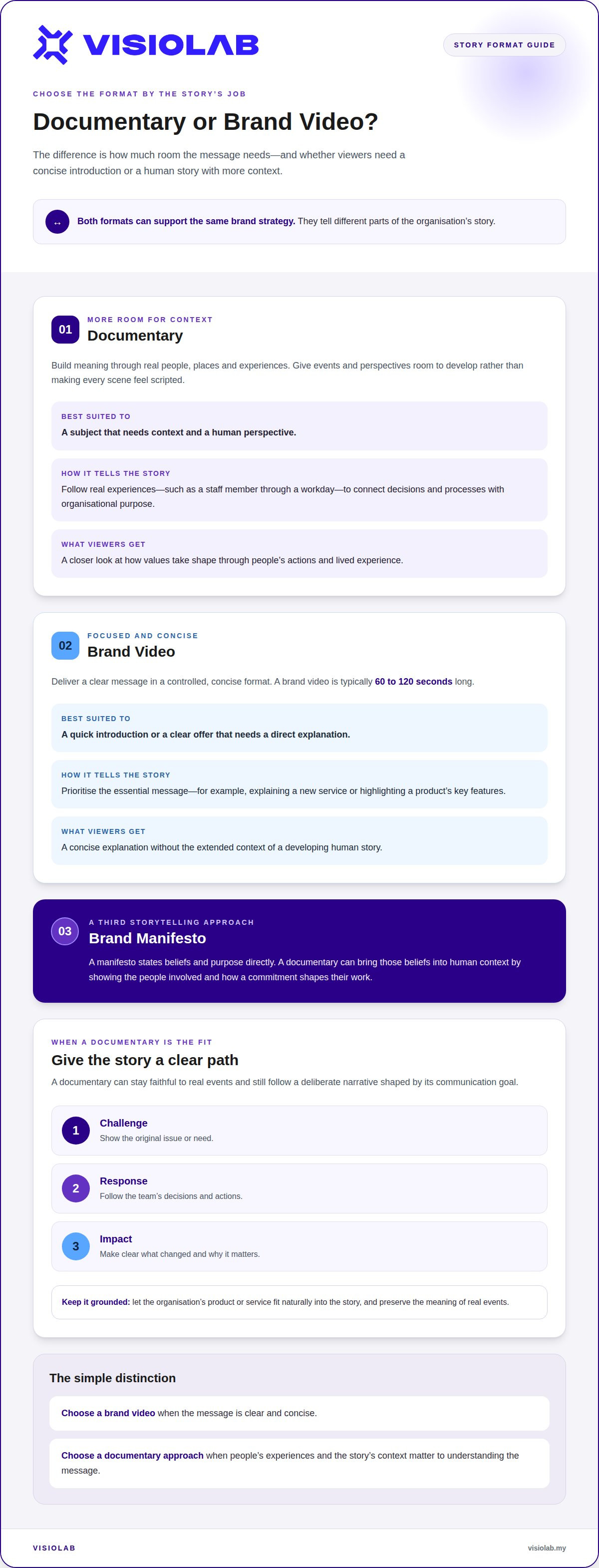
A documentary can remain faithful to real events while following a deliberate narrative shaped by a communication goal. One useful structure is challenge, response and impact: it gives viewers a clear path without asking participants to deliver scripted claims.
For instance, a film about a new process could show the original challenge, the team’s decisions and what changed. The organisation’s product or service should fit naturally into the story, rather than dominate every scene. This keeps the film human while making its business relevance clear.
Define the intended audience response before production. A film explaining a complex initiative may need context and informed interviews; a brand story may centre on one person’s experience. In either case, editorial choices should preserve the meaning of real events.
Featuring employees or customers also carries risks: participants may feel pressured, disclose sensitive information or later regret appearing in a film. Clear consent, careful interview boundaries and sensitive review can reduce these risks without scripting every answer.
Successful corporate documentary storytelling gives a real person’s experience a purposeful arc. Growth Begins When You Do, associated with LSBF and GrabAcademy, uses adult learners’ doubts and motivations to explore personal growth. This human perspective makes the subject more relatable than a list of course features.
A founder film can show the work behind an organisation’s purpose, combining archival material with present-day interviews. A community-impact film might follow one participant and show how a programme affects daily life. Both approaches connect organisational themes with specific experiences instead of broad claims.
Measure impact against the film’s objective. For an internal film, assess employee understanding and feedback; for a sales film, track relevant enquiries or audience engagement. Compare the results with the intended response and use them to guide future edits and distribution.
Brand documentaries connect an organisation’s purpose with lived experience. They help viewers understand not only what a company does, but why its work matters.
A brand video often delivers a focused message in a controlled, concise format. A brand documentary gives real people and events more room to develop; a brand video is typically 60 to 120 seconds long. The distinction matters when choosing between a quick introduction and a deeper story about how an organisation’s values take shape.
For example, a manufacturer could use a short corporate video to explain a new service. A documentary could instead follow a staff member through a workday, connecting decisions and processes with the organisation’s purpose. Both formats can support brand objectives, but their storytelling and production choices differ.
A brand manifesto states beliefs and purpose directly. A documentary can give those beliefs human context: a launch film about responsible sourcing, for instance, could follow the people involved and show how the commitment shapes their work. This makes abstract values tangible without turning every moment into a scripted claim.
Stories can also make ideas and consequences more memorable. The Royal Society describes how stories can hold attention and evoke emotion. In a corporate video, an employee’s account of solving a practical challenge may communicate a value more vividly than a list of values on screen.
Choose the story according to the intended response. A launch may need to clarify a new direction; a company heritage film may deepen understanding among employees or partners. Measure success against that objective, using indicators such as audience understanding, engagement or relevant enquiries, rather than views alone.
A documentary builds meaning through real experiences, while a conventional brand video often prioritises a concise, tightly controlled message. This distinction helps organisations match format to purpose: use a short video to explain a clear offer, or a documentary when the subject needs context and a human perspective.
For example, a new product announcement can lead with essential features. A documentary about the people developing it can explore the challenge, decisions and motivations behind the launch. Both formats can support the same brand strategy while telling different parts of its story.
Emotional storytelling builds connection when the people featured are more than proof points for a corporate message. A community film, for example, can follow a participant’s perspective and show the change they experienced, while giving the organisation’s role appropriate context.
That balance matters: overly polished performances can distance viewers, while honest accounts invite attention. For strategic guidance on blending emotional intelligence with intentional communication, firms like EQ4 Brand Architects help organisations shape narratives that resonate deeply while reinforcing broader objectives. Keep the purpose clear, give participants room to speak naturally, and edit their stories with care. The result can make a brand’s beliefs easier to understand and remember.
Yes. A carefully shaped film can connect employees with organisational values through specific people, decisions and outcomes. It can also make complex change easier to understand.
This narrative structure traces how an organisation began, changed, and found purpose through its people. It helps employees connect present-day priorities with the experiences that shaped them.
For example, an internal film about a Malaysian company’s expansion could open with its founding challenge. Interviews with long-serving staff can then reveal turning points, while current teams show how earlier values guide today’s work. This sequence gives employees context without turning the film into a chronology of dates.
To develop the story, first clarify the internal communication objective. Then identify people whose experiences illuminate it. A film about organisational values, for instance, might follow how one team puts those values into practice during a real project. Capture actions and details that support the message, rather than relying only on leadership statements.
A challenge-solution-impact narrative shows what needed to change, how people responded and what followed. This structure helps employees see how organisational decisions lead to practical consequences.
Imagine a company introducing a new process across departments. The film can show the initial difficulty, capture staff describing their adjustments and explain what changed as a result. Specific experiences make the story more informative than a leadership presentation that lists objectives without showing how work changes.
Innovation and community impact also make useful internal themes. A film could follow a team developing a new approach, or show how employees contribute to a local initiative. In either case, the story should distinguish confirmed outcomes from future aims. That clarity helps preserve trust while connecting business priorities with real experiences.
Emotional progression is the purposeful movement from context through tension or discovery toward meaning. It keeps an internal audience engaged and helps each new idea build on the last.
A film about workplace change might begin with uncertainty, show employees adapting, then close with what they learned. The shift should come from genuine experiences, not manufactured conflict. This lets viewers recognise concerns before considering the organisation’s response.
Effective documentaries combine a clear objective, credible participants, relevant context and a coherent visual narrative. To develop one, define the employee audience and desired understanding, identify a story that demonstrates the organisation’s values, then shape real material into a purposeful sequence. Interviews alone won’t create that progression; each scene should move the story forward.
Start by defining the purpose, audience, message and intended response. Then review available assets and budget, choose a format, plan production and edit for the viewing context.
Defining purpose and audience connects storytelling choices with the response a film needs to prompt. For example, a documentary for employees may clarify a restructuring, while a film for partners may explain an organisation’s wider impact. Naming the primary audience helps focus the message, choose relevant voices and determine what viewers need to understand.
Next, distil the communication objective into one central idea. A company introducing a complex initiative could focus on why it matters instead of listing every feature. That focus guides interviews, visual choices and the final format. It also helps production teams decide which details belong in the film and which might distract viewers.
Available assets and budget shape how the idea can be expressed. Existing photographs, archival footage, interview access and filming locations can each support different scenes. Working with commercial photography and art reproduction specialists like Image-Tec can help teams capture high-quality still imagery or digitise company archives to enrich the visual narrative. If workplace access is limited, interviews and existing materials may carry more of the story. Direct resources toward footage that communicates the message clearly.
Long-form storytelling suits subjects that need room for context and progression. A typical hero brand documentary runs 3 to 8 minutes. That format can hold a compelling account of a company’s evolution, but duration alone won’t sustain attention. Each scene needs to add information, reveal perspective or move the narrative forward.
Audience expectations influence how a story should sound, look and unfold. Employees watching an internal film may value candid accounts from colleagues, while external partners may need more context about the organisation’s role. Matching the format to viewers’ knowledge makes the message accessible without oversimplifying the subject.
Consider a documentary about a technical change. New employees may need the process explained through clear examples; experienced teams may respond better to interviews about decisions and lessons. A flexible narrative can retain one central message while adjusting the detail for each audience. That keeps the film relevant without creating competing versions of the organisation’s story.
Available assets also affect audience engagement. Strong archival footage can help viewers understand how an organisation reached its current position. If access to participants is limited, the story may need a different structure, such as leadership interviews supported by workplace visuals. Every choice should serve the audience, not simply showcase production resources.
Finally, plan where and how viewers will watch. A film shown during a presentation can rely on its surrounding context; a standalone version needs to orient viewers within the story. Decide what the audience should remember or do afterward, then shape the pacing, detail and closing message around that response.
A documentary can serve several channels when each version has a clear role. Keep one genuine central story, then adapt its emphasis, format and length for each audience.
For internal communications, use the film to explain purpose, values or organisational change. An employee story can introduce a new initiative, while behind-the-scenes scenes show how teams put it into practice. At a town hall, a short excerpt can prompt discussion; a longer version can give employees more context before or after the event.
In sales conversations, a documentary can help prospects understand the people and processes behind a business. For example, a film following a project from challenge to outcome can make the organisation’s approach tangible. Sales teams can use a relevant scene to open a meeting, then connect its details to the prospect’s needs. The film supports the conversation; it shouldn’t replace a clear explanation or next step.
At conferences and corporate events, use the story to frame a presentation or bring a theme to life. An opening film about a community initiative, for instance, can give speakers a shared reference point. Event coverage can capture genuine reactions and moments from the day, creating material for later internal updates or social promotion.
Social channels need edits designed for quick viewing. A shorter brand documentary edit for social sharing is typically 60 to 90 seconds, while social cutdowns are typically 15 to 60 seconds each. Each version should carry one idea, introduce its subject quickly and make sense without relying on context from a longer film.
Plan those edits during production, not as an afterthought. Identify scenes that can stand alone, interview answers that express a complete thought, and visuals suited to different formats. A vertical social edit, an event-screen version and an internal presentation may each need different framing, captions or openings. Keep the central message consistent while adapting its delivery.
Measure each use against its purpose. For an internal release, gather employee feedback about clarity; for a sales presentation, track relevant follow-up conversations. For social posts, review viewing and engagement patterns. These measures show which story elements hold attention and where the message needs refinement, without treating views alone as evidence of business impact.
Map the story to its channels before production begins, so each edit has a defined audience and purpose. Plan your documentary for multiple channels with a clear central narrative and audience-led edits.
VISIOLAB helps organisations turn complex messages into clear, story-led visual content. Its Corporate Video and Documentary work can shape real people, experiences and purpose into a coherent film for employees, customers or stakeholders.
Choose a documentary when the story needs a human perspective and room to unfold. For a direct explanation of a process or internal initiative, an Explainer and Training Video can make key information easier to follow. An ESG Video can bring environmental, social and governance themes into focus through relevant organisational stories.
Start by defining the audience, message and response the film should support. With those decisions in place, VISIOLAB can align the storytelling format with your communication goal.
Contact VISIOLAB to discuss your corporate video needs.
Identify the organisational story that can advance a real priority. Choose a subject with a clear human perspective, then decide what you want viewers to understand or do. That decision gives production a meaningful centre and keeps creative choices aligned.
A corporate documentary storytelling approach works best when the story is true to people’s experiences and purposeful for the organisation. Let that principle guide the brief: define the audience, name the central message and consider how the finished film will support communication beyond its first release.
VISIOLAB’s Corporate Video, Explainer and Training Video, and ESG Video offerings can support different communication needs. If you’re ready to shape a project around your organisation’s message, Discuss your project with VISIOLAB.
Every strong film begins with a clear reason to tell the story. Choose yours, and give it room to make a lasting connection.
Consider a documentary when the subject depends on real experiences, unfolding events or multiple perspectives. For example, a company introducing a new operating model could document how teams adapt over time. A short scripted film may better suit a fixed announcement or simple instruction. Choose based on whether viewers need to see people and processes or simply receive a concise message.
A brand documentary develops a story through real experiences, while a brand video often delivers a more controlled message. A recruitment campaign might use a concise brand video to explain the role and workplace. A documentary could follow an employee’s experience on a project, revealing more of the organisation’s culture. The formats can complement each other, but each needs a distinct purpose and audience.
They build trust by letting viewers hear specific experiences and see evidence that supports the message. For example, a film about a new service could show how a team responds to a real customer need, with clear context about what happened. Don’t present one person’s account as proof of every outcome. Accurate details, balanced editing and transparent storytelling make a film more credible.
Narrative documentary video production shapes real footage into a film with a clear sequence and point of view. It may combine interviews, workplace scenes, archival material and natural interactions. For example, a project about a new facility could move from the original need to construction milestones and eventual use. This structure helps audiences follow events while distinguishing recorded fact from editorial interpretation.
Documentary storytelling can feel more authentic because it captures real settings, voices and interactions instead of relying entirely on prepared claims. A staff member describing a work challenge in their own words may feel more grounded than a scripted endorsement. Authenticity still depends on thoughtful editing: removing important context or staging a supposedly spontaneous moment can undermine openness.
Organisations use documentary films to explain complex subjects through people and concrete experiences. A company describing a transformation, for example, can show how it affects different teams instead of relying only on a written announcement. The film can also be adapted for presentations, social channels or internal viewing. Its suitability depends on the subject, audience and communication goal, not a trend.
A corporate documentary storytelling approach uses real people, events and environments to communicate an organisation’s message through a shaped narrative. It combines a clear purpose with interviews, observational footage and editorial choices that help viewers understand the subject. For example, a film about an employee initiative could follow its development and show how participants experienced it, rather than presenting only company claims.
Start interviews with open prompts about specific experiences, such as “What changed after the new process began?” Give participants time to answer in their own words, then ask for examples that clarify their meaning. Explain the film’s purpose and intended audience before filming, and agree on how sensitive details will be handled. Don’t ask people to repeat a preferred corporate message or promise an outcome.
Let’s create and collaborate
We’re versatile multitaskers, and we thrive on a lot of projects. You've seen a few of our works that we are most proud of, and your project could be next in line.

Empowering brands with captivating visual stories, creating strong connections and growth.
