
A polished corporate video can still miss its mark. What makes a corporate video successful isn’t simply cinematic visuals or a confident voice-over. It’s whether the right audience understands one clear idea and knows what to do next. Success is designed before filming and evaluated after distribut...

A polished corporate video can still miss its mark. What makes a corporate video successful isn’t simply cinematic visuals or a confident voice-over. It’s whether the right audience understands one clear idea and knows what to do next. Success is designed before filming and evaluated after distribution.
Teams often have plenty to say but limited viewer attention. A video that tries to explain everything can bury its central message, while production flair alone can’t make a story relevant to its audience. The goal isn’t polish for its own sake. It’s purposeful communication.
In this guide, you’ll learn how to shape a corporate video around audience needs, a focused message, and a business objective. We’ll look at how to choose a format, plan the response you want from viewers, and define measures before release so you can assess performance after distribution. From the first brief to the final review, each decision should support the same outcome: a video that connects and delivers value.
• Clarify the business objective and the audience outcome you want before choosing a format or planning production.
• Build the video around one central message, supported by evidence that matters to viewers.
• Choose production elements that strengthen the story. Visual polish can capture attention, but it can’t compensate for an unclear brief.
• Match performance measures to your goal, and distinguish viewing behaviour from outcomes such as understanding or action.
• Use focused questions about audience research, approvals, accessibility, and post-release review to assess a potential production partner.
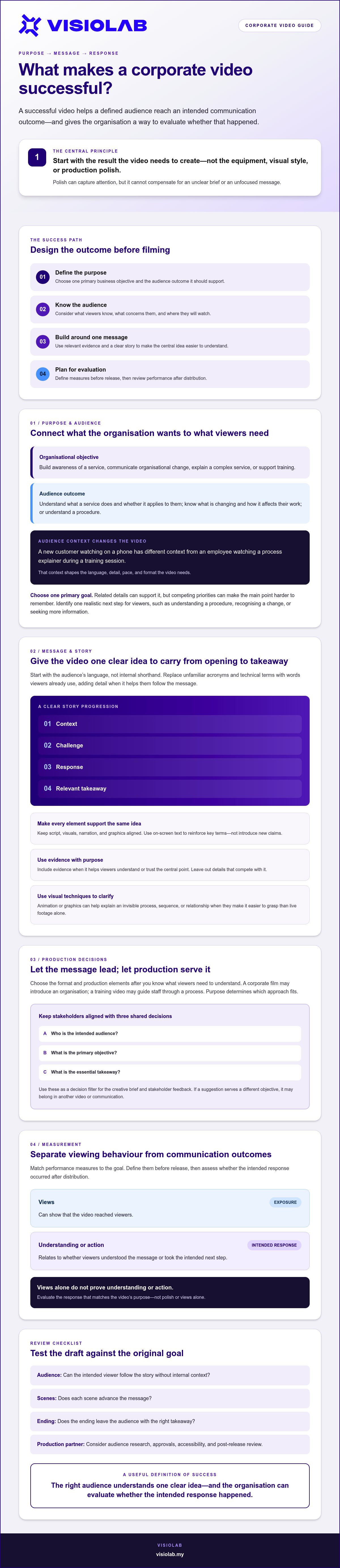
When considering what makes a corporate video successful, start with the result it needs to create, not the equipment or visual style. A video succeeds when it helps a defined audience reach an intended communication outcome and the organisation can evaluate whether that outcome happened. The format can vary: a Corporate film may introduce an organisation, while a training video may guide staff through a process. Purpose determines which approach fits.
A successful corporate video connects an organisational objective to a useful audience response, then measures whether that response occurred. That’s more precise than judging success by polish or views alone.
Separate what the organisation wants from what the viewer needs. An organisation may want to build awareness of a service; its audience may need to understand what the service does and whether it applies to them. A leadership team may want to communicate organisational change; employees may need clarity about what is changing and how it affects their work.
Other goals include explaining a complex service or supporting training. Choose one primary goal for the video. A single focus gives the script, visuals, and call to action a shared direction. Related details can support that goal, but competing priorities can make the main point harder to remember.
Define the audience before shaping the story. Consider what viewers already know, what concerns they may have, and where they’ll watch. A new customer watching on a phone has different context from an employee viewing a process explainer during a training session. Those differences affect the language, detail, pace, and format the video needs.
Then identify one realistic next step. It could be understanding a procedure, recognising a change, or seeking more information. The desired response should suit the audience and the video’s purpose, rather than ask every viewer to take an immediate business action.
For more on connecting audience insight with production planning, explore this strategic corporate video production guide. A clear purpose gives the project a testable direction: define the intended response before production, then choose a measure that can indicate whether viewers reached it. Views can show exposure, but they don’t prove that viewers understood the message or acted on it.
Once the purpose is clear, give the video one idea to carry from opening frame to final takeaway. A practical workflow is to research the audience, define the message, shape the story, and review it against the original goal. This keeps production choices grounded in communication rather than personal preference or a growing list of internal requests.
Let the message lead. Choose production techniques only after you know what viewers need to understand. Every element should support the same central idea.
Start with the audience’s language, not internal shorthand. Replace unfamiliar acronyms and technical terms with words viewers already use. Add necessary detail when it helps them follow the message. Then build a clear progression: context, challenge, response, and relevant takeaway.
For example, a video explaining a complex service might first show a problem the audience recognises, then explain how the service responds and what viewers should understand next. Use animation or graphics when they make an invisible process, sequence, or relationship easier to grasp than live footage alone. Harvard Business Publishing’s business-focused video examples offer a useful reminder that strong video communication starts with a substantive idea.
Keep the script, visuals, narration, and graphics aligned. If the message is about making a process easier to follow, the visuals should clarify each step, the narration should explain transitions, and on-screen text should reinforce key terms rather than introduce new claims. Include evidence when it helps viewers understand or trust the central point. Leave out details that compete with it.
Before scripting, agree on three things: the intended audience, the primary objective, and the essential takeaway. Use these as a decision filter for the creative brief. When feedback conflicts, ask which suggestion better supports the agreed goal. If a suggestion serves a different objective, it may belong in another video or communication.
Review the draft in sequence. Can the intended viewer follow the story without internal context? Does each scene advance the message? Does the ending leave the audience with the right takeaway? These checks help teams resolve subjective feedback using a shared standard.
For a broader perspective on shaping meaning through design, read about the strategic role of visual communication. Organisations considering how strategy and production can work together can also explore VISIOLAB’s corporate video work.
Strong visuals can earn attention, but they can’t repair an unclear brief. If viewers don’t know what the video is about or why it matters to them, a dramatic opening, elegant colour grading, or elaborate motion graphics won’t make the message clearer. Production quality should serve the communication goal, not compete with it.
Ask whether each production choice helps viewers understand, trust, or remember the intended message. Clear sound can make an interview easier to follow. A graphic can show how a process works. A decorative transition that adds no meaning may slow the story. The answer to what makes a corporate video successful isn’t one signature look. It’s the fit between production choices and audience needs.
Choose a format based on the message, audience, access to people or locations, and viewing environment. Each approach has strengths and trade-offs. Interviews bring a human perspective, but need thoughtful questions and clear answers. Demonstrations make visible processes easier to follow, but depend on being able to show the action safely and clearly.
Useful for showing real people, places, and activities. It can add immediacy, though location access and visual complexity may affect what can be captured.
Helpful for abstract systems, procedures, or information that needs simplification. It offers control over what viewers see, but still needs a clear narrative and careful explanation.
Can build a fuller picture through real experiences and perspectives. They need a focused story so additional detail doesn’t blur the main point.
No format guarantees results. Select the one that makes the message easiest to grasp in the context where viewers will encounter it.
Credibility begins with what the video says. Use specific, supportable statements, and avoid sweeping claims or superlatives that the content can’t substantiate. Then align the craft: pacing should suit the subject, visuals should add context, and graphics should clarify rather than decorate. A serious safety topic, for instance, calls for a different visual rhythm from a company introduction.
Make the experience easy to follow, too. Clear audio matters wherever viewers watch. Captions can help people follow dialogue in sound-sensitive settings or when audio isn’t available. Readable on-screen text and uncluttered graphics also support comprehension, particularly on smaller screens. Polish earns its place when it removes friction between the message and the viewer. Otherwise, it’s only surface.
A video’s release is the start of measurement, not the finish line. Before publishing, record a baseline and decide what evidence would indicate progress toward the original objective. That might mean comparing awareness before and after distribution, checking whether employees can explain a new process, or tracking whether viewers take a relevant next step. Without a baseline, it’s harder to tell whether results reflect the video or other factors.
Separate distribution measures from audience outcomes. Views, watch time, and completion can show how people encountered and watched a video. They don’t establish that viewers understood it, felt confident applying it, or acted on it. Interpret video metrics against the objective, the audience, and the viewing context. That context could include where the video was shared and whether viewers watched independently or as part of a session.
Choose measures that match the job the video needs to do. For an awareness video, look beyond total views. Consider whether it reached the intended audience and how relevant viewers engaged with it. For training, pair viewing data with a suitable check of understanding or task confidence, such as a knowledge question or a practical demonstration where appropriate.
For internal communication, ask whether employees understood the message and know what to do next. A short follow-up question or manager feedback may reveal more than completion data alone. Use methods that fit the subject and audience, and avoid treating a single metric as proof of every outcome.
Look for patterns before making changes. If viewers leave early, review the opening alongside where and how the video was distributed. Gather audience comments, check whether captions are clear, and consider whether the structure delivers key information soon enough. A drop-off point is a clue, not a diagnosis by itself.
When evidence points to a specific issue, test a focused adjustment: refine the opening, reorder a section, improve captions, or make the next step more explicit. Keep the original objective in view so optimisation doesn’t turn into change for its own sake.
If documentary storytelling suits the communication goal, explore this corporate documentary storytelling guide for further perspective. For support connecting video strategy with production, discuss your corporate video objectives with VISIOLAB.
Repeatable results come from a connected process, not a hand-off between disconnected stages. Audience research informs the brief; the brief shapes the script; the script guides production; and distribution planning determines how the finished video reaches its intended viewers. Agreeing on the objective and approval process early helps keep these stages aligned. A post-release review can turn lessons from one project into better decisions for the next.
A partner should bring more than production capability. Look for a team that can connect communication strategy to creative execution and discuss how results will be evaluated, without promising outcomes no production partner can guarantee.
Use the first discussion to understand how the team thinks, communicates, and works with your stakeholders. Ask questions such as:
• How will you learn about our audience and turn our communication objective into a focused brief and script?
• Who reviews the script and production plan, and how will feedback and approvals be coordinated?
• Which channels and formats are we planning for, and how will the video work in those viewing environments?
• How will accessibility needs, including captions and clear on-screen text, be considered?
• What performance measures should we review after release, and what information will we need to assess them?
Look for clear reasoning rather than a one-size-fits-all answer. The right approach should reflect your audience, message, internal approval needs, and intended viewing context.
VISIOLAB is a Malaysia-based strategic video agency serving corporate, GLC, MNC, and government organisations nationally. Its capabilities include corporate films, ESG stories, explainers, training and safety content. Depending on the brief, motion graphics may help clarify information, event coverage may document an occasion, and industrial documentation may support project communication. Each format serves a different need, so the choice should follow the objective.
When assessing VISIOLAB or any potential partner, look for a process that connects the audience, message, production choices, and evaluation from the start. To learn more about the company’s corporate video capabilities, explore VISIOLAB’s corporate video services.
Strong corporate video starts with a defined purpose: know who needs the message, what they should understand, and how you’ll assess the result. Keep the story focused on one central idea, then choose a format and production approach that help the audience follow it. After release, look beyond views and measure whether the video supported the intended outcome.
That’s the practical answer to what makes a corporate video successful: strategic choices that connect audience needs to a clear message, purposeful execution, and meaningful evaluation.
VISIOLAB is a Malaysia-based video agency founded in 2016, serving corporate, GLC, MNC, and government organisations nationally. Its capabilities include corporate films, ESG stories, training and safety content, motion graphics, and industrial documentation. The right format depends on the communication need, and a connected strategy can help guide each decision.
Ready to shape a video around your organisation’s goals? Explore VISIOLAB’s corporate video services and take the next step with clarity and purpose.
A successful corporate video achieves a defined communication purpose for a specific audience. To understand what makes a corporate video successful, connect a clear message with a suitable story and format, then give viewers a relevant next step. Evaluate the video against its original objective: awareness may call for different measures than training or internal communication. Production quality and view count can offer useful context, but neither proves on its own that viewers understood or acted on the message.
Measure success by matching each indicator to the video’s objective. For awareness, review reach among the intended audience and relevant viewing behaviour. For training, use a suitable knowledge check or task-related feedback. For internal communication, ask whether employees understood the message or know what action to take. Combine platform data with audience feedback where appropriate. Views show that a video was watched, but they don’t prove comprehension or business impact by themselves.
A corporate video doesn’t always need a sales-style call to action, but viewers should know what to do with the information. A training video might ask staff to follow a procedure, while an explainer could direct viewers to a relevant resource. Define the intended next step in the brief and make it clear in the video. Keep it realistic and relevant: the right action depends on the audience, message, and communication purpose.
There’s no single ideal length for every corporate video. Choose a duration that gives the audience enough time to understand the message without adding material that distracts from its central takeaway. Consider the topic’s complexity and where viewers will watch. A detailed training video may need space to explain a process, while a short update may not. Prioritise clear structure and useful information over an arbitrary time limit.
Both matter, but production quality can’t replace relevant, clear content. Good sound, considered visuals, and careful editing make a video easier to watch; a focused message gives viewers a reason to pay attention and understand. A polished video can still miss its purpose if the brief is unclear or the content doesn’t address audience needs. Start by defining the audience and objective, then use production choices to strengthen the message.
Animation can make abstract ideas, systems, or procedures easier to visualise, especially when they can’t be filmed directly. It isn’t automatically the best format. An interview may add a human perspective, while live footage can show a real process or workplace. Choose the approach that helps the intended audience understand the subject. Keep animation accurate and readable, with visuals that support the narration rather than compete with it.
A useful corporate video brief identifies the intended audience, communication objective, central takeaway, and desired next step. It should also state where viewers will encounter the video, what evidence or information must be included, and who needs to review it. Note practical needs such as captions, available footage, and distribution formats. These details help the production team shape a focused story and give the organisation a clear basis for evaluating the finished video.
Let’s create and collaborate
We’re versatile multitaskers, and we thrive on a lot of projects. You've seen a few of our works that we are most proud of, and your project could be next in line.

Empowering brands with captivating visual stories, creating strong connections and growth.
