
A factory tour shouldn’t depend on being in the right place at the right time. Creating a virtual factory tour gives customers, partners, and stakeholders a way to explore a real facility remotely through interactive 360-degree images or video, with access to different areas from a screen.That doesn...
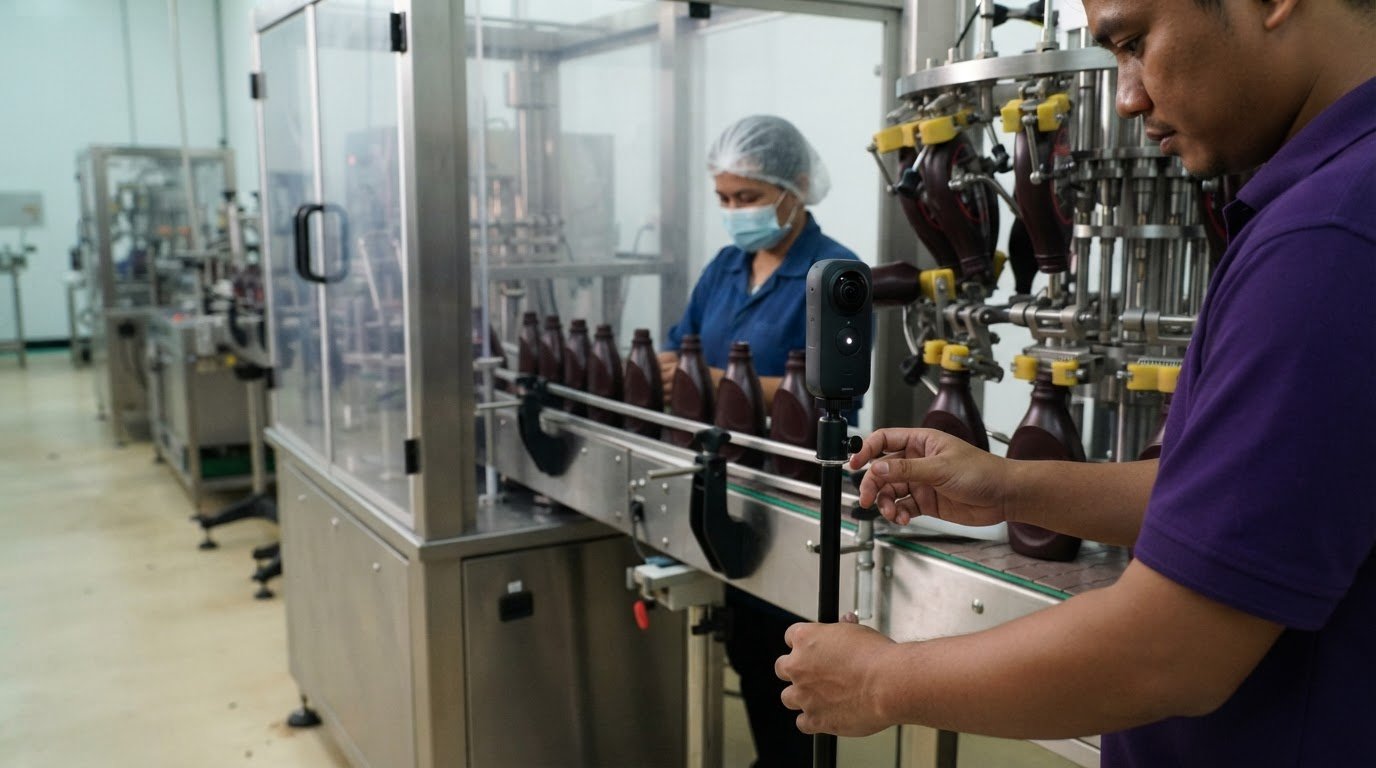
A factory tour shouldn’t depend on being in the right place at the right time. Creating a virtual factory tour gives customers, partners, and stakeholders a way to explore a real facility remotely through interactive 360-degree images or video, with access to different areas from a screen.
That doesn’t mean a virtual visit should feel like a flat walkthrough. The route, camera positions, and floor plan shape what visitors see and how easily they understand the operation. A well-planned experience makes equipment, processes, and the wider facility easier to explore, even when visitors can’t travel to the site.
This guide explains what a virtual industrial tour is and how to plan its key elements, from camera placement and route design to floor-plan details and audience access. You’ll also learn how virtual factory tour videos can help businesses share their facilities with a wider audience and make the experience more useful for prospective customers, partners, and other stakeholders.
• Shape the tour around what visitors need to understand, not just the factory’s physical layout.
• Plan camera positions, route, and floor plan together to create a clear, coherent visit.
• Choose browser or VR access based on how your audience will explore the experience.
• Use virtual visits to make facility access more practical for people who can’t travel to the site.
• Connect the visual experience to your wider story, from operations and products to safety and sustainability.
A virtual industrial tour is a digital experience that lets remote visitors explore a real manufacturing facility. It can combine 360° photographs or video, interactive navigation, and equipment information. Creating a virtual factory tour begins with deciding what visitors should understand, then shaping the views and explanations around that purpose.
A 360-degree camera captures the environment around it, creating an interactive view visitors can rotate and explore. This gives customers more perspective than a single fixed image. Interactive 3D equipment models can add another layer: visitors can zoom in, rotate a model, and examine different product sizes or configurations.
These features can make a factory visit more useful for customer conversations. For example, someone interested in a particular machine can explore its position on the production floor, then review its specifications and practical applications. The tour connects an overview of the facility with relevant equipment details. Creating a virtual factory tour around a clear narrative helps visitors understand how processes, machinery, and products relate, rather than encountering disconnected scenes.
A virtual tour is a prepared digital experience, a live-streamed tour happens in real time, and an in-person tour brings visitors onsite. The format matters: virtual navigation supports self-guided exploration, while a livestream lets a host respond to questions as the tour unfolds. Onsite visits provide a physical presence but require travel to the facility.
Match the format to the purpose. A prospective customer reviewing factory capabilities independently may prefer a self-guided tour. A live session suits a group seeking explanations about a production stage. An onsite visit shows physical scale directly, while a digital tour offers another way to introduce the operation. The formats can complement each other: visitors might explore a virtual overview before a scheduled discussion.
For filming in Malaysia, get the facility owner’s permission and agree on filming areas before production. Follow the site’s safety procedures and restricted-area rules during filming.
Consider safety, privacy, and intellectual property before recording. Footage could reveal hazards, identifiable people, confidential documents, customer details, or proprietary processes. Plan camera views to avoid sensitive information, arrange consent for identifiable participants, and review footage before release.
Production time depends on the facility’s size, route complexity, access arrangements, filming conditions, and interactive features. A straightforward route requires different planning from a tour featuring multiple departments, equipment models, and extensive review.
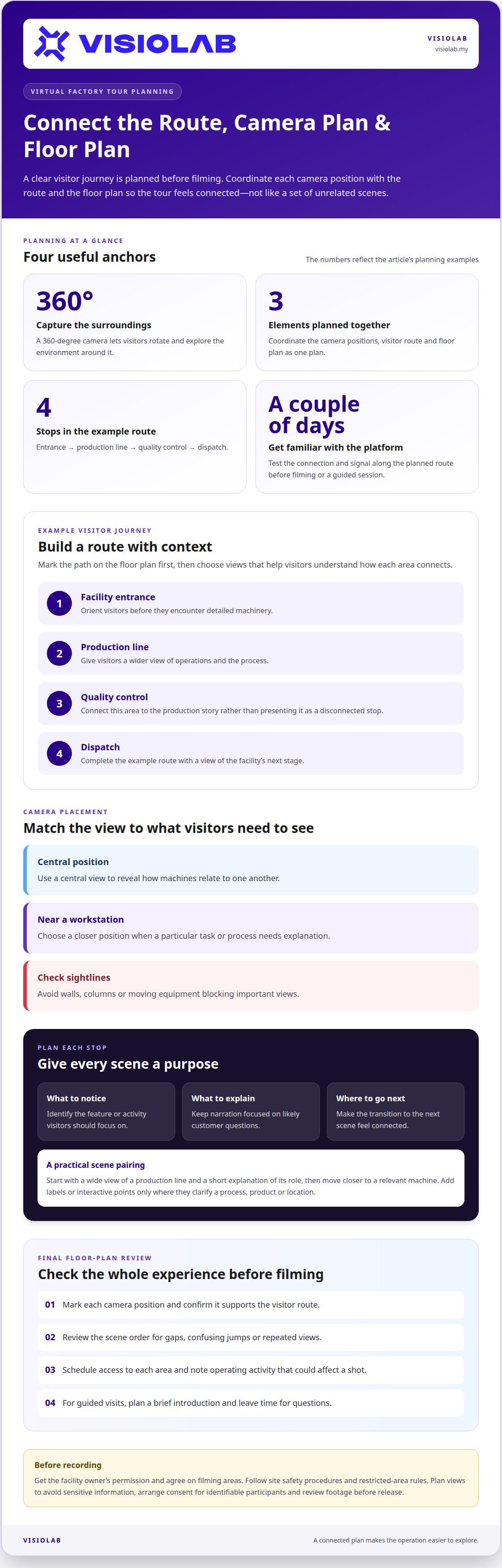
Plan the route before filming so each camera position supports a clear visitor journey. A floor plan helps connect production areas, key equipment, and transitions into a coherent view of the facility.
Start by marking the visitor’s path on the floor plan. For example, a route might move from the facility entrance to a production line, then to quality control and dispatch. This sequence gives potential customers context before they encounter detailed machinery. It also helps the production team identify where a 360-degree camera should capture the environment and where a closer view would explain a process more clearly.
Choose camera positions according to what each area needs to communicate. A central position can reveal how machines relate to one another, while a view near a workstation can show a particular task. Avoid placing the camera where walls, columns, or moving equipment block important sightlines. Mark each position on the floor plan, then review the route for gaps, confusing jumps, or repeated views. The aim is an immersive visit that feels connected, not a collection of unrelated scenes.
Production planning also means selecting equipment that suits the tour format and location. A 360-degree camera can capture the surrounding space, while a conventional video camera can record a directed explanation or close-up. A walkthrough may combine both. Before filming, the production team maps the route, schedules access to each area, and identifies operating activity that could affect a shot. These decisions help keep filming focused and allow the team to capture useful material without unnecessary stops.
A script and storyboard give each stop a purpose. For every camera position, note what visitors should notice, what explanation they need, and how the next scene connects. For example, a storyboard could pair a wide view of a production line with a short explanation of its role, then move to a closer view of a relevant machine. Keep narration focused on customers’ likely questions. Add labels or interactive points only where they clarify a process, product, or location.
Before filming, the team should become familiar with the tour platform a couple of days ahead. Test the connection and signal along the planned route to help prevent lag during a guided session. A final floor-plan review can confirm that camera positions, scene order, and narration align. For a guided visit, plan a brief introduction and leave time for attendees’ questions.
Clear route planning and visual storytelling work together: one guides movement, the other gives each stop meaning. For support shaping an immersive virtual experience, connect the floor plan, camera plan, and storyboard into one production approach.
A virtual factory tour lets potential clients explore a facility without arranging physical travel. For a Malaysian manufacturer speaking with a prospective buyer elsewhere in the country, a shared digital visit can provide an initial view before considering an onsite meeting. This makes it easier to introduce operations to people who cannot attend in person and gives the discussion a practical starting point.
The efficiency comes from giving visitors useful context before a sales conversation. A recorded tour can explain the production flow and show relevant work areas, allowing a meeting to focus on the customer’s questions instead of repeating a general introduction. For example, if a prospect wants to understand how a product moves through production, the team can direct attention to those stages and discuss the details.
Guided virtual visits can simplify scheduling across time zones. A sales team can conduct guided factory visits for clients on different continents in a single morning. Instead of organising separate onsite visits for every prospect, the team can use a shared route and adapt the conversation to each attendee’s priorities. This can be useful when the initial discussion concerns production capabilities or how departments work together.
Digital access can also reach stakeholders who would otherwise be difficult to gather at one site. Customers, partners, and internal decision-makers can explore the same facility experience at different times. A manufacturing company can use a tour to introduce selected operations to a new client, then share it with colleagues who join the decision later. A shared visual reference can help keep discussions focused.
Make the experience relevant to each audience. A potential customer may want to understand quality checks, while a supplier may need a broad view of receiving and production. Give each visitor a useful starting point and make the most relevant scenes easy to find. Clear labels and short explanations help people navigate independently and focus on details connected to their role.
A virtual tour can also prepare visitors for an onsite meeting. A client who understands the basic layout beforehand can use their time at the facility to explore questions that benefit from direct observation. The digital experience becomes a preview, not a substitute for every visit. A host can also use a guided session to explain selected scenes and make room for questions.
Use visitor behaviour to improve the experience: review which scenes attract attention and which questions arise afterward. If customers repeatedly ask about a process the tour only briefly shows, revise that section or add a clearer explanation. This turns engagement into practical insight. The goal is to help more people understand the facility, support better-prepared conversations, and use onsite time where it adds the most value.
A browser-based tour gives attendees access through a web browser on a suitable device. A VR headset can offer a more immersive walkthrough, with viewers looking around the captured environment. The right option depends on how attendees will join and what the experience needs to show.
Virtual factory tours can be hosted on a platform that supports interactive 360-degree content and shared through an access link. A company website or intranet can also present the tour when its setup supports the required experience. For VR access, use a delivery platform that supports the tour format and the intended headset. The exact platform choice depends on content compatibility, audience access, and how the tour will be shared.
For browser access, keep the invitation simple. Send attendees a link with a short note explaining what they’ll see and how to begin. For example, a customer evaluating a production facility could receive the tour before a sales discussion. The note can direct them to start at the facility overview, then explore the production area relevant to their questions.
Before sending invitations, the production team should test the full walkthrough on the devices the audience is likely to use. Open the tour in a desktop browser, then try a mobile device if attendees may use one. Check that navigation controls are clear, labels are readable, and key scenes load as intended. If the experience includes audio, test playback and captions where provided.
VR access needs a different introduction. Tell attendees how to enter the tour, move between scenes, and exit the experience safely. Keep instructions brief and place them before the first immersive view. A guided session can begin with a host explaining the route, then pause at selected areas for questions. Attendees using a browser can follow the same route without wearing a headset.
Access decisions also shape the invitation process. A link shared with external customers should lead to the intended tour, while an internal audience may use an intranet location. Explain whether the session is self-guided or hosted, and include a suggested starting point. This prevents first-time visitors from arriving in the middle of a complex process without context.
For a live virtual visit, test the connection and signal along the route before attendees join. Become familiar with the platform a couple of days before hosting, and allow time for questions during the session. If a scene loads slowly or a control confuses viewers, the host can guide attendees to the next stop while the team improves the experience.
A browser tour prioritises familiar access; VR prioritises immersive presence. Offering both can serve customers with different devices and preferences, provided each route is tested and the invitation explains what to expect. The goal is a clear first click, an easy-to-follow walkthrough, and an experience attendees can navigate without friction.
A virtual factory tour video keeps a facility accessible beyond scheduled visits. A prospective customer on another continent can explore at 2 a.m., without arranging physical travel. That access can introduce the site before a conversation and give visitors context for later discussions about production, machinery, or capability.
Availability is one advantage. A tour can remain accessible at any time of day, so customers in different time zones can explore when it suits them. A sales team can share the same facility overview with each prospect, creating a consistent starting point. For example, visitors can review the production sequence before a meeting and use that time to discuss their specific requirements.
The format can also make complex operations easier to explain. A broad view can establish where a process takes place; close-up footage can show a machine or work area in greater detail. Labels, narration, and selected scene transitions connect those views. This matters when a customer needs to understand how equipment fits into a wider manufacturing environment, rather than seeing machinery without context.
A recorded tour offers a repeatable presentation. Sales, recruitment, and stakeholder teams can share the same approved story instead of rebuilding an introduction for every visit. The focus can vary by audience: a prospective client may explore production capabilities, while a job candidate may benefit from seeing the working environment. One central experience can support these conversations while keeping the facility narrative coherent.
There’s also value in making the facility visible without opening every area to visitors. A planned route can showcase selected operations and explain them clearly, while avoiding restricted or irrelevant spaces. For example, a tour can focus on a production line and quality process, then use concise narration to clarify each stage. That control makes access a deliberate communication choice.
Businesses can measure engagement and ROI by tracking tour starts, completion, time spent, and interactions with key scenes, then connecting those signals to inquiries, meetings, and sales outcomes. Compare attributable commercial outcomes with the tour’s production and distribution costs to assess its contribution.
A virtual tour may support a shorter sales cycle by answering initial questions before a sales discussion. The cycle could shorten by weeks or even months when prospects gain useful information earlier, though the impact depends on the buying process and how the tour supports it. Track follow-up activity to see whether visitors move from exploration to a meaningful conversation.
Make each scene serve a business purpose: explain a process, show relevant machinery, or answer a customer concern. For a virtual experience designed around your facility and audience, talk with VISIOLAB about a virtual factory tour.
VISIOLAB’s Virtual Experience helps businesses present their facilities and operations through an engaging digital tour. It’s a natural fit when customers, partners, or stakeholders need to explore a site without relying on an onsite visit. A clear route and focused storytelling can help viewers understand what happens across the facility and why it matters.
For a broader message, Corporate Video can introduce the organisation, while Explainer and Training Video can clarify processes. ESG Video can communicate environmental, social, and governance initiatives. Each format serves a different purpose, so production should reflect the audience’s needs and the story the business wants to tell.
To discuss a virtual factory experience for your organisation, contact VISIOLAB.
Your factory has a story worth making accessible. Start by deciding what visitors should understand, which parts of the operation best demonstrate it, and how the experience can support your business goals. With that direction in place, creating a virtual factory tour becomes a focused storytelling project, not simply a way to document equipment and workspaces.
Consider how the experience will fit alongside your other communications. A tour can stand on its own or complement Corporate Video, Explainer and Training Video, and ESG Video content. The right combination depends on the people you want to reach and the message they need to take away. Start with the audience, shape the story around their needs, and let production choices serve that purpose.
Ready to shape a virtual visit around your facility and its story? Contact VISIOLAB to plan your tour. Give your operations a clearer perspective and invite more people to see what makes them distinctive.
A virtual factory tour combines captured views of a facility with digital navigation, giving remote visitors a way to explore selected spaces. The production team records the agreed areas, prepares the visual material, and arranges scenes into an accessible experience. For example, a customer assessing a component can move from its storage area to the production stage where it is used, building context before a technical discussion.
Common formats include still-image 360° tours, recorded video walkthroughs, guided live-streamed visits, and headset-based experiences. Each suits a different viewing situation: a self-guided photo tour supports independent exploration, while a host-led session allows attendees to ask questions in real time. A business can also combine formats, such as pairing a recorded overview with a scheduled discussion for customers who need more explanation.
Show areas that help visitors understand how the facility works, such as receiving, production, inspection, packaging, and dispatch. A tour might trace one product from incoming materials to its finished state, explaining the purpose of each stage. It can also introduce workplace practices or sustainability initiatives where relevant. Exclude sensitive information and areas that don’t support the visitor’s purpose.
Equipment depends on the format. A 360° tour needs a 360-degree camera and a stable support; a narrated walkthrough may also need a video camera and microphone. Production software can prepare and edit the captured material, while a compatible tour platform arranges scenes and navigation. The right setup depends on image quality needs, facility conditions, audio requirements, and whether visitors will use a browser or headset.
Begin by defining the visitor’s purpose and choosing the facility areas that serve it. Then map a logical route, mark camera positions, and plan what each scene should explain. Arrange site access and filming around operating conditions. Capture the scenes, review them for continuity and sensitive content, then assemble and test the tour on its intended viewing devices before sharing it with visitors.
Add hotspots to let visitors open relevant information at specific points, such as a machine label, process explanation, or related scene. Narration can guide attention and clarify details that images alone may not convey. Keep each prompt tied to the scene, and use concise language. For example, a hotspot beside a packaging line could explain its role, while narration introduces the next stage in the process.
Production time depends on the facility’s size, route complexity, access arrangements, filming conditions, and interactive features. A tour with multiple departments, equipment models, and extensive review requires different planning from a straightforward route.
Let’s create and collaborate
We’re versatile multitaskers, and we thrive on a lot of projects. You've seen a few of our works that we are most proud of, and your project could be next in line.

Empowering brands with captivating visual stories, creating strong connections and growth.
