
A polished launch film can still miss its goal if it has nowhere useful to go. A strong digital product launch video strategy isn’t built around one hero asset. It connects an audience insight to a set of videos designed for specific moments, needs and channels.If you’re unsure which formats your la...

A polished launch film can still miss its goal if it has nowhere useful to go. A strong digital product launch video strategy isn’t built around one hero asset. It connects an audience insight to a set of videos designed for specific moments, needs and channels.
If you’re unsure which formats your launch needs, how to turn views into meaningful action, or how to coordinate creative work with launch timing, you’re not alone. The answer isn’t simply to make more video. It’s to give each asset a purpose, from building awareness to explaining the product and guiding viewers to a relevant next step.
This guide shows you how to shape a coherent campaign, from audience research and message development to format selection, distribution and measurement. You’ll learn how to plan a core launch story, adapt it for the touchpoints your audience uses and choose measures tied to your objective. The result is a clearer sequence from insight to launch, with creative choices and channel plans working together.
• Set a launch objective first, then align the audience, message, video assets, channels and measures around it.
• Build your digital product launch video strategy as a connected set of assets, matching each format to an audience need and launch stage.
• Compare launch films, demonstrations, animations, short-form cutdowns and event content by the action each should encourage.
• Carry the strategy through briefing, scripting, production, review and channel adaptation to keep the campaign coherent.
• Choose measures that reflect your goal, such as qualified views, completion, click-through or a defined on-page action.
Creating attention is not the same as helping an audience understand a product or take a useful next step. A video may attract views yet leave people unclear about what the product does, who it’s for or why it matters. Start by deciding what the launch needs video to communicate, then build your creative choices around that purpose.
A digital product launch video strategy is the plan that links a launch objective, target audience, core message, video assets, distribution channels and measures of progress. It clarifies whether the campaign should build awareness, explain how a product works, support consideration, encourage adoption or meet another defined objective. That makes video one coordinated part of the wider go-to-market strategy, rather than a standalone film.
Be precise about what video can influence. A communication objective might be helping prospective users understand a key feature or guiding existing customers to an onboarding resource. Revenue, sign-ups and adoption are commercial outcomes shaped by multiple factors. Video can support them, but it can’t guarantee them on its own.
Before discussing style, length or production, translate the business goal into one clear communication objective. If a product is unfamiliar to its intended audience, for example, the campaign might explain the problem it solves and demonstrate its central benefit. If existing customers need to use a new feature, the focus may instead be showing where it fits into their workflow.
Align the people who will shape or approve the campaign before creative development begins. Product leaders can clarify what the product does, marketing can define the positioning and audience, and sales or customer teams can surface recurring questions. Leadership can confirm how the communication objective supports the launch goal. A shared brief gives everyone a reference point when creative decisions arise.
Describe what viewers already know, what they may question and where they are in the launch journey. An unfamiliar prospect may need a plain-language introduction to the problem and the product’s value. An informed existing customer may need a closer look at a specific feature or a clear route to start using it. One campaign can serve both groups, but the message should reflect their different needs.
Choose one primary next action for each audience and asset. That might be exploring product details, watching a demonstration, registering for a launch event or beginning an onboarding step. Match the action to the objective: an awareness video shouldn’t demand the same commitment as a product walkthrough. This gives the campaign a practical foundation for choosing formats, channels and measures.
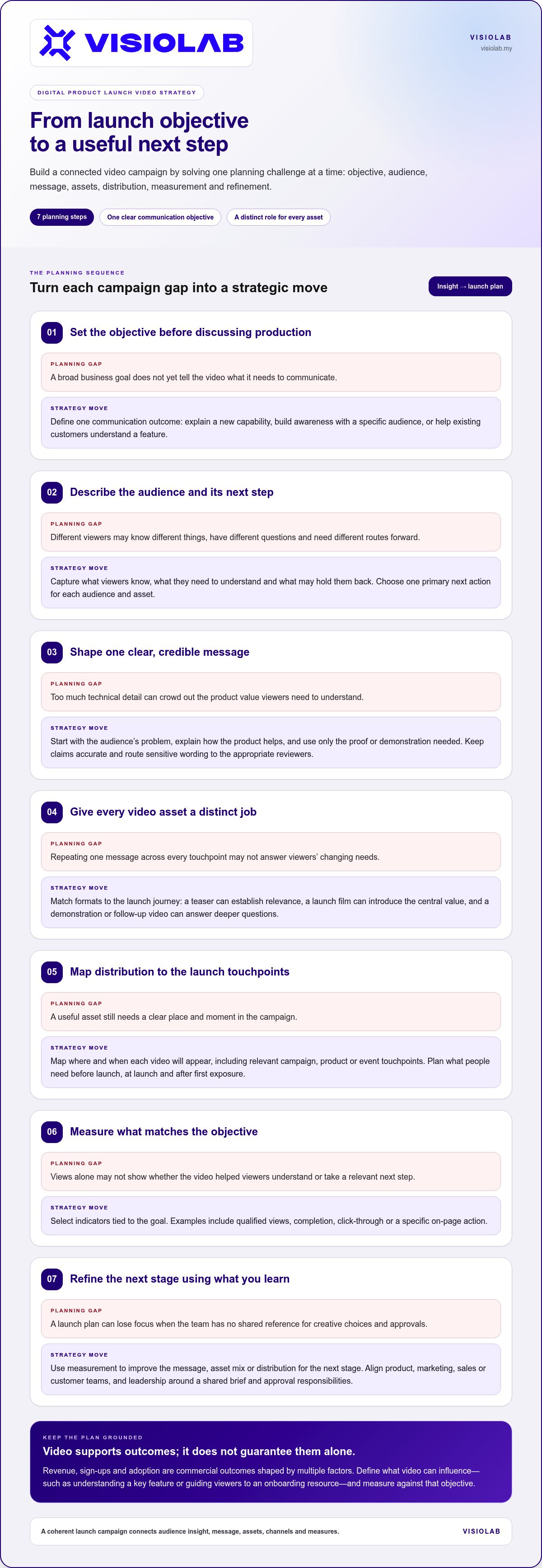
A launch campaign holds together when each decision guides the next. Use this sequence to move from business intent to a practical plan, then keep stakeholders aligned around a shared brief. By clarifying the objective, audience, key message, required assets and approval responsibilities before production, you can reduce late changes and keep the work focused.
Define the communication outcome the videos should support, such as explaining a new capability or building awareness among a specific audience.
Capture what viewers know, what they need to understand and what might prevent them from taking the next step.
State the product’s defining value in clear, audience-centred language. Choose only the proof or demonstration needed to make it credible.
Give each video a distinct role in the launch journey. Consider product launch video formats as you match storytelling approaches to audience needs.
Map where each asset will appear and when, including relevant campaign, product or event touchpoints.
Select indicators that reflect the objective, such as qualified views, completion, click-through or a specific on-page action.
Use what the measures reveal to improve the message, asset mix or distribution for the next stage.
Start with the audience’s problem, then explain how the product helps address it. If a feature needs context, show it in a relevant use case instead of crowding the script with technical details. Keep product claims accurate, and route technical, legal or compliance-sensitive wording to the appropriate reviewers. This gives creative teams room to make the story engaging without blurring what the product can do.
Plan what people need before launch, at launch and after their first exposure. A teaser can establish relevance; a launch film can introduce the central value; a demonstration or follow-up video can answer deeper questions. Assign each asset a different job instead of repeating one message everywhere. A broader strategic corporate video approach can connect those creative choices with disciplined production.
For smoother execution, agree on who owns the message, who reviews product details and who gives final approval. VISIOLAB brings strategic messaging and production discipline together to translate product complexity into clear visual communication. Explore VISIOLAB’s corporate video approach to see how video planning can support organisational goals.
The right mix depends on what the product needs explaining, how the audience prefers to engage, what source material is available and which launch objective matters most. Treat each format and channel pairing as a hypothesis: decide what role it should play, then review the response against your campaign measures. No format guarantees reach or action.
| Asset type | Audience need | Launch stage | Channel fit | Intended next action |
|---|---|---|---|---|
| Flagship launch film | Understand the central story and value | Announcement or launch | Website, product page, launch event | Explore the product |
| Product demonstration | See how a feature or workflow works | Launch and consideration | Product page, email, sales presentation | View details or request a demonstration |
| Explainer animation | Make an abstract or complex idea easier to follow | Pre-launch education or launch | Website, social channels, presentations | Understand the core concept |
| Short-form cutdown | Get one focused message quickly | Awareness and campaign reminders | Social platforms and paid placements | Watch more or visit the product page |
| Event or virtual experience content | Experience a launch presentation or explore a product environment | Launch day and follow-up | Digital event, event page, follow-up email | Attend, explore or continue learning |
A flagship film gives the campaign a recognisable central asset and establishes its launch story. A demonstration is more useful when viewers need to see the product in action; an explainer animation can clarify a process or concept that’s difficult to film. Short-form adaptations can focus on one benefit or question for concise placements. Give every asset its own message and next step, rather than simply shortening the same script and repeating it everywhere.
Choose channels based on where the audience is likely to encounter the message and what they need to do next. Owned channels, such as a product page or email, can carry deeper context; social and paid placements can introduce a focused idea and direct viewers to more information. Adapt framing, captions, aspect ratio and calls to action to each placement’s requirements. For a digital event, consider how virtual experience production can support the launch presentation and audience journey.
Use early responses to test the assumptions behind your digital product launch video strategy. If viewers engage with a short clip but don’t continue to the product page, review the hand-off, message and destination. If a demonstration prompts questions, use those questions to inform follow-up content. The goal is a coordinated asset mix that learns and adapts, not a fixed set of deliverables.
A clear plan can still lose its purpose if production, approvals and distribution happen in separate silos. Keep the objective visible from the first brief to the final review. A strong video can’t guarantee launch results, but a connected workflow makes its role clear and its contribution easier to assess.
Before production begins, document the audience, communication objective, core message, intended action, required assets and approval process. Confirm who owns product details, who reviews sensitive claims and who makes the final decision. This reduces conflicting feedback and gives the team a shared standard for assessing creative choices.
Plan the main asset and its channel adaptations together. A product demonstration, for example, may need a full version for a product page and shorter edits for campaign placements. Scripting and storyboarding help the team test whether the story is easy to follow before production. Schedule review checkpoints for the script, storyboard, rough cut and final delivery so technical or compliance-sensitive wording can be addressed early.
Deliver each version with its intended placement in mind. Check that the framing, captions, call to action and destination align with the channel and the audience’s next step. The message should feel consistent across assets, even when the format changes.
Choose indicators based on what each video is meant to do. Separate them into three layers:
qualified views and how long viewers stay with the video.
completion, click-through or engagement with a relevant element.
a defined on-page action, such as visiting product details or starting an onboarding step.
Views are an attention signal, not proof of business impact. Interpret them alongside the campaign context: who saw the asset, where it appeared, what action it invited and whether the destination supported that action. A high view count with little movement to the next step may point to a mismatch between the video’s promise and its call to action, or between the asset and the placement.
Use available analytics consistently, and verify each platform’s current measurement capabilities before setting reporting expectations. Review the response to identify useful edits, distribution adjustments or questions that future launch communications should answer. That learning loop is part of a practical digital product launch video strategy: measure, interpret and refine rather than treating delivery as the finish line.
VISIOLAB combines strategic messaging with disciplined production. Explore VISIOLAB’s strategic video production.
A strategy is ready for production when its decisions connect: the audience knows what matters, each asset has a role, and the team understands how the campaign will be delivered and assessed. Use this checklist to spot gaps before production moves into final delivery.
Is the communication objective clear, and does it reflect what the intended audience already knows?
Can the team state the central message simply? Is the audience’s next action specific and appropriate to the launch stage?
Does each asset have a distinct role before launch, at launch or in follow-up? Is its intended channel identified?
Are product details, sensitive claims and final creative decisions assigned to the right stakeholders?
Is there a plan for publishing and adapting each asset, with indicators tied to its purpose?
If an item is unresolved, address it in the brief rather than leaving the production team to interpret it. Clear decisions make reviews more focused and help keep the message consistent across formats.
Complex products and organisational messages need more than attractive visuals. VISIOLAB brings strategic messaging and production discipline together to translate complexity into clear visual content. Depending on the audience and campaign, a connected plan can draw on launching videos, corporate films, animations, event coverage or virtual experiences, with each asset serving a defined role rather than acting as an isolated film.
That planning can also support broader campaigns. A commercial can introduce a product benefit, while other assets explain how it works or carry the story into a launch event. Keep the creative approach and production workflow connected to the same message, even as content is adapted for different touchpoints.
With the audience, message, assets, channels, approvals and measures aligned, your digital product launch video strategy has a practical foundation for execution. Explore VISIOLAB’s commercial video production guide for broader campaign planning. To discuss a digital launch video project, share your launch objective and audience with VISIOLAB and start shaping the campaign around what they need to see.
A successful launch campaign is more than a polished film. It connects an audience need to a message, a purposeful mix of video assets, relevant distribution points and measures that show whether viewers are taking the intended next step.
Build from the objective, not the camera. Give each asset a distinct role across the launch journey, and assess attention alongside meaningful actions. That structure helps your digital product launch video strategy stay coherent from the first brief through production and refinement, without treating video as a guarantee of commercial results.
VISIOLAB has worked with corporate, GLC, MNC and government organisations since 2016, bringing strategic messaging and production discipline together. Its capabilities include launching videos, corporate films, animations, event coverage and virtual experiences, planned to make complex ideas clearer across relevant touchpoints.
Have a product launch ahead? Discuss your digital product launch video strategy with VISIOLAB and start shaping a campaign around what your audience needs to understand. A clear story is a strong place to begin.
A digital product launch video strategy is a plan that connects a launch objective with audience needs, messaging, video assets, distribution channels and measures. It defines what each video should help viewers understand or do, and how the campaign will assess their response. Rather than relying on a single polished film, the strategy coordinates relevant content across the launch journey, from initial awareness to product understanding or adoption.
Start by setting one communication objective, then identify the audience and what they need to know at that stage. Shape a clear central message, choose supporting proof or a demonstration, and assign each asset a role in the campaign. Next, map distribution, approvals and measures before production. For example, a new feature launch might pair a short introduction with a detailed walkthrough, each leading to a relevant next step.
Choose videos according to the product, audience and campaign objective. A flagship launch film can establish the central story; a product demonstration can show a feature in action; and an explainer animation can clarify an abstract or complex idea. Short-form cutdowns can focus on one benefit for concise placements. Event or virtual experience content may support a launch presentation. Each asset should answer a distinct audience need rather than repeat the same message.
Measure success against the video’s assigned objective, not views alone. For awareness, review qualified views and viewing duration; for interaction, consider completion or click-through; for action, track a defined step such as visiting product details or starting onboarding. Interpret results in context, including the audience, channel, message and destination. Video can support commercial goals, but metrics should distinguish audience response from business outcomes influenced by other factors.
Use one video when a single asset can clearly serve the audience and campaign objective. Use several when viewers need different information across launch stages or channels. A flagship film might introduce the product, while a demonstration answers practical questions and short edits highlight specific benefits. The goal isn’t to create the largest asset library; it’s to give each video a distinct role and keep the core message consistent.
Begin planning once the launch objective, product positioning and intended audience are clear, before production decisions are locked in. Early planning gives stakeholders time to agree on the message, identify necessary assets, assign approvals and prepare distribution. It also creates room to resolve technical or sensitive claims during scripting and review. If planning starts late, teams may face rushed approvals or assets that don’t fit their intended channels.
Yes, a launch video campaign can span channels if each asset is adapted to its placement and audience context. A product page can provide room for a fuller explanation, while social posts or email may call for a more focused edit and a clear route to further information. Keep the central message consistent, but tailor framing, captions, format and call to action to each channel’s current requirements.
Let’s create and collaborate
We’re versatile multitaskers, and we thrive on a lot of projects. You've seen a few of our works that we are most proud of, and your project could be next in line.

Empowering brands with captivating visual stories, creating strong connections and growth.
