
A polished ESG video can still miss its mark. An effective ESG video content strategy for PLCs connects each story to existing commitments, reveals the company’s distinctive expertise, supports progress and challenges with evidence, and responds to audience sentiment. Bursa Malaysia introduced enhan...

A polished ESG video can still miss its mark. An effective ESG video content strategy for PLCs connects each story to existing commitments, reveals the company’s distinctive expertise, supports progress and challenges with evidence, and responds to audience sentiment. Bursa Malaysia introduced enhanced sustainability reporting requirements for Main Market and ACE Market listed companies on 26 September 2022, making clear, consistent communication an important part of how PLCs explain their ESG priorities.
That alignment matters: audiences want more than polished claims. They want to understand what a company is doing, where it is making a difference, and what work remains.
This guide shows how to shape ESG videos around your commitments and business goals, choose a perspective your company can credibly own, and communicate results without glossing over limitations. It also explores how evidence, stakeholder input and audience feedback can make ESG content clearer and more distinctive for Malaysia’s market.
• Connect each video to existing ESG commitments and business priorities so public messaging reflects what the company is working to achieve.
• Find a distinctive point of view by identifying where your expertise can educate stakeholders and contribute to industry conversations.
• Build trust by pairing evidence of progress with candid explanations of challenges, limitations, and corrective steps.
• Map direct stakeholders and affected communities, then use their feedback to shape relevant content and future video topics.
• Choose ESG topics and video formats around audience needs, from clear explainers to stories that make complex initiatives easier to understand.
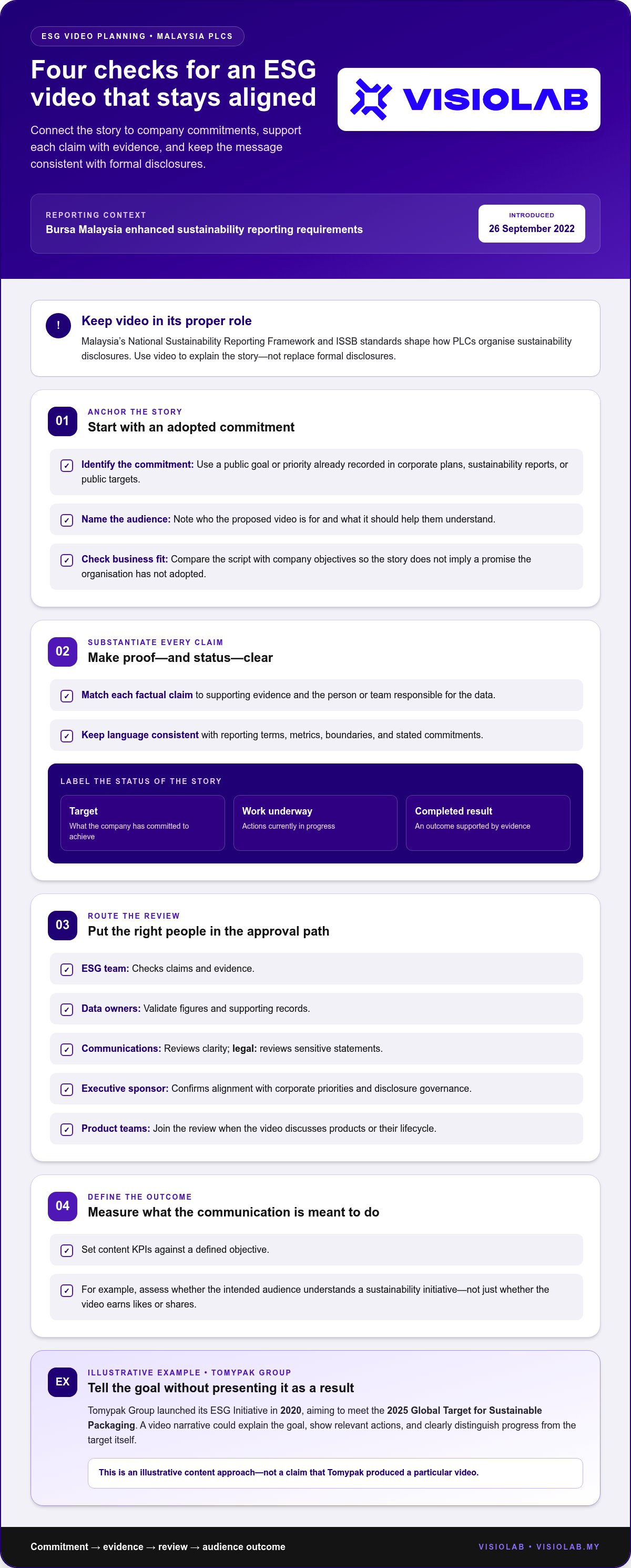
Malaysia’s National Sustainability Reporting Framework and ISSB standards shape how PLCs organise sustainability disclosures. Keep video claims consistent with the company’s reporting language, metrics, boundaries and stated commitments. Use video to explain the story, not replace formal disclosures.
Before publishing ESG videos, document the review path: the ESG team checks claims and evidence, data owners validate figures, communications reviews clarity, and legal reviews sensitive statements. An executive sponsor confirms alignment with corporate priorities and disclosure governance. Involve product teams when the video discusses products or their lifecycle.
Start with commitments already recorded in corporate plans, sustainability reports and public targets. For each proposed video, note the commitment, audience, available proof and intended action. Then compare the script with the company’s business objectives. This alignment check helps prevent a compelling visual story from making a promise the organisation has not adopted.
Bursa Malaysia introduced enhanced sustainability reporting requirements for Main Market and ACE Market listed companies on 26 September 2022. Treat that reporting context as a prompt to keep video language consistent with the company’s disclosures. Match each important statement to supporting evidence, and make the distinction clear between a target, work underway and a completed result.
Tomypak Group offers a useful example of translating an existing commitment into a clear narrative. The group launched its ESG Initiative in 2020, aiming to meet the 2025 Global Target for Sustainable Packaging. A video strategy could explain the goal, show relevant actions, and distinguish progress from the target itself. This is an illustrative content approach, not a claim that Tomypak produced a particular video.
Executive buy-in connects public messaging with internal ESG commitments. Give leaders a concise brief linking the proposed story to business priorities, evidence and the company’s reporting position. Set content KPIs against a defined objective. For example, measure whether the intended audience understands a sustainability initiative, not just whether the video earns likes or shares.
Build a practical alignment checklist before scripting:
Identify the public goal or priority the video will explain.
Match each factual claim to a data owner and supporting record.
Route the script and visuals through ESG, communications, legal and executive review.
Choose a KPI that reflects the communication goal and audience response.
Together, these steps give Malaysian PLCs a repeatable foundation for an ESG video content strategy for PLCs: a clear commitment, a coherent message and evidence for every claim.
A Malaysian PLC can stand out through expertise it can demonstrate, not claims that merely sound impressive. Compare peer companies’ ESG topics, viewpoints and audience responses. Note which issues are clearly explained, which perspectives feel familiar, and where stakeholders still need practical guidance. This can reveal opportunities for original content without turning the exercise into a contest of slogans.
Next, connect potential themes to capabilities the company can evidence. A manufacturer might explain how design choices affect material use, while a financial institution could clarify how governance shapes responsible decisions. These are examples, not claims about specific Malaysian companies. For each idea, identify the people, processes and records that can support the story. If a theme has no clear link to demonstrated expertise, refine it before scripting.
Use a three-step exercise to find a distinctive angle. First, list the organisation’s ESG initiatives and the teams responsible for them. Second, map each initiative against audience questions and common industry coverage. Third, choose a topic where the company can offer a specific lesson, credible viewpoint or actionable resource. This gives each video a purpose beyond repeating familiar sustainability language.
Compare peer communications to spot topics that receive attention but little practical explanation.
Frame the issue through a capability, process or lesson the company can substantiate.
Give viewers a clear takeaway, such as a practice they can apply or a question they can ask.
Ask internal specialists and external experts whether the narrative reflects real expertise and sound governance.
Validate the narrative before production. Bring together relevant stakeholders, such as ESG, product, communications and legal teams, and invite external experts to challenge assumptions. A video about supplier engagement, for example, should distinguish the company’s own approach from broader industry advice. This review can sharpen the message and flag claims that need more context.
Measure value beyond views. A video may prompt useful industry conversations, create partnership opportunities or lead to invitations to speak on thought leadership. Track those outcomes alongside audience response and the video’s original objective. Success is not simply visibility; it is also a clearer understanding of what the company contributes.
Once a distinctive angle is clear, a focused ESG video narrative can turn specialist knowledge into an accessible story. Keep the central idea specific, useful and grounded in evidence.
ESG content can position a company as an educator by sharing actionable resources, standards and best practices that help advance its industry. This lets the company contribute practical knowledge while giving audiences material they can use beyond the video. Keep the educational value grounded in expertise the company can demonstrate, rather than broad claims.
Before publication, validate the distinctive ESG narrative with key stakeholders and external experts. Their review can help ensure the perspective is credible and useful. Assess broader outcomes too, such as industry conversations, partnerships and invitations to speak on thought leadership. These complement audience response when judging whether the content contributes beyond visibility.
Trust grows when ESG reporting presents evidence, progress and limitations together. For Malaysian PLCs, each video should explain what has been achieved, what remains difficult and what comes next.
PLCs can make claims about documented actions, measured outcomes and progress against stated goals. Support each claim with evidence that matches its scope, timeframe and wording, such as an approved dataset, project record or published target.
For example, a company describing packaging improvements should specify which products or operations the claim covers. Avoid broad statements such as “fully sustainable” when the evidence supports only a specific initiative. Clear context helps viewers understand what the evidence actually shows.
Incomplete data, delayed targets and uneven progress can complicate an ESG story. Inaccurate or exaggerated video claims can undermine trust and conflict with corporate reporting, especially when visuals imply results beyond the evidence.
Reduce these risks with a clear review trail: assign an owner to each claim, attach supporting records and compare the final script with current disclosures. Include limitations and corrective actions instead of presenting a flawless picture.
A useful script separates three stages: commitment, action and result. State the target, describe the work underway, and show measured outcomes only when the evidence supports them. If progress has fallen short, explain the gap and the steps being taken. This gives viewers a fuller account than a success-only montage.
Show the initiative’s lifecycle, not just its most photogenic moment. For a product-related story, consider material sourcing, manufacturing and what happens after sale. A video about a recycling programme, for instance, should distinguish collection activity from verified reuse or recovery outcomes. These details help audiences judge the claim’s actual reach.
Pair each statement with the record or data that supports it.
Name the product, operation or initiative covered by the claim.
Describe delays or underperformance and the corrective action underway.
Check narration, captions and visuals against the same evidence.
Train content teams to recognise greenwashing and purpose-washing. A positive tone can still be pragmatic: show meaningful action, avoid implying universal impact, and make limitations visible. This matters especially when compelling visuals could suggest more than the data establishes.
Before release, ask whether viewers can identify the claim, its evidence and its limits. If not, revise the wording or visuals. A transparent ESG video makes progress understandable without disguising the work still ahead.
Start with the people affected by each initiative, then shape the message around their questions. Investors, employees, customers and nearby communities need different levels of detail and different reasons to engage.
For investors, use concise explainers that connect ESG priorities to governance, risks and business decisions. Employees may respond better to practical stories showing how a workplace initiative affects daily processes. Customer-facing videos can clarify product impacts, such as material sourcing or emissions, using plain language and visible evidence.
Audience mapping should include direct stakeholders and broader community groups affected by company activities. For a manufacturing PLC, that could mean investors, staff, suppliers, customers and communities near operating sites. Bursa Malaysia’s ESG programme survey received responses from 103 PLCs; 60% of those respondents had a market capitalisation below RM1 billion. That context reinforces the value of right-sized communication, rather than assuming every PLC has the same resources or audience needs.
Research sentiment before choosing a script angle. Review stakeholder questions, public feedback, employee comments and recurring concerns about the initiative. Group responses by audience and topic. If customers ask about packaging disposal while employees ask about implementation, address those needs in focused videos instead of forcing them into one message.
List people directly involved and communities affected by the initiative.
Review feedback and identify recurring concerns, such as emissions or sourcing.
Match detail and tone to the audience’s knowledge and decision.
Provide a clear way for viewers to share questions and feedback.
Measure performance against the video’s defined purpose. For investor education, track meaningful engagement with the content and questions raised; for employee communication, assess understanding through feedback; for customer content, monitor responses related to the initiative. Views, likes and shares can show reach, but they do not prove that audiences understood or trusted the message.
Make versions for Malaysian audiences accessible with accurate captions, readable on-screen text and a transcript. Choose English or Bahasa Malaysia according to the audience, and consider other language versions when stakeholder research shows a clear need. Keep technical terms consistent across versions. For example, explain an emissions measure in plain language rather than relying on unexplained acronyms.
Review audience responses after release and use the findings to improve the next video. If viewers repeatedly misunderstand a claim or ask for evidence, clarify the explanation and make the supporting context easier to find. This feedback loop makes sentiment research a practical planning tool, not a one-off pre-production exercise.
Choose topics based on the company’s actual impacts, business priorities and stakeholder questions. Malaysian PLCs can use sustainability videos to explain environmental action, people-focused programmes and governance practices, connecting each story to evidence and audience needs.
Environmental topics can cover energy use, emissions, water, waste, packaging and climate-related plans. A manufacturer might show how materials move through production, or explain a packaging initiative from sourcing through disposal. Make the scope clear: specify which operations or products a claim covers, and distinguish a target from measured progress. Malaysia’s government has committed to carbon neutrality by 2050, giving climate action a national context without making every company’s pathway identical.
Social topics can make workplace and community impacts visible. Consider employee development, workplace safety, supplier relationships, accessibility or the effects of operations on nearby communities. A training video, for example, can explain what employees learn and how the programme fits daily work. Keep people’s experiences specific and respectful; personal stories should not substitute for evidence about a programme’s reach or outcomes.
Governance topics can explain how ESG decisions are made and monitored. Show how responsibilities are assigned, how concerns are escalated, or how a sustainability priority informs business decisions. Financial institutions may also explain the Climate Change and Principle-based Taxonomy for Malaysia’s financial sector, published by Bank Negara Malaysia in April 2021. It sets out five guiding principles for assessing and categorising economic activities.
Use a topic filter before developing scripts:
Link the subject to an operational impact, commitment or strategic priority.
Identify who needs the explanation and what question the video answers.
Match the topic to records, data or first-hand expertise.
Choose a process, decision or practical example that makes the subject clear.
Build a balanced editorial plan. A PLC might pair an emissions explainer with a workplace training story and a governance walkthrough. This creates variety without treating ESG as a single campaign or using the same format for every issue. Review the plan as priorities and stakeholder concerns evolve, and give each new topic a clear purpose.
Turn your priority topics into clear, evidence-led stories with an ESG video content plan shaped around your audiences and commitments.
Research cultural, economic and social trends to keep topic choices grounded and avoid engaging with ESG superficially or opportunistically. Compare competitors’ topics, viewpoints and audience responses to identify gaps and opportunities to differentiate. Cover product lifecycles transparently, from material sourcing and manufacturing to what happens after sale. These checks help a video explain an initiative’s intent, boundaries and relevance.
The wider market offers useful context for planning. FTSE Russell annually assesses and rates about 40% of main market PLCs in Malaysia for ESG performance. Bursa Malaysia invited over 100 PLCs in the FTSE Bursa Malaysia EMAS Index to take part in its ESG programme survey. Bursa Malaysia, Alliance Bank Malaysia and OCBC Bank Malaysia signed a memorandum of understanding on Nov 18 to establish the #financing4ESG initiative. Such developments can inform editorial choices, while each PLC should keep its account tied to its own evidence and stakeholders.
VISIOLAB helps Malaysian PLCs turn complex ESG commitments into clear, audience-focused visual stories. Its ESG Video service can present an initiative, explain its evidence and show progress in a format stakeholders can follow.
Choose the format to match the communication task. A Corporate Video can place sustainability priorities within the wider company story. An Explainer and Training Video can clarify a process or help employees understand an initiative. A Safety Video can communicate workplace practices. Each format has a distinct purpose, so start with the audience, message and evidence you want to convey.
Bring VISIOLAB in when your team is ready to turn a specific ESG story into video. Contact VISIOLAB to discuss your project, or visit visiolab.my.
Start by choosing one audience decision your video should support. A focused ESG video content strategy for PLCs can turn that priority into a clear creative brief: define the viewer, the message they need and the action or understanding you want to encourage.
VISIOLAB can shape that brief into an ESG Video, Corporate Video, or Explainer and Training Video, depending on the story and its audience. Bring a priority initiative and its supporting material into the conversation, then develop a direction that fits your organisation’s voice and communication goals.
Contact VISIOLAB to plan your ESG videos and give your next sustainability story a purposeful start. Clear intent creates stronger stories, and stronger stories can move meaningful work forward.
Let’s create and collaborate
We’re versatile multitaskers, and we thrive on a lot of projects. You've seen a few of our works that we are most proud of, and your project could be next in line.

Empowering brands with captivating visual stories, creating strong connections and growth.
