
Could a strong tender video fall short before anyone watches it because its file or delivery misses an instruction? In Malaysia, government tender video submission requirements are set out in the specific tender brief. Assumptions about format, duration, language or submission method can put a compl...

Could a strong tender video fall short before anyone watches it because its file or delivery misses an instruction? In Malaysia, government tender video submission requirements are set out in the specific tender brief. Assumptions about format, duration, language or submission method can put a compliant bid at risk.
It’s understandable to feel uncertain when creative expectations sit alongside precise technical directions. The goal isn’t simply to make a polished video. It’s to meet every stated requirement while presenting your organisation’s story clearly and purposefully.
This practical 2026 checklist will help you locate the tender’s exact instructions, prepare the video and supporting files, and complete a documented final review before submission. You’ll learn what to verify, from content and file specifications to naming and delivery, without treating one tender’s rules as a standard for every opportunity. Strategic planning and production discipline help bring compliance and compelling storytelling together.
• Use the tender brief as the source of truth for government tender video submission requirements. Don’t assume one set of rules applies to every opportunity.
• Turn each instruction into a compliance matrix that records its source, owner, deadline and completion status.
• Review submission compliance, playback reliability and audience-facing quality as separate parts of the video check.
• Before submitting, confirm the required specifications and assign clear owners for approvals, technical checks, export and upload.
• Translate verified tender requirements into a focused production brief so the video’s message and execution stay aligned.
A video can be clear, persuasive and professionally produced, yet still miss the mark if it doesn’t follow the tender’s instructions. For Malaysian bidders, government tender video submission requirements are the tender’s stated rules for the video’s content, files, delivery method and evaluation. They may define what the video needs to communicate, how it should be supplied and what reviewers will assess.
Those details are tender-specific. General guidance about government procurement, the process through which the state purchases goods, works or services, can provide context, but it can’t replace a project’s own instructions. As a practical rule: The published tender documents take precedence over generic video checklists.
Assumptions can lead to preventable mismatches. A bidder might prepare a short video when the brief sets a different duration, use a familiar file format that isn’t accepted, choose a language that doesn’t meet the stated requirement or upload through an unspecified platform. Don’t treat common practice as permission. Verify each detail against the current documents for that tender.
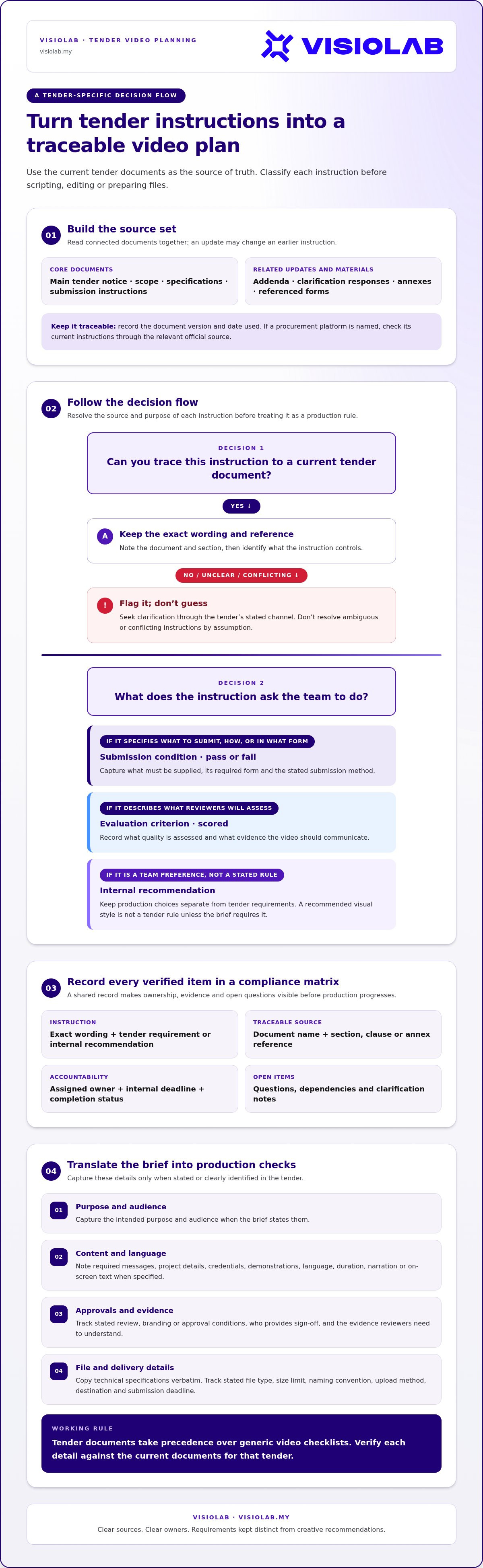
Begin with the main tender notice, scope, specifications and submission instructions. Then review addenda, clarification responses, annexes and referenced forms. An update may change an earlier instruction, so record the document version and date you used. If the tender names a procurement platform, check its current instructions through the relevant official source. The platform’s general process should not be mistaken for the tender’s creative specifications.
Read the documents as one connected brief. The scope may explain the video’s purpose, while an annex or submission form may specify supporting materials or delivery details. For broader context, Government procurement describes the general purchasing process, but the tender documents remain the working reference for your video submission.
Separate pass-or-fail conditions from scored criteria. A mandatory condition may specify that a file must be included or submitted through a stated channel. A scored criterion may assess how clearly the video communicates the proposed approach. Record each item’s exact wording, the evidence requested and its document reference. If instructions appear ambiguous or conflict, flag the issue and seek clarification through the tender’s stated channel rather than resolving it by guesswork.
What must be supplied, in what form and by which stated method?
What qualities will reviewers assess, and what evidence should the video communicate?
Which document, section or clarification supports your interpretation?
This separation helps the team protect compliance without flattening the story. Once the rules are clear, creative decisions can serve the intended audience and evaluation criteria instead of competing with the submission conditions.
Turn the tender instructions into a working compliance matrix before scripting or editing begins. This makes government tender video submission requirements visible to everyone responsible for the submission and helps distinguish tender requirements from production recommendations.
For each instruction, record its exact wording, document and section reference, assigned owner, internal deadline and status. Add a notes field for questions, dependencies or clarifications. Mark each item as either a tender requirement or an internal recommendation. For example, a team may recommend a particular visual style, but unless the brief requires it, that choice shouldn’t be recorded as a tender rule.
Capture these only when stated or clearly identified in the brief.
Note required messages, language, duration, narration or on-screen text when specified.
Record any stated review, branding or approval conditions, including who must provide sign-off.
Track file type, size limit, naming convention, upload method, destination and submission deadline.
Keep the matrix traceable. A requirement linked to a specific clause or annex is easier to verify than a note based on memory. For wider context on the 2026 procurement environment, the Malaysia's Public Procurement Laws and Regulations 2026 overview is a useful reference, but it doesn’t replace the instructions for an individual tender.
List the required messages, project details, credentials, demonstrations and supporting evidence named in the brief. Then connect each item to an evaluation criterion: what should reviewers understand, and what visual or spoken evidence will make it clear? Check specifically for requirements such as subtitles, narration, on-screen text, branding or approval. Don’t assume these are mandatory simply because they’re common production choices.
Plan for clarity, not just inclusion. If a tender asks for a demonstration, identify the relevant proof point and how the video will show it without crowding the message. If a credential or project detail is requested, verify its source internally and assign someone to approve its use. This turns evaluation criteria into practical creative decisions while keeping claims grounded in the requested evidence.
Copy technical specifications verbatim into the matrix and cite where each appears. Don’t replace a stated term with a familiar equivalent or infer missing settings. Track the final file, its name, upload destination, access permissions and receipt confirmation as separate checks. A file can meet its technical specification and still be submitted incorrectly if the destination or naming instruction is missed.
Once verified, the checklist can guide a focused production plan. Explore strategic corporate video production for an approach that aligns messaging and production decisions with the brief.
A tender video has three distinct tests: it must meet the stated submission conditions, play reliably and communicate evidence clearly to its intended audience. Treating these as separate review layers helps the team catch a technical issue without mistaking it for a content weakness, or vice versa. Each layer has a different purpose.
| Layer | What to check | What success looks like |
|---|---|---|
| Submission compliance | Required file specifications, duration, naming, delivery method and other stated conditions | The final deliverable matches the tender instructions |
| Playback reliability | Whether the file opens and plays with its audio, captions and visuals intact | Reviewers can access and watch it as intended |
| Audience-facing quality | Whether the story presents relevant evidence clearly and addresses evaluation criteria | Reviewers can follow the message and understand its support |
Technical compliance enables review, while clear evidence helps evaluators understand the message. Neither layer substitutes for the other. A compelling story can’t fix a file that fails a stated requirement, and a technically correct export can’t make an unsupported claim persuasive.
Use only the tender’s stated export settings. Before export, verify the required codec, container, resolution, file-size limit and duration against the current documents. These specifications vary by tender, so don’t assume a familiar setting is acceptable. If your team prepares an alternate export internally, label it as a contingency, not as a tender requirement or a substitute for the requested file.
Then test the final file, not just the editing timeline. Open it on a separate device and check the beginning, middle and end. Confirm that audio is audible, captions appear correctly if included, and on-screen text remains legible. Make sure the file opens without restricted access, missing media or unexpected playback dependencies. A successful export is only the starting point.
Map each relevant criterion to a specific scene, statement, demonstration or supporting visual. This creates a clear line from what the tender asks evaluators to assess to what the video actually shows. Avoid generic claims when a concrete, approved example or demonstration can make the point easier to understand.
Keep every statement consistent with the written bid and approved project information. Motion graphics can clarify a process or relationship, while documentary-style visuals can show relevant activity. Use either only when it supports the requested evidence, rather than adding visual polish that distracts from it.
Record the exact evaluation point.
Identify the scene or statement that addresses it.
Check that the supporting information is accurate and approved.
Review the three layers independently, then watch the complete video as an evaluator would. Does it meet the stated requirements, play as intended and make its evidence easy to follow?
A final review should follow a fixed sequence, not depend on whoever happens to be available before the deadline. For government tender video submission requirements, assign a named person to each hand-off: content approval, technical review, final export and upload. One person may hold more than one role, but every responsibility needs a clear owner.
Use this ordered check before the submission is locked:
Compare the exported video and accompanying materials against every relevant row in your compliance checklist. Resolve gaps by referring to the tender documents.
Have the content owner verify names, figures, claims, captions, logos and spelling against approved information and the written bid.
Have the technical reviewer check audio levels, visual consistency, playback, duration and file characteristics against the tender’s stated specifications.
Confirm the export owner has saved one approved master file with a clear version identifier. Remove or clearly separate outdated drafts so they can’t be mistaken for the submission file.
The upload owner should follow the stated tender process, check the portal status and retain permitted evidence of submission, such as an available confirmation or receipt.
Review the actual exported file and every required accompanying item, not just the project timeline or a preview. Check spellings, figures, names, logos, claims and captions. Listen for inconsistent audio levels and inspect visuals for legibility and consistency. Then compare the final duration and file characteristics with the tender’s explicit specifications. Record approval and any resolved issues against the relevant checklist items.
Keep version control simple. Give the approved master a distinct identifier, share it with the submission team and restrict the upload task to that version. If a correction is made after approval, send the revised export through the same review and sign-off steps. A filename change alone doesn’t make an unreviewed file final.
Set internal review, approval and export deadlines ahead of the tender’s submission time, leaving room to address a failed export or upload error. Don’t assume the deadline will be extended or that another submission channel will be accepted. If a platform reports an issue, follow the tender’s stated process for handling it and keep a record of relevant status information where permitted.
Before closing the task, confirm that the portal shows the required submission status and that permitted confirmation evidence has been retained. Clear ownership and a documented final review turn a rushed hand-off into a controlled process.
For a tender video where the message and production workflow need to stay aligned, plan your strategic corporate video with a clear brief and review path.
A tender video is strongest when its creative direction begins with verified requirements. Turn the compliance matrix into an execution brief: define the purpose, intended audience, required messages, evaluation criteria, technical specifications, approval steps and delivery deadlines. This gives the production team a clear frame for creative decisions and keeps each choice connected to the tender rather than assumption.
VISIOLAB combines strategic messaging with production discipline to translate complex briefs into focused visual communication. Corporate films, explainers, motion graphics and training content can each serve different communication needs. The right approach depends on what the tender asks the video to show, explain or support. Production can strengthen how clearly a response is communicated, but it can’t guarantee a tender outcome.
Start by translating required messages and evaluation criteria into a focused concept and script. Each major point should have a clear place in the story, whether delivered through narration, an interview, a demonstration or supporting visuals. This keeps the video purposeful and prevents attractive but irrelevant material from taking time away from the evidence reviewers need to understand.
Next, plan filming, animation, approvals and revisions around the stated deliverables and deadlines. Identify who provides facts, who approves content and which scenes or graphics need review. Build the tender’s requirements into production decisions from the outset, including any stated language, duration, branding or file specifications. Once the video is finished, review it against the compliance matrix before preparing the final handover.
Connect each required message to a clear story point.
Align filming or animation, approvals and review stages with the stated deliverables.
Check the completed video against requirements before export and delivery.
Choose a format based on the communication task, not production trends. A corporate film or documentary-style story may provide organisational context when the brief calls for it. An explainer or motion-graphics sequence can make a process or technical message easier to follow. Training content may suit a brief that requires instructional communication. In each case, visuals should clarify relevant information and keep claims consistent with the written bid and approved project details.
These choices matter because government tender video submission requirements shape both the final deliverable and the production path. A focused script, planned approvals and a disciplined review process connect the creative idea to the tender’s stated expectations. They also give internal stakeholders a shared reference for decisions and sign-off.
If you’re preparing a video for a Malaysian tender, shape a clear, tender-aligned video brief with VISIOLAB. Start with verified requirements, then build a story that communicates them clearly.
A tender video can do more than meet a submission requirement. It can help reviewers grasp your organisation’s approach, see the relevance of your evidence and follow a clear message from beginning to end. Make each creative choice purposeful and shape it around the audience and the tender’s stated needs.
Use the government tender video submission requirements as the foundation for a production conversation, not a limit on clear storytelling. With the right strategy, your team can turn a complex brief into a focused visual narrative while keeping delivery practical and aligned with the tender.
VISIOLAB is a Malaysia-based video agency serving government, GLC, MNC and corporate sectors. To explore an approach shaped around your brief, discuss a strategic video approach for your tender submission.
Start with clarity, build with purpose, and let your story make its point.
No. Government tender video submission requirements are set for each procurement exercise, not by a universal video standard. A later clarification may also affect how an earlier clause should be read, so check for updates issued after production planning began. Keep dated copies of the documents used to guide the video. This makes decisions easier to trace if the tender instructions change.
Use only the format named in the tender. Check whether the specification describes the container, codec, resolution, size, duration or a combination, since these refer to different file properties. A file extension alone may not prove that the video uses the required encoding. If the instructions give an upload limit but no export settings, don’t treat that limit as a complete technical specification.
Submit a link only if the tender allows or requests that method. If permitted, test it in a private browser window or with an account that doesn’t own the file to catch sign-in barriers and permission problems. Check whether access could expire before evaluation, and avoid moving or changing the file after submission. Retain the link and any available platform confirmation in your bid records, where permitted.
Follow the stated duration limit if the tender provides one. If it doesn’t, choose a length that covers the requested content without unnecessary repetition, rather than relying on a supposed Malaysian standard. Draft a timed outline before production, giving each required point room to land. If the draft runs long, tighten the message instead of speeding up narration until it becomes difficult to follow.
Not automatically. Match language and accessibility choices to the tender wording and intended audience. If instructions require English captions but don’t specify the narration language, treat those as separate decisions and seek clarification through the stated process if needed. Check captions against the final audio, including names and technical terms. Keep requested language versions distinct in the production plan to avoid delivering the wrong version.
The risk and any consequence depend on the tender’s conditions and submission process; no single outcome applies to every case. Don’t rely on being able to replace a file after the deadline. Before uploading, test the exact master from the location and account intended for submission. Keep the original export and review notes so the team can investigate playback or access problems if they arise.
Use video to make the written response easier to grasp, not to create a competing account. A visual sequence could clarify a process already described in the proposal, while a new performance claim may prompt questions if the bid doesn’t support it. Ask the proposal owner to check the script for consistency, then trim sections that repeat written paragraphs without adding a useful visual explanation.
Let’s create and collaborate
We’re versatile multitaskers, and we thrive on a lot of projects. You've seen a few of our works that we are most proud of, and your project could be next in line.

Empowering brands with captivating visual stories, creating strong connections and growth.
