
A corporate film budget is easier to approve when it is presented as a strategic investment, not a creative wish list. To understand how to convince a board of directors to approve a corporate film budget, show how the proposed spend supports organisational priorities, why the scope is realistic, an...

A corporate film budget is easier to approve when it is presented as a strategic investment, not a creative wish list. To understand how to convince a board of directors to approve a corporate film budget, show how the proposed spend supports organisational priorities, why the scope is realistic, and how progress and results will be monitored.
It is reasonable for directors to ask whether the budget matches the work and whether its value is clear. A persuasive proposal answers both questions directly: it links the film to a business need, explains the production choices behind the budget, and makes assumptions visible without promising outcomes the film cannot guarantee.
This article explains how to align a film budget with organisational goals, present a realistic case, and keep board discussions focused on strategic decisions. It also shows how to build accountability into the proposal, so directors understand what they are approving and how the investment will be monitored.
• Connect the film’s purpose to organisational priorities so the proposal reads as a planned investment, not a standalone creative expense.
• Make the budget easier to assess by showing how the project scope, schedule, and production choices shape its costs.
• Keep board discussion focused on strategic trade-offs, approval boundaries, and the assumptions that could affect the plan.
• Present clear measures for tracking spending and progress, so accountability continues after approval.
• Frame the film around the audience and organisational need it serves, then match the format and scope to that purpose.
A persuasive proposal connects the film’s purpose, scope, and costs to an organisational priority. That connection helps directors assess both its strategic value and whether the budget is appropriate.
Strategic-plan alignment means linking the proposed film to a stated organisational goal and its intended outcome. This matters because board members need to see how funding supports priorities, rather than treating production as a standalone expense.
Name the relevant priority, the audience it affects, and the change the organisation wants to support. For example, a film supporting a change agenda could explain new processes to employees. Show how the proposed scope serves that purpose, then weigh the investment against other planned work.
A business case explains the need, proposed response, resources required, and expected organisational value. It gives directors a clear basis for judging whether the budget supports the strategy.
Set out the problem the film addresses, why this format suits the audience, and how the organisation will use the finished content. Then describe the planned work, production schedule, key assumptions, and relevant costs. Explain the organisation’s outlook for the year ahead and how the proposal supports its change agenda.
Keep the case focused by separating essential scope from optional refinements. This helps the board assess the proposal’s purpose and trade-offs without confusing creative choices with strategic outcomes.
ROI metrics connect the film’s purpose to observable results. Choose indicators that match the goal, and define how each will be measured.
Possible measures include training completion, audience engagement, enquiries, or changes in understanding. The right measure depends on how the film will be used. For example, an internal explainer might be assessed through employee comprehension, while a launch film might be evaluated through audience responses and subsequent enquiries.
Measurable business results can be assessed by comparing a relevant baseline with results after distribution. A training film could be evaluated using completion and assessment records; a campaign film could be linked to enquiries through its call to action. These are evaluation methods, not guaranteed outcomes.
Audience-impact estimates describe whom the film is intended to reach, how they will encounter it, and what action may follow. This makes assumptions about reach, engagement, and conversion visible to directors.
Map distribution channels to specific audience groups, such as employees receiving the film through internal communications or prospective customers viewing it during a campaign. Estimate reach based on the intended audience and distribution method, then track engagement using relevant viewing or response data.
identify the intended audience and distribution channels.
choose an observable response tied to the film’s purpose.
define the action, such as submitting an enquiry, and how it will be recorded.
Present these as assumptions to monitor, not promised returns. This distinction lets the board assess the proposal’s logic and planned accountability.
A focused board meeting connects production choices to purpose, expected outcomes, and the organisation’s tolerance for risk. Keep the discussion at that level: directors should understand what approval covers and where management can adjust the plan.
Compare alternatives that address the same communication need, such as a written guide, a live briefing, or a corporate film. Consider how each could reach the intended audience, explain complex information, and support repeat use. The strongest option is the one that fits the purpose and operating context, not necessarily the one with the lowest initial cost.
Product placement and in-kind contributions can affect a proposal, but they need clear boundaries. Identify any donated locations, staff time, equipment, or third-party products, then explain their value and conditions. For example, a location offered at no charge may still require scheduling coordination or restrict filming. Show these contributions separately from cash funding, and do not treat them as guaranteed until agreed.
For Malaysian tax and accounting treatment, distinguish production costs by their nature and intended use, then assess them under the organisation’s accounting policy and applicable Malaysian tax rules. Accounting classification and tax treatment are not necessarily the same. State the proposal’s assumptions without presenting a tax deduction as certain.
Risk management starts with a practical review of potential disruptions, such as access delays, approval changes, or an unavailable location. Explain how each risk could affect scope, schedule, or spending. Production insurance can be part of this review: describe the risks it is intended to address and any relevant assumptions, without implying that coverage removes every production risk.
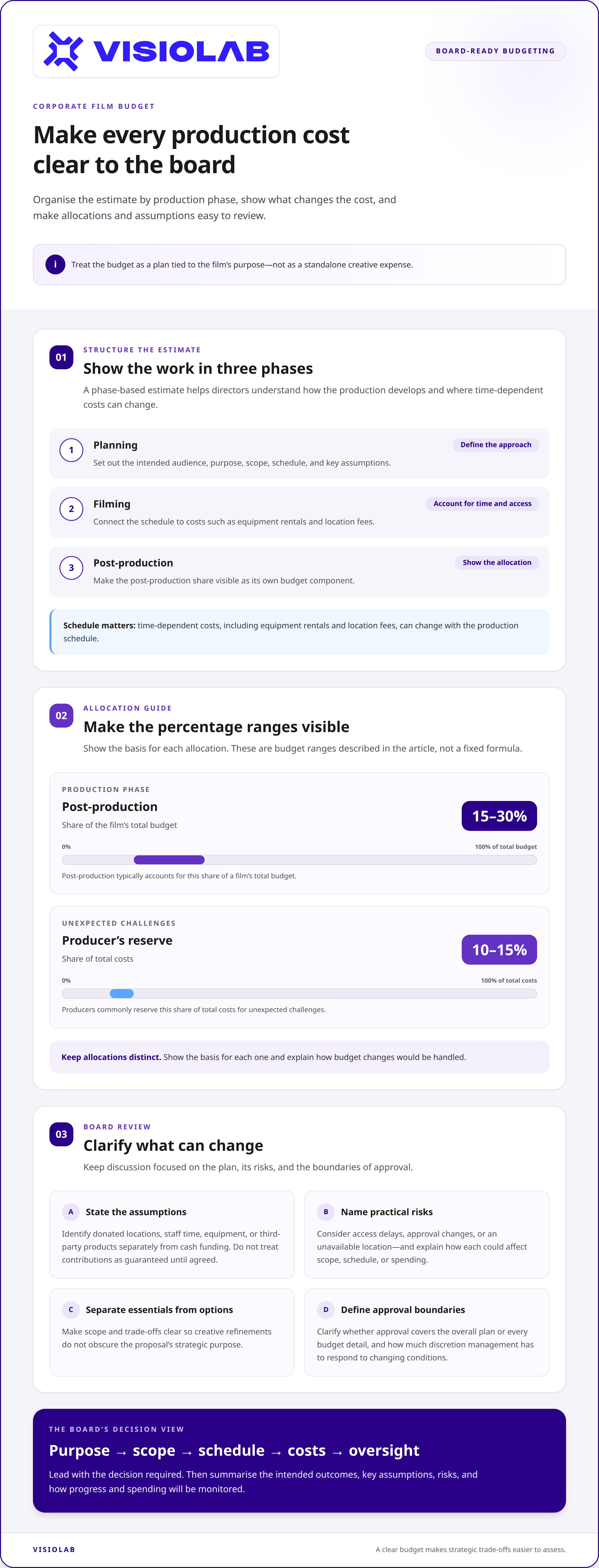
Organise the estimate by production phase so directors can see how the work develops: planning, filming, and post-production. A production schedule informs the budget because time-dependent costs, including equipment rentals and location fees, change with the schedule. Post-production typically accounts for 15-30% of a film’s total budget, while producers commonly reserve 10-15% of total costs for unexpected challenges. Show the basis for each allocation and how changes would be handled.
In the meeting, lead with the decision required, then summarise the scope, key assumptions, risks, and expected outcomes. Clarify whether approval covers the overall plan or every budget detail, and how much discretion management has to respond to changing conditions. This keeps discussion strategic rather than focused on minor expenses.
state what the board is being asked to approve.
show how scope changes affect the plan.
explain how significant changes will be reported.
Clear phase estimates make corporate film production planning easier to discuss as a defined organisational investment.
A governance board reviews, questions, challenges, and approves a draft budget prepared by an executive director or senior leader. For a corporate film, the board’s role is to test whether the proposal follows the organisation’s financial planning policy and whether oversight will continue after approval.
Set the financial planning policy before management prepares the budget. It should clarify priorities, acceptable risk, and what budget approval means: agreement with the overall plan, approval of each figure, or something in between. This gives proposal writers a clear framework and prevents the board meeting from becoming an unstructured review of individual expenses.
During review, compare forecast revenue and expenses with the current year and prior years. Ask whether forecast income reflects past results and reasonable future projections, and whether planned expenses account for previous spending and new costs. For example, if a film supports a new internal initiative, directors can ask whether the coming year’s forecast includes the resources needed to deliver it.
Test assumptions before approving the draft. Consider whether revenue growth or losses are realistic, how a change in an assumption could affect operating results, and which expenses are fixed or vary with service volumes. If the proposal creates an operating deficit, ask how it will be covered, including whether reserves or additional funding are expected. These questions reveal the decisions behind the forecast.
Approval should also establish how management can respond when conditions change. The board can assess whether the budget complies with its policy without approving every operational detail. Agree on which changes management can make and which require further board review. For example, management may be able to adjust a minor production expense, while a major scope change may need escalation under the board’s agreed process.
Once work begins, monitor actual performance against the approved budget and the same period in the prior year. Review revenue and expense projections throughout the year, and address variances early rather than waiting until year-end. Weekly budget meetings with department heads can review current status and forecast upcoming expenses; board reports can then focus on material changes, their causes, and proposed responses.
establish the policy and approval boundaries.
compare forecasts with current and prior-year results.
track actuals, investigate variances, and update projections.
This cycle makes approval an active governance decision. The budget should reflect the board’s priorities when approved, while regular reporting shows whether spending and assumptions remain aligned as the year progresses.
Directors have a legal duty to pay attention and ask questions during a budget presentation when appropriate. Boards should check whether revenue growth or loss assumptions are realistic and achievable, and whether projected revenue aligns with past results and reasonable future projections. They should ensure expenses reflect prior years and new costs, distinguish fixed expenses from those that vary with service volumes, and compare actual financial performance with the budget and the same period in the prior year during in-year reviews.
A realistic budget makes creative ambition achievable within the proposed scope. Directors can assess that balance by checking whether the planned work, schedule, and resources fit together. A polished concept alone is not enough: the estimate should show what production requires and what the organisation can expect to receive.
Start by testing the scope against the intended result. A film requiring several locations, interviews, animation, or multiple versions needs a plan that accounts for those choices. If the goal is to explain a process to employees, for example, compare a focused explainer with a broader brand film. The selected approach should meet the communication need without adding production elements that do not serve it.
Review the schedule alongside the estimate. A compressed filming window may require more coordination, while additional filming days can affect crew, location, and equipment requirements. Check that approvals, access, and subject availability are reflected in the proposed sequence. A schedule that assumes immediate decisions may make a budget look lean while leaving little room for real delivery conditions.
confirm that each planned scene or deliverable supports the film’s purpose.
connect crew, locations, equipment, and post-production work to the scope.
show how access, approvals, and schedule decisions shape the estimate.
identify which creative choices can change without undermining the intended result.
Ambition is easier to assess when the proposal separates essential work from enhancements. For example, a core film might meet the communication objective, while extra versions could adapt it for different audiences. Show the practical effect of each choice, including what changes in production and which audience need it serves. This gives directors a basis for weighing value against financial constraints.
Use monitoring to keep the approved plan connected to actual production. Track scope decisions, schedule changes, and budget movements against the estimate. If a location becomes unavailable, record the impact on the plan and the options for responding. Clear change records help directors distinguish necessary adjustments from avoidable expansion.
A realistic proposal does not remove uncertainty; it makes assumptions visible and explains how decisions will be handled. The board can then judge whether the plan is ambitious enough to meet its purpose while remaining practical for the organisation’s resources and approval process.
Benchmarks can offer a further check, provided they are treated as context rather than a substitute for a project-specific estimate. The page estimates that above-the-line costs make up around 30-35% of a typical film budget, while below-the-line film costs account for 45-60% of a project’s budget. It also estimates that production costs make up about 25-30% of a typical film budget. These proportions can help directors ask whether a proposal has accounted for the work it includes and whether its categories are clearly explained.
It also notes that the average US feature film production budget was roughly 51 million dollars a few years before its stated estimate of 64 million dollars. Differences in scale and scope matter, so these figures should not be used as targets. The relevant test remains whether the estimate’s assumptions, resources, and planned outcomes fit the film being proposed.
Approval gives management authority to spend within agreed boundaries; accountability connects that authority to results. For a corporate film, the full board remains accountable for the final budget result and for monitoring it throughout the year. That responsibility continues after the meeting.
Set a clear budget policy before approval. It should guide resource allocation towards expected results and ensure planned expenditure is prudent. Directors can then assess whether the proposal follows that policy, rather than treating approval as a promise that every estimate will remain unchanged. The policy also gives management a shared reference when production decisions or operating conditions shift.
Board communication matters. Directors should communicate budget policy to management with one voice, so individual members do not give conflicting directions. For example, if the board agrees that scope changes require approval, members should apply that boundary consistently. A unified position makes accountability clearer for both the production team and the directors monitoring outcomes.
Test the link between income and expenditure. Projected revenue should be supported by the expenses needed to deliver the work, and added expenses should have supporting revenue where applicable. If a proposal relies on expected income, directors can ask what happens if that income changes. This scrutiny helps reveal whether the plan can adapt without quietly undermining other organisational priorities.
Agree on reporting before production begins. A useful update can show the approved budget, actual spending, outstanding commitments, scope changes, and the reason for each variance. Directors can then distinguish a timing difference from a genuine increase in expected spending. For example, a delayed payment may shift the timing of an expense, while an added filming requirement may change the overall plan.
compare approved, actual, and forecast spending.
explain what changed, why, and who authorised it.
connect spending updates to completed work and upcoming commitments.
record the decision needed when a variance challenges the plan.
Sometimes a variance calls for a decision, not just an explanation. The board may need to approve a scope adjustment, ask management to revise the forecast, or consider how to address a shortfall. Recording the decision and its rationale creates a clear trail for later reviews and helps directors assess whether the project remains aligned with its purpose.
Build a production plan with clear budget controls and reporting from the outset. Discuss a corporate film plan that gives your board a clear view of scope, spending, and accountability.
VISIOLAB helps organisations turn complex messages into clear, purposeful corporate films. Bring the team in when the board has approved a communication need and you’re shaping the scope, audience, and production plan.
For internal change or strategic messaging, a Corporate Video can give the organisation a focused narrative. An Explainer and Training Video can make processes easier to communicate, while an ESG Video can bring sustainability commitments to life in a clear story. A Safety Video can support consistent communication about workplace practices.
Share the intended audience, organisational objective, key message, and board-approved constraints. These details help shape a production approach around the approved purpose and budget, rather than adding creative scope without a clear reason.
To discuss a corporate film for your organisation, contact VISIOLAB.
Once the board has set its priorities and boundaries, translate them into a focused creative brief. Define the audience, the message they need to understand, and the response the organisation hopes to encourage. This gives production decisions a clear reference point from the first conversation.
A strong answer to how to convince a board of directors to approve a corporate film budget starts with a proposal that connects purpose to practical delivery. Carry that clarity into the film itself: a compelling story, a considered scope, and choices accountable to the approved direction.
VISIOLAB can help shape that direction into a film concept suited to your organisation’s communication needs. Contact VISIOLAB to discuss your film and take the next step with a clear purpose in view.
Bring the board’s vision into focus, then give your audience a story worth remembering.
A budget is realistic when each planned cost supports a defined production requirement and the schedule allows the work to happen. Review the estimate against the proposed scenes, locations, contributors, and deliverables. For example, if the film depends on interviews with senior staff, the plan should account for their availability and approval time. Clear assumptions make it easier to spot gaps before they become production challenges.
The board should look for a clear link between the requested resources, the intended work, and the organisation’s financial capacity. Check whether the proposal identifies its funding source, key dependencies, and the decisions management may make without returning for approval. A useful review also asks what would change if a core assumption shifted, such as a stakeholder becoming unavailable or the intended audience changing.
Let’s create and collaborate
We’re versatile multitaskers, and we thrive on a lot of projects. You've seen a few of our works that we are most proud of, and your project could be next in line.

Empowering brands with captivating visual stories, creating strong connections and growth.
