
Boredom in safety training is more than a minor annoyance: it's a critical liability that compromises your site's operational integrity. If you're struggling with how to make safety training videos not boring, you've already recognized that outdated, "cringey" materials are failing your frontline wo...
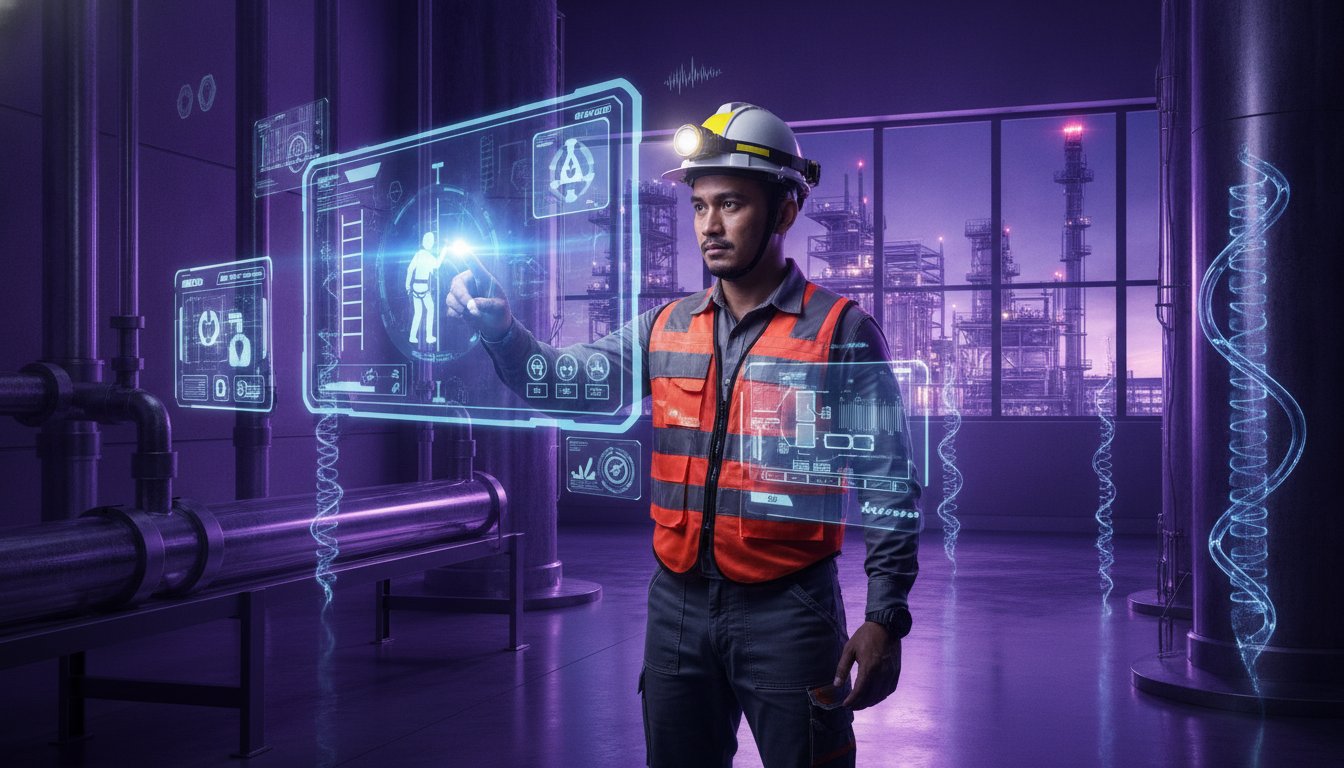
Boredom in safety training is more than a minor annoyance: it's a critical liability that compromises your site's operational integrity. If you're struggling with how to make safety training videos not boring, you've already recognized that outdated, "cringey" materials are failing your frontline workers. When a team tunes out, risks escalate and expensive incidents become inevitable. This disconnect doesn't just waste time; it erodes the very safety culture you're trying to build.
We'll show you how to move your strategy beyond the basics, replacing tired tropes with cinematic storytelling and precise technical execution. This 2026 strategic guide transforms dry compliance into a high-impact visual narrative that actually commands attention. We'll examine how to utilize 3D motion graphics and modern industrial documentation to ensure your message sticks, accidents drop, and your safety standards become a benchmark for the Malaysian industrial sector. The goal is simple: clear perspective leads to concrete results.
• Eliminate the "compliance fog" by using narrative frameworks that put your workers at the center of the story rather than keeping them as passive observers.
• Learn how to make safety training videos not boring by utilizing 3D motion graphics to visualize high-risk industrial scenarios with cinematic clarity.
• Swap exhaustive 30-minute marathons for interactive micro-learning sprints that respect cognitive limits and boost operational recall.
• Bridge the gap between technical SOPs and high-impact storytelling to turn standard compliance into a strategic brand asset for Malaysian GLCs and MNCs.
Traditional safety training often falls into a "compliance fog." This is the mental state where workers, specifically those in high-stakes environments like energy or construction, simply tune out. They recognize the lecture-style format immediately and their brains shift into standby mode. If you're searching for how to make safety training videos not boring, you're actually looking for a way to penetrate this fog. Disengagement isn't just an HR problem; it's a "boredom risk factor." A worker who is bored by a video is a worker who won't remember the emergency protocol when a real crisis hits.
Cognitive load theory explains why many training modules fail. When a video is packed with dense technical jargon and legalistic disclaimers, the brain's working memory becomes overwhelmed. Information isn't processed; it's discarded. To combat this, modern standards are shifting toward micro-learning principles, which break down complex procedures into digestible, high-impact fragments. This approach ensures that the most critical safety steps are actually retained rather than lost in a sea of text-heavy slides.
For Malaysian GLCs and MNCs, the era of generic training is over. By 2026, the "Strategic Safety Video" will be the industry standard. This isn't just a video; it's a purpose-built tool that bridges creative mastery with technical safety requirements. It moves the needle from passive viewing to intentional learning through several key shifts:
Boredom leads to distraction on-site.
If the training feels irrelevant, workers treat SOPs as optional.
Information buried in a dull narrative is impossible to retrieve under pressure.
Watching a video is a passive act; learning is an active one. If your content doesn't provide mental stimulation or emotional resonance, it won't trigger the empathy needed to make consequences feel real. Safety shouldn't be an academic exercise. Strategic Engagement is the bridge between information and action. By positioning the viewer as an active participant in a scenario, you force the brain to solve problems in real-time, which solidifies the learning process far better than a standard checklist ever could.
Nothing kills authority faster than "cringey" content from the early 2000s. Poor audio quality, shaky footage, and outdated aesthetics signal to your team that safety isn't a priority. If the production looks cheap, the message feels cheap. If you want to know how to make safety training videos not boring, you must first address the visual and auditory quality of your content. Moving from instructional to impactful visual communication requires a professional touch that respects the audience's intelligence and the gravity of the subject matter.
Standard Operating Procedures (SOPs) are often viewed as static lists of rules. This is a fundamental error in communication. To truly understand how to make safety training videos not boring, you must stop treating your workers as passive observers and start treating them as protagonists. A strategic narrative turns a dry checklist into a journey of consequence. When a worker sees themselves in the story, the information moves from the screen to their long-term memory. Narrative is the vehicle; safety is the destination.
This framework relies on emotional anchoring. We don't just show a procedure; we show why that procedure matters to the worker's life outside the factory gates or the construction site. By connecting site safety to the ability to return home to family, the content gains a weight that technical jargon can never achieve. Editorial clarity is essential here. We strip away the fluff to focus on the narrative arc: the challenge, the choice, and the safe resolution. This approach aligns with global OSHA workplace safety training standards while maintaining a modern, engaging pulse.
Relatability is the foundation of engagement. For a diverse Malaysian workforce, your characters must feel authentic rather than caricatured. We avoid the trope of the "perfect" worker who never makes a mistake. Instead, we show realistic characters facing common pressures: tight deadlines, fatigue, or equipment quirks. By utilizing advanced explainer video production Malaysia techniques, we humanize technical data. We turn abstract safety figures into lived experiences, making the "Safety Hero" a mirror for the viewer rather than a distant ideal.
Conflict drives attention. In safety training, the "near-miss" is your most powerful narrative tool. It builds tension without being gratuitously graphic. We construct realistic "What If" scenarios that explore the immediate consequences of a bypassed step. This isn't about fear; it's about perspective. The psychology of near-miss storytelling allows workers to experience the gravity of a mistake in a controlled environment. It creates a narrative arc that leads directly to an actionable SOP. When the resolution of the story depends on the correct safety choice, the lesson becomes unforgettable. If you're ready to move beyond basic slides, strategic video storytelling can redefine how your team views risk.
Visual clarity is the ultimate antidote to disengagement. If you're solving for how to make safety training videos not boring, you must select a visual medium that matches the complexity of your environment. It isn't just about looking good; it's about providing a clear perspective that drives operational safety. 2D motion graphics excel at simplifying abstract regulatory requirements. Cinematic live action builds immediate trust on the factory floor. For complex industrial sites, integrating drone visuals with motion tracking creates a high-level construction progress video Malaysia can rely on for both documentation and training.
The decision between live action and 3D animation often comes down to the risk level of the scenario. While live action is perfect for behavioral training, 3D animation is essential for visualizing chemical reactions or internal machinery failures. This strategic selection ensures your content adheres to OSHA workplace safety training guidelines while maintaining a modern, high-energy pulse. You don't just want workers to watch; you want them to perceive the danger before it manifests.
3D motion graphics allow us to visualize "invisible" threats. Gas leaks, electrical arcs, and structural stress aren't always visible to the naked eye, but they are lethal. In the energy and oil and gas sectors, 3D animation provides a safe environment to explore high-risk failures without endangering personnel. Beyond the initial impact, animation offers superior longevity. It's significantly easier to update a digital model than it is to reshoot live-action footage when a piece of equipment changes. This flexibility makes 3D a cost-effective, long-term asset for your safety library.
Authenticity is the currency of trust. Cinematic live action uses real site environments and authentic faces to ground the training in reality. By adopting corporate documentary Malaysia styles, you can elevate a standard induction into a compelling brand narrative. Strategic lighting and professional sound design aren't just fluff. They signal the seriousness of the message. When the production quality is high, the perceived importance of the safety protocol rises accordingly. You aren't just showing a procedure; you're building a culture of excellence.
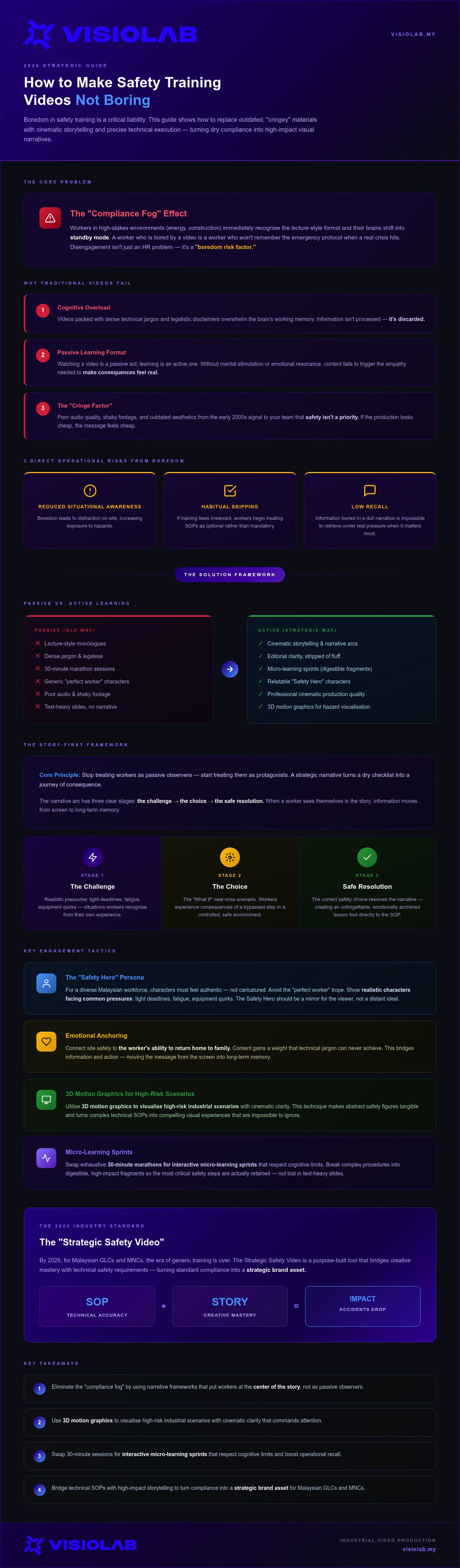
The 30-minute training marathon is a relic of the past. In 2026, retention is built through the sprint. High-impact safety communication now relies on micro-learning: the practice of breaking complex modules into three-minute, hyper-focused segments. If you want to know how to make safety training videos not boring, you must respect your audience's time and cognitive bandwidth. By delivering information in bites, you ensure that frontline workers, who rarely sit at a desk, can consume and apply safety protocols in real-time. This approach ensures your message isn't just heard; it's remembered when it matters most.
Interactivity is the next frontier. Static viewing is replaced by "Choose Your Own Adventure" paths where workers test their decision-making in high-risk scenarios. This isn't just entertainment. It's a psychological test of situational awareness. Gamification elements, such as visual rewards for identifying hazards correctly, turn a mandatory task into a competitive challenge. This shift toward mobile-first, interactive content ensures that safety isn't a chore; it's a skill-building exercise. When workers feel a sense of agency, their engagement levels spike, and site accidents drop.
The first ten seconds determine your training's success. This 10-second hook must be immediate and visceral, pulling the viewer into the narrative before they have a chance to disengage. Rhythmic editing is another secret to how to make safety training videos not boring, as it keeps the pulse of the content aligned with the fast-paced nature of modern site work. To ensure clarity, follow the 'Rule of Three' for safety takeaways: present three clear actions, three specific risks, and three immediate resolutions. This structure prevents cognitive overload and ensures the most critical data points survive the noise of a busy workday.
We are bridging the gap between traditional video and virtual product launch production Malaysia can leverage for immersive training. Augmented Reality (AR) overlays now provide real-time SOP guidance directly on the workshop floor, turning a smartphone into a safety guide. For management, interactive video data offers superior HSE reporting. You don't just see who watched the video; you see how they decided when faced with a simulated risk. This level of insight is invaluable for proactive safety planning across your organization. If you're ready to modernize your approach, explore our interactive training solutions to drive measurable results.
Safety training shouldn't be a box-ticking exercise hidden in a basement archive. At VISIOLAB, we view safety communication as a core pillar of your corporate brand legacy. We don't just produce content; we act as a Visionary Architect for your safety message. Our discipline lies in the bridge between high-end creative strategy and technical industrial mastery. If you've been searching for how to make safety training videos not boring, the answer lies in elevating the subject matter to a level that commands respect. We transform dry compliance into a visual narrative that reflects your organization's commitment to excellence and operational precision.
Our process goes beyond the lens. We dive deep into the specific risks of your industrial environment to ensure every frame delivers tangible value. By combining digital fluency with a clear perspective on site-specific challenges, we create content that resonates with both the boardroom and the frontline. This strategic alignment ensures that your investment doesn't just stop accidents; it builds a culture of proactive care that defines your market position in Malaysia.
High-quality training videos are tangible proof of your commitment to the "Social" pillar of ESG. For public listed companies and GLCs, safety documentation is no longer just internal; it's a matter of corporate transparency. By utilizing professional ESG video production Malaysia standards, you visualize your impact on worker well-being for stakeholders and regulators alike. Exceptional safety content proves that you value your human capital. It turns a standard operating procedure into a powerful statement about your corporate ethics and long-term sustainability goals.
Success in safety communication requires a partner who understands that the "how" is just as important as the "what." This is why choosing a video production agency in Malaysia requires a focus on strategic impact over basic execution. A low-cost, instructional video might save RM today, but it costs your organization in engagement and retention tomorrow. The VISIOLAB roadmap moves from a rigorous strategic brief to a high-impact launch, ensuring your content is future-proofed for 2026 and beyond. We don't just deliver a file; we deliver a result. If you're ready to redefine how to make safety training videos not boring, take the next step and consult with VISIOLAB for a comprehensive safety communication audit. Let's build a safer, more engaged workforce together.
Operational excellence begins with a workforce that is genuinely engaged. By moving beyond the compliance fog and embracing a story-first framework, you transform mandatory training into a high-impact narrative. You've learned that how to make safety training videos not boring involves more than just better cameras; it requires strategic psychology, 3D motion graphics, and interactive micro-learning designed for 2026 retention. These tools don't just reduce incidents. They build a resilient safety culture that serves as a cornerstone of your corporate brand legacy.
As specialists in strategic communication for Malaysian GLCs and MNCs, we bring technical industrial mastery to every frame. We redefine safety through cinematic storytelling and nationwide production capability. Don't settle for outdated materials that compromise your site's integrity. Transform your safety culture with VISIOLAB’s strategic video production. Your team's safety is the ultimate metric of success. Let's build a future where every worker returns home safely, every single day.
Storytelling moves safety from a checklist to a lived experience. It anchors technical procedures in emotional consequences, making the information stick. When workers see a narrative arc involving characters they recognize, they internalize the "why" behind the SOP. This approach is the foundation of how to make safety training videos not boring, as it replaces passive observation with active mental participation. Narrative clarity leads to operational certainty.
Modern attention spans demand brevity. By 2026, the standard for high-retention safety content is the micro-learning format, typically lasting between two to three minutes. These short sprints prevent cognitive overload and allow frontline workers to consume specific modules during brief intervals. Long-form marathons are being replaced by strategic, modular content. This approach delivers one clear, actionable safety takeaway at a time without wasting time.
Neither is inherently better; the choice depends on your specific risk environment. 3D animation is superior for visualizing "invisible" threats like gas leaks or internal machinery failures. Live action, however, builds trust through authentic faces and real site environments. We often combine both, using cinematic live action for behavioral training and 3D motion graphics for technical visualizations that are impossible to film safely. Perspective drives safety.
ROI is measured through both operational data and engagement metrics. You should track the reduction in workplace accidents and "near-miss" incidents following the deployment of new training. Additionally, modern interactive video platforms provide data on completion rates and quiz scores. A high-impact safety video pays for itself by preventing a single major industrial accident. Such incidents can cost Malaysian companies millions in RM and lost productivity.
Yes, they are powerful tools for documenting the "Social" pillar of ESG. High-quality safety videos prove a tangible commitment to worker well-being and occupational health standards. For Malaysian public listed companies and GLCs, these videos serve as evidence of corporate transparency. They show stakeholders that safety is a strategic brand value rather than just a regulatory requirement. Visual proof builds investor confidence and brand legacy.
The most common error is prioritizing legal compliance over audience engagement. Using dense technical jargon and "cringey" outdated aesthetics causes workers to tune out immediately. Avoid poor audio quality and shaky footage, as these undermine your authority. Another mistake is ignoring the first ten seconds. If you don't hook the viewer instantly, the rest of your strategy on how to make safety training videos not boring fails.
Engagement for diverse teams requires visual-first storytelling that transcends language barriers. We use 2D and 3D motion graphics to illustrate procedures clearly without relying solely on voiceovers. When text is necessary, we utilize clear, localized subtitles in Bahasa Malaysia, English, and other relevant languages. This ensures the core safety message remains consistent and impactful regardless of the viewer's primary language. Clarity is a universal requirement for site safety.
Micro-learning is the practice of delivering educational content in small, hyper-focused bursts. In a safety context, this means breaking down a massive safety manual into a series of three-minute videos. Each clip focuses on a single procedure or risk. This method respects the modern attention span and ensures that critical safety information is retained. It's about readiness for immediate application on the industrial site when pressure is high.
Let’s create and collaborate
We’re versatile multitaskers, and we thrive on a lot of projects. You've seen a few of our works that we are most proud of, and your project could be next in line.

Empowering brands with captivating visual stories, creating strong connections and growth.
