
What if a rising view count says more about exposure than whether your launch video moved anyone to act? Measuring the success of a product launch video means looking beyond views and likes to see whether the story held attention and supported the launch objective. That’s not always easy: analytics...

What if a rising view count says more about exposure than whether your launch video moved anyone to act? Measuring the success of a product launch video means looking beyond views and likes to see whether the story held attention and supported the launch objective. That’s not always easy: analytics are split across platforms, and several campaign channels can influence the same decision.
The numbers also need context. Since 24 August 2026, YouTube has counted a public view from the first frame of playback, while its Engaged views metric retains the previous, stricter definition. A higher view count alone may not signal deeper audience interest.
This guide will help you build a practical measurement plan before publishing. You’ll learn how to match KPIs to your objective, set up consistent tracking across channels, and interpret reach, engagement and conversion data without overstating what the video achieved. The result is a clearer view of how strategic messaging and audience response connect to business outcomes, and where to improve the next launch.
• Define what the launch needs to achieve, whether that’s clearer product understanding, qualified interest or a specific audience action.
• Match each campaign objective to a stage-specific KPI, then read the metric alongside its data source and audience context.
• Make measuring the success of a product launch video repeatable by recording KPI definitions, platform sources, owners and reporting windows before release.
• Align the audience, message, distribution and desired action before production so the response is easier to interpret after launch.
• Use the review to identify where the campaign can improve, from the video’s editorial clarity to how it supports the wider launch.
Success means achieving the launch objective, not simply accumulating views. A video designed to introduce a product to a new audience has a different job from one intended to explain how it works or move interested buyers towards a next step. The measure of success must fit that job.
Start by naming the audience change you want the video to create. That might be greater awareness among a defined audience, clearer understanding of a product’s value, qualified interest from potential buyers, or a specific action such as visiting a product page. The launch stage matters too: an early teaser may aim to build recognition, while a demonstration may be expected to resolve questions and support consideration.
A video metric records audience behaviour; a business outcome shows whether that behaviour contributed to the result the launch sought. A view can show exposure. It cannot, by itself, establish that someone understood the offer, considered it, or made a purchase.
This distinction also helps separate social video marketing from the idea that a video must go viral. As the overview of social video marketing indicates, sharing is only one part of a broader marketing approach. Pass-along activity may extend reach, but it does not replace evidence tied to the launch objective.
Translate the campaign brief into one primary audience response before selecting KPIs. For example, a launch video for a complex product might aim to help prospective customers understand its core purpose; a video aimed at existing leads might encourage them to explore a product page. Name the audience segment and the intended response clearly enough that the team can tell whether a signal is relevant.
Keep the communication goal distinct from the commercial outcome. The video can explain a product and prompt a click, but a completed sale may also depend on the landing page, pricing, sales follow-up, or other campaign channels. Define what the video is expected to communicate, then identify the wider outcome it may support. This makes later reporting more credible.
Direct evidence includes a tracked link click or a video-attributed form submission, provided the tracking is set up correctly. Indirect evidence may include a rise in branded searches, enquiries, or sales during the wider launch period. These signals can suggest that the video contributed, but they don’t prove it acted alone.
Several channels often work together, and audiences may encounter a launch message more than once before responding. Set expectations in advance: measurement can show recorded exposure, engagement, and tracked actions, then assess how those signals align with the campaign timeline. It can’t reliably assign every shift in awareness or revenue to one video without stronger attribution evidence. Clear messaging makes the audience response easier to interpret, while an honest account of limits keeps the findings useful.
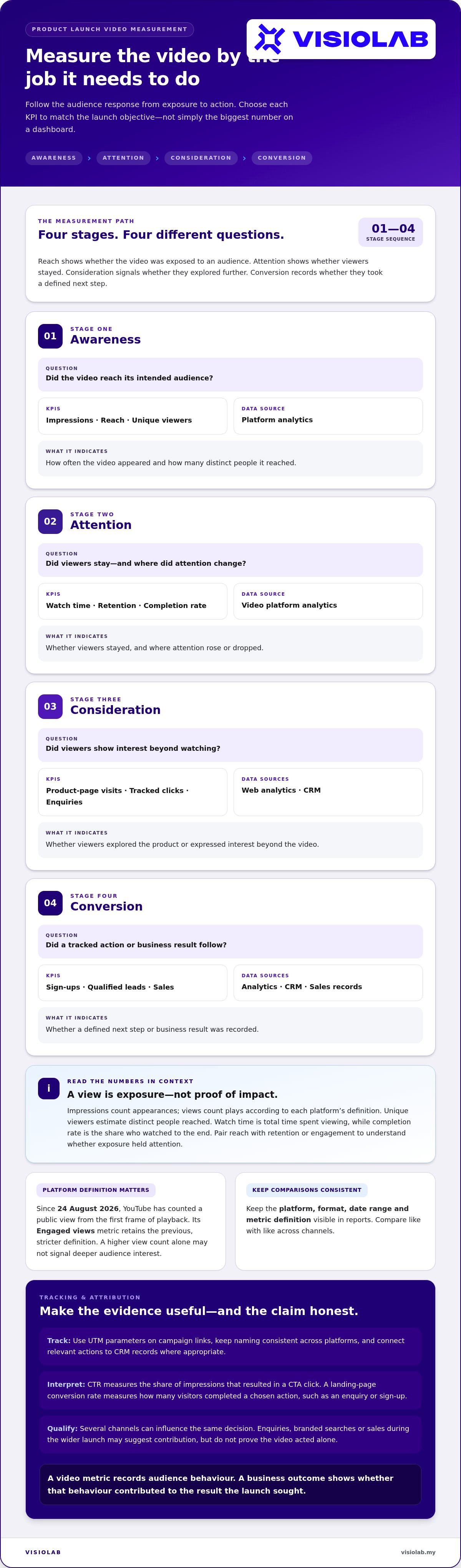
Choose metrics by the question you need to answer. Reach shows whether the video was exposed to an audience; attention shows whether viewers stayed; consideration signals show whether they explored further; conversion metrics record whether they took a defined next step. A metric is useful only in relation to the objective it is meant to measure.
| Objective | Metric | Data source | What it indicates |
|---|---|---|---|
| Awareness | Impressions, reach or unique viewers | Platform analytics | How often the video appeared and how many distinct people it reached |
| Attention | Watch time, retention and completion rate | Video platform analytics | Whether viewers stayed, and where attention rose or dropped |
| Consideration | Product-page visits, tracked clicks or enquiries | Web analytics and CRM | Whether viewers showed interest beyond watching |
| Conversion | Sign-ups, qualified leads or sales | Analytics and CRM or sales records | Whether a tracked action or business result followed |
Impressions count appearances; views count plays according to each platform’s definition. Unique viewers estimate distinct people reached. Watch time measures total time spent viewing, while completion rate shows the share who watched to the end. These metrics answer different questions: a large reach can coexist with brief viewing, and a strong completion rate among a smaller audience may indicate sustained attention.
Definitions aren’t always consistent across platforms. Since 24 August 2026, YouTube has counted a public view from the first frame of playback, while its “Engaged views” metric retains the previous, stricter view definition. Compare like with like: keep the platform, format, date range and metric definition visible in reports. Pair reach with retention or engagement to see whether exposure held attention.
A click-through rate (CTR) measures the share of impressions that resulted in a click on the video’s call to action. It signals response to the prompt, not completion of the next step. A landing-page conversion rate measures how many visitors then completed a chosen action, such as submitting an enquiry or signing up. Watch time reveals attention; CTR reveals response; conversion reveals follow-through.
Use UTM parameters on campaign links to identify traffic associated with the video in your web analytics. Keep naming consistent across platforms, and connect relevant actions to CRM records where appropriate. Then review enquiries, qualified leads and sales alongside the wider campaign timeline. A sale may reflect video exposure, other campaign touchpoints, product fit, or sales follow-up, so report the video’s contribution with context rather than assigning it sole credit. Clear strategic messaging can make the intended response easier to assess; VISIOLAB’s launching video production brings that communication focus into the video itself.
A high view count can look impressive while telling you little about whether the right people noticed the launch, understood the offer, or took a useful next step. Views, likes, and shares are signals, not proof of business impact. Their meaning depends on who engaged, how they watched, and whether their behaviour aligns with the launch objective.
Correlation between video exposure and increased sales does not prove that the video caused the increase. Other campaign activity, market conditions, product interest, and sales follow-up may also contribute. Measuring the success of a product launch video means assessing evidence carefully, not turning a coinciding change into a causal claim.
Consider a hypothetical launch aimed at procurement decision-makers. A video might attract a large general audience and earn plenty of likes, yet reach few people involved in purchasing. Another version might draw fewer viewers but prompt relevant product-page visits from the intended segment. The first has more visible activity; the second may offer a stronger signal against the campaign’s goal.
Read engagement alongside audience fit and retention. A share can extend distribution, but it doesn’t reveal whether the recipient is relevant. Likes may show a positive reaction, but they don’t necessarily indicate understanding or intent. Retention patterns can add context: if viewers leave before the product’s key benefit appears, high reach may not have delivered the core message. Ask what the metric says about the intended audience, and what it leaves unanswered.
No single tracking method captures every influence. Tagged links, platform reporting, and CRM journey records each reveal a different part of the path from exposure to action:
can identify visits or actions associated with a specific video link in web analytics. They won’t capture someone who watches and later navigates directly to the site.
can show video exposure and engagement within that platform. Its attribution may rely on platform-defined windows or interactions, so it may not match website or CRM reporting.
can connect known enquiries or leads with recorded campaign touchpoints. They may still miss activity that wasn’t captured or linked to a contact.
Cross-device viewing can break the visible connection between a video watched on one screen and an action taken on another. Privacy choices and blocked tracking can limit identifiable journeys; offline conversations or event interactions may not appear in digital records at all. These gaps don’t make measurement pointless. They define how confidently you can interpret it.
In reporting, distinguish tracked outcomes from inferred influence. Say “tagged visits followed the video release” when that’s what the data shows, or “the video may have contributed to increased enquiries” when other channels could have played a role. This language keeps the findings credible and useful for the next launch decision.
A reliable measurement plan starts before the video goes live. Decide what success should look like, make sure the right data can be collected, then review the results against the original objective. This turns measuring the success of a product launch video into a repeatable process rather than a collection of platform screenshots.
First, record a relevant baseline, such as current product-page visits or enquiries, and define the target audience, campaign period and primary KPI. Then document each KPI’s precise definition, data source, reporting owner and measurement window. Agree on these details before launch so teams don’t compare different definitions or timeframes later.
Use consistent UTM parameters on campaign links to distinguish video traffic from other activity. Test each link, landing page and conversion event before publishing. Confirm that the people responsible can access platform analytics, web analytics and relevant CRM reporting. For campaigns using a virtual format, the virtual product launch production guide can help teams consider how the launch format fits the communication plan.
Follow a clear sequence, from the objective to the next campaign decision:
State the audience response the video is meant to support, such as understanding a product benefit or visiting a product page.
Select a primary measure that reflects that response, with supporting metrics that add context.
Note definitions, platform sources, owners, campaign dates, baseline and reporting windows.
Test tagged links and conversion events, and confirm access to reporting tools before release.
Compare results with the objective and baseline, then record what to retain, adjust or test next.
Use a compact scorecard to keep reporting useful. The figures below are placeholders, not recommended benchmarks:
Product-page visits from the launch video; target: [set before release].
[record the result] within [reporting window].
[channel, audience segment, creative version, campaign activity or tracking limitation].
[retain, adjust or test], with a short reason tied to the evidence.
Interpret performance against your own baseline and stated target, not an invented universal benchmark. Where the data permits, segment by channel, audience, creative version and campaign timing. If one version holds attention but another generates more relevant visits, the difference can inform what to refine. Keep the explanation close to the result: note what changed, what the data supports and what remains uncertain.
Close each review by assigning a practical next step. Retain elements that supported the objective, adjust parts of the message or distribution that underperformed, and test one purposeful change in the next campaign. For strategic support with a launch video shaped around clear messaging and measurable response, work with VISIOLAB on your product launch video.
Measurement starts before production, with a clear line between the audience, the message, the distribution plan and the action you want viewers to take. If these elements point in different directions, post-launch data becomes harder to interpret. A video may hold attention without communicating the intended benefit, or invite clicks from people outside the audience the launch needs to reach.
Start with one audience and one primary response. For example, a launch video for a new service might be designed to help prospective clients understand what it does and prompt them to explore a relevant page. That objective can shape the script, visual choices, call to action, distribution channels and tracking plan. Strategic planning brings creative decisions and measurement into the same frame. For broader context, strategic corporate video production shows how clear communication goals can guide the production approach.
Make the intended response visible in the creative. A video meant to build understanding should present the product’s purpose and key benefit in a clear sequence. A video designed to encourage exploration needs a relevant next step. Match the format and call to action to the audience’s needs, then plan where the video will appear and how each placement will be tracked.
Editorial clarity matters. If the message introduces several ideas at once, it may be difficult to tell which one prompted audience interest. A focused narrative gives viewers a clear path from the launch message to the desired action. It also gives the campaign team a better basis for interpreting response: did people stay for the key explanation, click through after the prompt, or disengage before the main point?
Build distribution and measurement into the creative brief, not as a final technical step. Record the intended audience, core message, primary action, planned channels and tracking requirements together. If the launch includes a virtual experience or event, align the video’s role with the wider format so the team can interpret responses across touchpoints without treating every outcome as video-only.
Share a short measurement brief with everyone involved in the launch. Include the objective, audience, primary KPI, supporting signals, data sources, reporting owner and review window. Add the approved call to action and a note on what the tracking can and cannot establish. When stakeholders work from the same definitions, reporting is more consistent and creative decisions can be reviewed against the original intent.
That clarity supports more than the current campaign. It gives the next launch a stronger starting point: keep what helped communicate the message, refine what confused the response, and make the next test purposeful. Measuring the success of a product launch video works best when the video is built to serve an objective the team can observe and learn from.
VISIOLAB’s launching video work brings strategic messaging together with corporate video production, without promising a particular campaign outcome. If you’re aligning a future launch around a clear message and measurable objective, explore VISIOLAB’s corporate video services.
Your next product launch can do more than introduce an offer. It can help your team learn which message resonated, what prompted interest and where the audience needed a clearer next step. Set that learning goal before production, then build a video and measurement plan around it. That makes measuring the success of a product launch video part of a stronger campaign rhythm, not just a post-launch report.
VISIOLAB produces launching videos and corporate films, combining strategic messaging with production discipline. Its work also includes event coverage and virtual experiences, supporting different ways to bring a launch story to its audience. The aim is thoughtful alignment between what the video says, who it reaches and what the campaign is designed to achieve, without treating any single metric as a guaranteed result.
Give your next launch a clear objective and a story built to serve it. Explore VISIOLAB’s strategic video production and take the next step with confidence.
There’s no universal view target that fits every product launch video. Set a goal using comparable past campaigns, or state the assumptions behind a new target, such as the audience size and planned distribution. For example, separate expected organic exposure from paid placement rather than treating them as equivalent. While measuring the success of a product launch video, assess whether views came from the intended audience and led to the response the campaign was built to encourage.
The most important KPI is the one closest to the launch’s main objective. If the goal is to introduce a product to a defined audience, qualified reach may matter most; if the goal is to prompt exploration, product-page visits may be more useful. For a response-focused launch, tracked enquiries could be the lead measure. Choose one primary KPI, then use a small number of supporting metrics to explain why it moved.
Choose the measurement window before release and base it on the campaign schedule and the time your audience may need to respond. A team might review distribution signals while the video is live, then assess enquiries or sales after the relevant response period. There’s no fixed window for every launch. State the start and end dates in your report, and use comparable windows when reviewing campaigns side by side.
Yes, but use evidence suited to awareness rather than treating video exposure as proof that awareness changed. A pre- and post-campaign survey can ask whether respondents recognise the brand or recall the launch message. Keep the questions, audience and survey method consistent across both measurements. Reach and branded search trends can provide additional context, but each reflects a different signal. Explain the method and its limits when sharing findings.
Use tagged campaign links, landing-page events and CRM records to connect trackable interactions with sales activity. A CRM record can include a campaign identifier and the dates of recorded touchpoints, helping teams see where the video appeared in a customer journey. If reporting an attribution model, name it clearly, such as first-touch or last-touch. These methods show recorded associations, not every offline or cross-device influence, so avoid claiming the video alone caused a sale.
A useful report gives stakeholders enough detail to understand both the result and how it was measured. Include the launch objective, intended audience, reporting dates, KPI definitions, data sources and the relevant campaign context. Separate completed actions, such as enquiries, from signals like viewing or engagement. Note gaps that could affect interpretation, then close with a decision: what to keep, what to change and what to test in the next launch.
Let’s create and collaborate
We’re versatile multitaskers, and we thrive on a lot of projects. You've seen a few of our works that we are most proud of, and your project could be next in line.

Empowering brands with captivating visual stories, creating strong connections and growth.
