
What if an ESG video made your annual report easier to understand without trying to replace it? That’s the goal. If you’re exploring how to produce ESG video for annual report, start with verified disclosures, then shape them into a focused story stakeholders can follow. Dense metrics can be difficu...

What if an ESG video made your annual report easier to understand without trying to replace it? That’s the goal. If you’re exploring how to produce ESG video for annual report, start with verified disclosures, then shape them into a focused story stakeholders can follow. Dense metrics can be difficult to communicate, and every claim needs to align with approved reporting and supporting evidence.
A clear video can bring performance, action and next steps into view. It can’t carry every disclosure, and it shouldn’t ask audiences to trust unsupported claims. The challenge is building a concise narrative while coordinating contributors, approvals and creative choices.
This guide explains how to select material ESG information, structure a credible narrative and use interviews, documentary storytelling or motion graphics to clarify complex subjects. You’ll also learn how to organise reviews and align the finished video with your annual report and wider corporate communications. Strategic planning and production discipline can make complex information clearer while keeping the underlying disclosures in focus.
• Learn how to produce ESG video for annual report by turning selected, material disclosures into a focused story grounded in evidence.
• Keep every figure, date, boundary and key term consistent with the approved annual report.
• Choose interviews, documentary footage or motion graphics to suit the subject and make its meaning easier to grasp.
• Reduce review friction by assigning clear owners for data accuracy, technical review, governance and communications approval.
• Align the video’s message and release with the annual report, using visuals that help stakeholders understand performance and next steps.
An annual-report ESG video is a focused companion to the written report. It selects a small number of relevant disclosures and interprets them through concise visual storytelling: a leader explains a priority, footage shows an initiative in practice, or graphics make a process easier to follow. The goal isn’t to retell every page. It’s to give stakeholders a more direct route into the organisation’s priorities, actions, performance and future commitments.
The distinction matters. The video should help people understand the report, not stand in for it. Disclosures, supporting data and any applicable assurance remain in the formal reporting materials. Keep the video’s claims consistent with those materials, and direct viewers to the report for full detail. For background on the environmental, social and governance dimensions behind this work, see Understanding ESG principles.
An annual-report ESG video is a focused interpretation of reported evidence; a general sustainability film can tell a broader brand story. That distinction guides how to produce ESG video for annual report: choose what stakeholders need to understand, then build the narrative around supportable information.
Set one primary communication objective before developing the creative treatment. The video might explain progress on a material priority, show how a programme is being carried out, or clarify what the organisation plans to do next. One objective gives the script a clear centre and helps prevent a short film from becoming a catalogue of every ESG activity.
Next, identify who needs that explanation. Investors may want context for performance and priorities; employees may need to see how commitments connect to their work. Customers and communities may be relevant audiences when the subject affects them directly. Define success by whether viewers can understand the message, access the content and recognise its alignment with the report. Views can indicate reach, but they don’t show whether the story was clear or credible.
Video earns its place when it can clarify something that text and charts alone may not convey as easily: a complex initiative, a human impact or a long-term programme. A recorded conversation can add context to an employee or community perspective. Documentary footage can show observable activity, while motion graphics can break down a process, timeline or set of relationships. The format should serve the evidence, not simply decorate it.
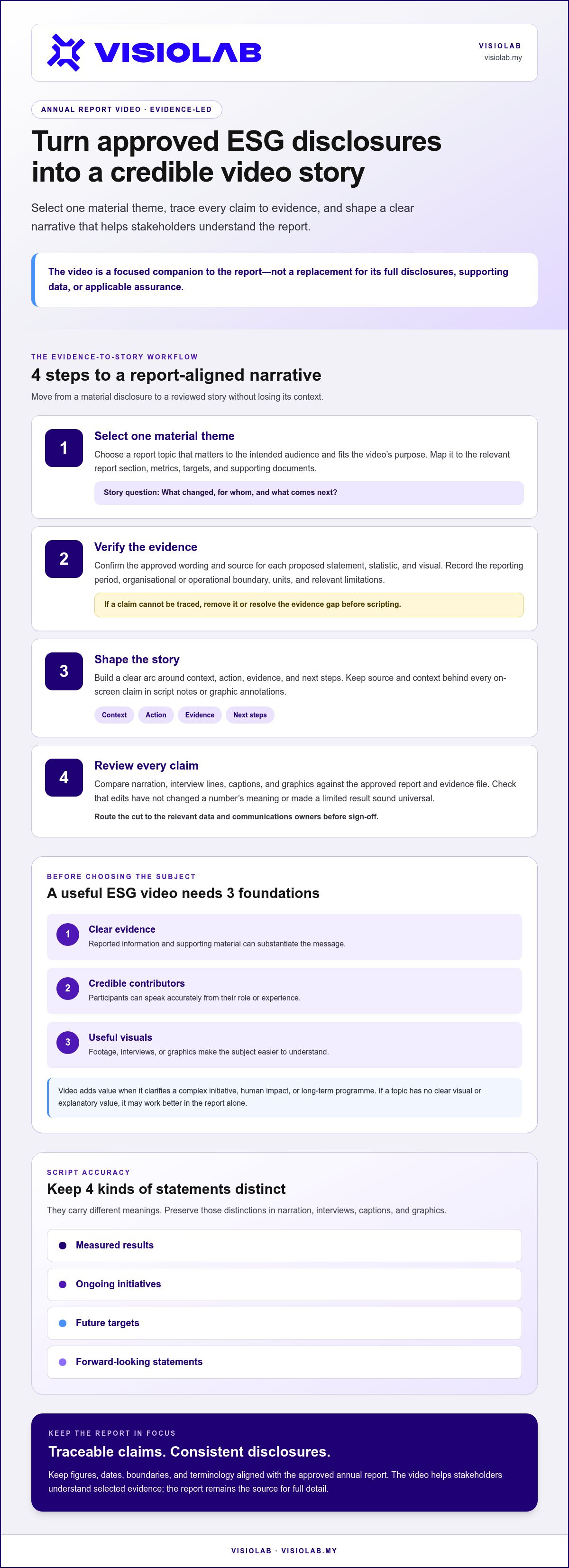
Before choosing a subject, check whether it has the foundations for a useful story:
The reported information and supporting material can substantiate the message.
Participants can speak accurately from their role or experience.
Footage, interviews or graphics can make the subject easier to understand.
If a topic has no clear visual or explanatory value, it may work better in the report alone. Adding a video simply to make reporting feel more modern can dilute attention. A deliberate subject, grounded in the annual report, helps stakeholders see what the organisation did, why it matters and what comes next.
A strong narrative begins with approved annual-report material, not an attractive concept looking for evidence. Keep figures, dates, boundaries and terminology aligned with the report, then build a story that explains one priority without flattening important detail. Producing an ESG video for an annual report is both an editorial and evidential process: select the right subject, trace its support, shape the message and check each claim before release.
Every measurable claim in the video needs a traceable source, so viewers can follow the message back to the evidence.
Choose a report topic that matters to the intended audience and fits the video’s purpose. Map it to the relevant report section, metrics, targets and supporting documents. Frame a story question: What changed, for whom, and what comes next?
Confirm the approved wording and source for each proposed statement, statistic and visual. Record the reporting period, organisational or operational boundary, units and relevant limitations. If a figure or claim can’t be traced, remove it or resolve the evidence gap before scripting.
Organise the narrative around context, action, evidence and next steps. This creates a clear arc without turning the video into a list of achievements. Use script notes or graphic annotations to preserve the source and context behind each on-screen claim.
Compare narration, interview lines, captions and graphics against the approved report and evidence file. Check that edits haven’t changed a number’s meaning or made a limited result sound universal. Route the cut to the relevant data and communications owners before sign-off.
A focused video can’t serve every audience equally at every moment. Decide whose understanding matters most: investors assessing progress, employees connecting a commitment to their work, or customers and communities affected by an initiative. Then map the chosen theme to its report disclosures and supporting records. A useful story question keeps the scope tight: what changed, who experienced that change, and what remains to be done?
Distinguish four types of statements in the script: measured results, ongoing initiatives, future targets and forward-looking statements. They carry different meanings. Describe a result as achieved only when the evidence supports that wording. For a pilot or programme still underway, make its status clear. Don’t present a target as a result or imply a wider impact than the reporting boundary supports.
For each metric, note its source and reporting period beside the script line or graphic. Include relevant scope information where viewers need it to interpret the figure. If data is estimated, partial or subject to a stated limitation, preserve that context in plain language rather than hiding it in a footnote. A strategic production partner such as VISIOLAB’s ESG video team can help translate approved material into a clear visual narrative while keeping the evidence at its centre.
The right format depends on what stakeholders need to see or understand. An interview can bring a credible voice forward; documentary footage can show activity in context; motion graphics can make an abstract process visible. A mixed-format video combines these tools when the story needs both human perspective and clear explanation. In every case, style should clarify the evidence, not make performance appear stronger than it is.
Use this comparison to match the visual approach to the communication need:
| Format | Best use | Visual strengths | Production considerations |
|---|---|---|---|
| Interview-led | Explaining decisions, responsibilities or lived experience | Direct perspective and human context | Choose contributors with relevant knowledge; keep responses accurate and focused |
| Documentary | Showing observable activities, people or places connected to the story | Grounds the narrative in real-world detail | Ensure footage represents the activity described and doesn’t imply wider impact |
| Motion graphics | Explaining data, systems or processes that are difficult to film | Shows relationships, sequences and concepts clearly | Keep labels, scale and visual emphasis faithful to the source material |
| Mixed format | Connecting evidence with people and practical activity | Balances explanation, human voice and observable detail | Give each format a clear role so the story feels coherent, not crowded |
Let the subject determine the lead format. Use interviews when a credible contributor can explain who made a decision, how responsibilities work, or what an initiative means in practice. Documentary footage is useful when real activities help viewers understand the work described. For an abstract process, 2D or 3D motion graphics can show stages or relationships that aren’t visible on camera. The format is a storytelling tool, not proof by itself.
A mixed approach can create a clear sequence: a contributor introduces the issue, documentary footage shows the work, and a graphic explains a relevant process or figure. Keep the transitions purposeful. Each visual should answer a question the audience may have, rather than simply adding pace or polish. This is a practical principle in how to produce ESG video for annual report: choose visuals for what they explain.
Make each chart readable and faithful to its source. Label units, reporting periods and comparison baselines, and avoid cropped axes or dramatic scaling that could distort the apparent change. Pair a number with context that helps viewers interpret it, but don’t use imagery or editing to imply a causal link the evidence doesn’t establish.
Design for people who may watch without sound, too. Use accurate captions for spoken content and concise on-screen text for essential figures or terms. Give graphics enough time to be read, and keep colour, labels and transitions consistent across the film. Whether the production uses interviews, documentary storytelling or motion graphics, a considered visual system helps stakeholders follow the message without overstating the result.
A disciplined workflow keeps the creative work moving while protecting accuracy. When planning how to produce ESG video for annual report, set responsibilities and review points before filming begins, not after a factual issue appears in the edit. Treat the video as part of the reporting process, with clear owners from the first brief to publication.
Record the report publication date, primary audience, communication objective, approved sources and required deliverables. Include accessibility needs, decision deadlines and named reviewers.
Assemble approved report material and source documents. Assign an owner to confirm ESG data, reporting periods and boundaries.
Agree on the narrative, contributors and visual approach before scripting. Select interviews, locations, archive material or graphics based on what the approved story needs.
Draft narration, interview prompts, captions and on-screen text, keeping claims consistent with the evidence.
Film and assemble the story, noting any new claims or visual choices that require verification.
Complete factual, technical, legal or governance, and communications reviews. Record decisions and resolve comments before final lock.
Prepare the approved video and supporting accessible materials for publication alongside the annual report.
Make the brief a working reference for the whole team. Name the ESG data owner, technical reviewer, legal or governance reviewer and communications approver. Clarify who makes the final decision if feedback conflicts. Set review rounds and deadlines upfront, so contributors know when input is needed and the editor has a clear route for resolving changes without reopening settled decisions.
Plan a checkpoint before filming to confirm the outline, script, contributors and proposed visuals against approved sources. If the narrative or evidence changes, update the relevant materials before production proceeds. Use this checkpoint to confirm interview arrangements, location access, archive permissions and graphic requirements, so the production plan reflects the story rather than assumptions.
Review the edit in stages. First, check narration, interviews, figures, names and subtitles for accuracy. Then inspect graphics and footage: a chart should reflect its source, and illustrative footage shouldn’t suggest an activity or result beyond what the reporting supports. Assign reviewers by expertise: data owners check figures, technical leads check explanations, and governance or legal reviewers assess relevant claims.
Before final lock, compare the complete video with the final annual report and the disclosure guidance applicable to the organisation. Keep a record of the approved version, resolved comments and final sign-offs. A documented approval trail protects reporting consistency by showing who checked each claim and which version was cleared for release.
Build publication into the plan: prepare accurate captions, a transcript and any accessible versions required, then align release placements with the annual report and wider corporate communications. Plan your ESG video production with VISIOLAB to connect strategic messaging with a disciplined review and release process.
Turning an annual report into a video takes more than a visual style. It takes a clear line between what the organisation has reported and what stakeholders need to understand. VISIOLAB combines strategic messaging and production discipline to shape that line, translating approved evidence into a focused story without losing its context.
The creative approach can follow the subject. A corporate film can frame the organisation’s priorities and progress. Documentary storytelling can bring observable work and relevant voices into view. 2D or 3D motion graphics can explain systems, timelines or data that are difficult to film. These formats can also work together, provided each visual choice supports the approved message rather than making performance seem greater than the evidence shows.
Strategic production starts by translating the communication objective into a brief, narrative outline and visual approach. From there, the team can coordinate interviews, footage and graphics around the agreed story, while keeping contributors and reviewers connected to the same source material. This gives creative decisions a clear purpose and helps keep the final edit aligned with the organisation’s reporting language and supporting evidence.
That connection matters in practice. If the story centres on a programme, for example, the visuals should illuminate the reported activity, while the script distinguishes completed work from activity still underway. Interviews add perspective, but they don’t replace evidence. Graphics can simplify a process, but their labels and figures must retain their intended meaning. The result is a narrative with both human clarity and reporting discipline.
VISIOLAB is a Malaysia-based strategic video agency serving corporate, GLC, MNC and government organisations. Its ESG and corporate video, documentary and motion-graphics capabilities support different communication needs, from explaining a complex initiative to showing the people and activities connected to it. A planned production process helps coordinate contributors, evidence, creative choices and approvals without losing sight of the central message.
Plan the video as a companion asset. It can introduce a priority, offer viewers a concise route into the story, and direct them to the relevant report context for full disclosures and supporting detail. The video should add perspective, not create a separate version of the organisation’s performance narrative.
The central story can also be adapted for suitable corporate communication channels while keeping its claims consistent. Carry forward the same approved wording, reporting period and qualifications rather than reshaping the message to fit each placement. For guidance on broader sustainability storytelling, explore VISIOLAB’s ESG video production approach.
If you’re considering how to produce ESG video for annual report, start with the evidence and the audience, then build a visual story that connects the two. A focused objective, an appropriate format and disciplined coordination can help stakeholders understand the report’s priorities while keeping the report itself at the centre.
Your next annual report can open a clearer conversation about what comes next. Before production begins, bring reporting and communications leads around one question stakeholders should be better able to answer. That decision gives the video a purpose beyond visibility and creates a practical test for creative choices: does this help explain the organisation’s direction with clarity and care?
Use that question to set the project in motion. Gather the approved material, identify the people who can bring its meaning into focus, and shape a story that reflects both progress and the work ahead. If you’re considering how to produce ESG video for annual report, make the first creative decision an act of focus: choose the message stakeholders need, then let the evidence guide how it’s told.
VISIOLAB can help shape that message into a purposeful visual story. Shape your ESG story with VISIOLAB and take the next step towards making your annual-report communication more engaging and clear.
Make it as long as needed to explain one clear story, and no longer. There’s no universal runtime that suits every annual report. A useful test is to review the outline aloud: if it includes several unrelated themes, narrow the scope instead of speeding up the narration. Allow viewers enough time to read figures, captions and qualifications. Let the message, not an arbitrary target, determine the final duration.
Include a clear purpose, the specific ESG topic being addressed, relevant evidence and a closing connection to the full report. For example, a video about an employee development programme might explain the need, show the programme in practice, and identify what the organisation is measuring or pursuing next. Include only details that help viewers understand that story. Put fuller methodology and supporting information in the report, where readers can examine it in context.
Use precise, proportionate language and let the evidence set the limits of the story. Avoid broad labels such as “sustainable” unless the video explains what they mean and supports them. If an initiative is a pilot, say so; if a result covers only part of the organisation’s operations, don’t imply it applies everywhere. Include relevant limitations, and make sure imagery doesn’t suggest outcomes that the reported information can’t support.
No. A video can help explain selected information, but it shouldn’t replace the written sustainability disclosures or their supporting detail. Reports provide the context readers need to review figures, reporting boundaries, methods and related information. Use the video as an entry point: identify the relevant report section on-screen or in its accompanying description, so stakeholders can move from the concise story to the fuller disclosure.
Before filming, create a claim register that pairs each proposed statement with its approved source, reporting period, owner and current status. Mark whether the claim describes a completed result, an ongoing activity or a target. Ask the data owner to resolve gaps before a line becomes narration or a graphic. Keep a dated, version-controlled copy of the approved script so the production team can identify which wording is cleared.
Begin once the communication objective, likely report theme and evidence owners are clear, while leaving room to align the final edit with the approved report. Early planning gives the team time to arrange contributors, locations and visuals without forcing unresolved claims into production. Work back from the publication date, setting internal milestones for evidence approval, scripting, filming, review and final alignment. The schedule should reflect your organisation’s reporting and sign-off process.
Motion graphics are often a strong fit when the audience needs to see how figures, stages or relationships connect. A simple animated flow can clarify a process that would be difficult to film, while a chart can show a reported measure over time. Keep the underlying data visible and labelled clearly. If the data needs human or operational context, combine graphics with a short interview or relevant footage rather than asking animation to carry the whole explanation.
Let’s create and collaborate
We’re versatile multitaskers, and we thrive on a lot of projects. You've seen a few of our works that we are most proud of, and your project could be next in line.

Empowering brands with captivating visual stories, creating strong connections and growth.
