
What if a safety video leaves employees just as unsure about the next step as they were before watching? An HSE training video Malaysia teams can use should do more than present information. It should make real procedures easier to understand and follow in the work environment where they matter.That...
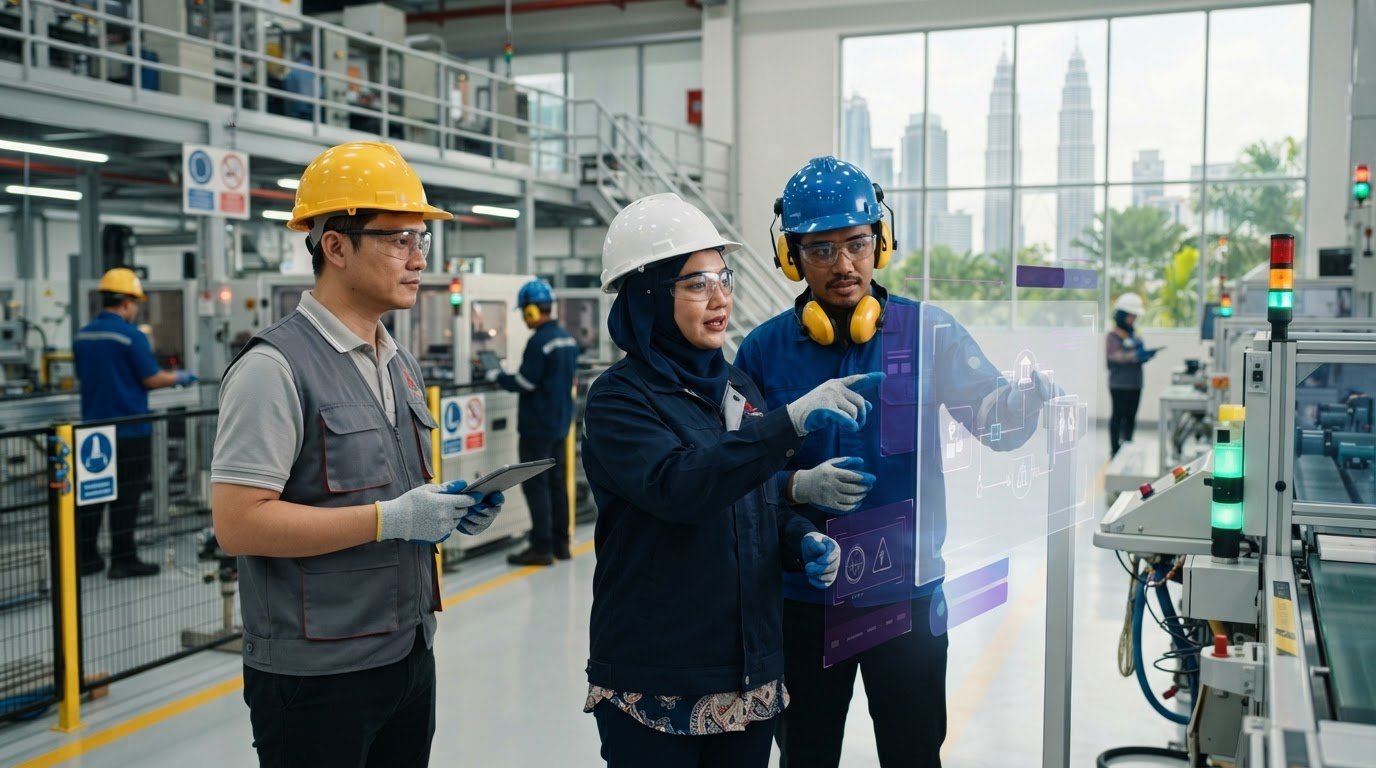
What if a safety video leaves employees just as unsure about the next step as they were before watching? An HSE training video Malaysia teams can use should do more than present information. It should make real procedures easier to understand and follow in the work environment where they matter.
That takes more than a polished script. Instructions need to match your organisation’s actual processes, and safety leaders and subject-matter experts need a clear way to review the facts, visuals, and wording. When those pieces align, video can turn dense guidance into a practical visual reference.
This guide explains how to plan, produce, and assess HSE training videos with reviewers and viewers in mind. You’ll learn what makes a video credible, how to choose a format for the procedure and audience, and why accessibility, updates, and distribution belong in the plan from the start. VISIOLAB brings strategic video production and motion graphics to complex subjects, helping organisations shape procedures into clear visual content. The goal is guidance employees can understand and apply at work.
• See how an HSE video can clarify sequences, hazards, equipment use, and workplace decisions.
• Build a production workflow that moves from defining the task to expert review and distribution.
• Choose live action, animation, or platform-hosted learning based on the procedure, audience, and viewing context.
• Plan review roles, languages, accessibility, and delivery channels before production begins.
• Assess an HSE training video Malaysia production partner by how well they translate complex processes and collaborate with your subject-matter experts.
An HSE training video is a focused visual guide that explains a health, safety, or environmental procedure, hazard, or work decision to a defined audience. Unlike a corporate film, which presents an organisation, its people, or its identity, a training video centres on a practical task: what to notice, what to do, and what to avoid. HSE stands for health, safety, and environment, within the wider field of Occupational safety and health (OSH).
Video is useful when words alone make a process hard to picture. It can show the order of steps in a repeatable procedure, draw attention to a hazard in a work area, demonstrate equipment use, or pause at a decision point to explain a safer response. If a procedure is difficult or unsafe to film directly, animation can illustrate movement, internal mechanisms, or changing conditions without staging the hazard.
A video supports training. It doesn’t replace competent instruction, supervision, workplace processes, or practical experience where these are needed. A demonstration may introduce a task, while hands-on practice and assessment help determine whether someone can perform it in the actual work context. Choose the format for the task and training purpose, not simply because it looks novel.
Consider video for repeatable procedures, site orientation, and hazard-recognition scenarios. A visual walkthrough can clarify sequence and location, such as showing where a worker should pause, check a control, or report a concern. Use real work settings when they accurately represent the process. For tasks requiring physical skill, pair the video with appropriate practice or assessment rather than treating viewing as proof of competence.
Start with the people who will use the guidance: employees, contractors, and supervisors. HSE teams can verify safety details, while communications teams can help make the language and visuals clear. Their input should reflect actual roles, equipment, work conditions, and experience levels. One video may not suit every job or risk. Separate versions or targeted modules can keep each message relevant.
For an HSE training video Malaysia organisations can use across teams, align the creative approach with the source procedure and expert review. VISIOLAB produces safety and training videos, including motion graphics that can help explain complex processes. The production partner shapes the visual explanation, while the organisation’s subject-matter experts remain essential to checking that it reflects the intended work practice.
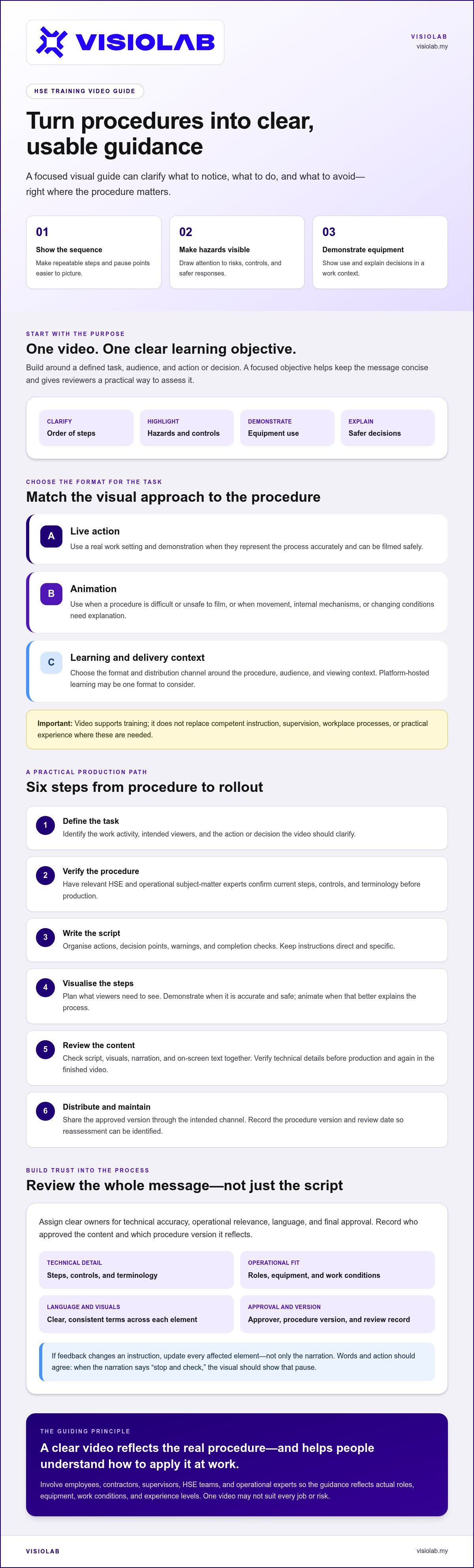
A reliable HSE training video starts with an approved procedure, not a camera or animation style. Build the content around one clear learning objective, such as identifying a specific hazard or following a defined sequence. A focused objective keeps the message concise and gives reviewers a practical way to check whether the video serves its purpose.
Identify the work activity, intended viewers, and the action or decision the video should clarify.
Ask relevant HSE and operational subject-matter experts to confirm the current steps, controls, and terminology before production begins.
Organise the procedure into actions, decision points, warnings, and completion checks. Keep each instruction direct and specific.
Plan what viewers need to see. Use a real demonstration when it can be filmed accurately and safely. Use animation when it can clarify a process that is difficult to show.
Check the script, visuals, narration, and on-screen text together. Verify technical details before filming or animation, then check them again in the finished video.
Share the approved version through the intended channel. Record the procedure version and review date so teams can identify when the video needs reassessment.
Make the relationship between words and action unmistakable. If the narration says to stop and check, the visual should show that pause, not a worker continuing to the next step. Use consistent terms in the voice-over, captions, labels, and demonstrations. Contradictions can confuse viewers even when each element seems clear on its own. Where local laws, standards, agency guidance, or HIRARC references are relevant, verify the current source and its application to the specific topic before citing it. The National Institute of Occupational Safety and Health (NIOSH) can be one starting point for consulting Malaysian OSH information.
Give the review process clear owners. Assign reviewers for technical accuracy, operational relevance, language, and final approval. Record who approved the content, which procedure version it reflects, and the review date. If feedback changes an instruction, update every affected element, not just the narration.
For an HSE training video Malaysia teams can use with confidence, expert review must shape the visuals as closely as it shapes the script. Organisations developing safety and training videos can explore VISIOLAB’s safety and training video production as one production option.
Choose a format by asking what the learner needs to see or do. Live action can show real equipment and interactions. Animation can reveal a hidden process or clarify a complex spatial relationship. A learning platform can organise video into structured modules and, where its features allow, track completion. These approaches can work together: a custom video can explain a task, while a platform provides a way for learners to access it.
| Format | Demonstrability | Visual complexity | Update needs | Delivery context |
|---|---|---|---|---|
| Live action | Strong for visible tasks, equipment, and interactions | Shows real environments; less suited to hidden processes | May need refilming if procedures, equipment, or sites change | Useful for briefings, orientations, or platform modules |
| 2D or 3D animation | Illustrates steps and concepts rather than real performance | Can show internal mechanisms, movement, or abstract hazards | Visuals can be revised, depending on the changes required | Can be shared as a standalone video or within a learning platform |
| Platform-hosted learning | Depends on the video and learning materials included | Depends on the content format | Depends on platform and content update processes | Fits structured modules and supported completion tracking |
Use live action when viewers need to recognise equipment, a real workspace, a demonstration, or how people coordinate. Before filming, plan permissions, site access, and how to avoid disrupting operations. Set safe filming arrangements, and have an HSE or operational expert confirm that the depicted practice is accurate and suitable. A convincing scene still needs to reflect the approved procedure.
Animation can make spatial relationships, hidden processes, or abstract concepts easier to visualise, especially when filming them directly would be impractical. A learning platform may suit organisations that need to group lessons into modules or record completion, provided their system supports those functions. Choose a format according to the learning objective, audience, available systems, and how often the source procedure may change.
For an HSE training video Malaysia project, there’s no universal winner. Match the format to the work: show what can be safely and accurately demonstrated, animate what the camera cannot explain clearly, and use platform delivery when it supports the organisation’s training structure. A blended approach can combine these strengths without expecting one video to meet every need.
A clear brief gives the production team a reliable starting point and helps reviewers focus on what matters: whether the video reflects the work. Before production, align the audience, objective, approved procedure, review responsibilities, and delivery plan. This turns a broad request into a useful production scope and reduces assumptions that might otherwise need to be resolved later.
Capture practical details before scripting. Separate essential safety instructions from background context so the video stays focused on the task and intended viewers.
Identify who will watch, such as employees, contractors, or supervisors, and what they already know.
State what viewers should understand or do, and cite the source procedure, including its version or date.
List essential steps, decision points, warnings, and areas where people commonly need clarification.
Name the people responsible for checking technical accuracy, operational relevance, language, and final release.
Note filming locations or constraints, required languages, accessibility needs, and the intended distribution channel.
Consider whether people will watch on a shared screen, mobile device, or in a work setting where sound may be limited.
Plan for the real audience, not an idealised one. Captions, readable on-screen text, clear narration, and suitable language can make guidance easier to access across roles and viewing environments.
Decide how you’ll assess usefulness before release. Depending on the objective, this could mean a short knowledge check, a practical demonstration, viewer feedback, or observation of the task. These methods provide different signals, so interpret them in context. Completion or positive feedback alone doesn’t prove that a video caused a change in workplace performance.
Assign an owner to maintain the content, record the approved procedure version and review date, and set triggers for reassessment. A change to equipment, work steps, or relevant guidance may make a previously accurate video outdated. Review it against the current source before continuing to distribute it.
For help shaping a complex message into clear visual content, explore strategic explainer video production. A well-planned HSE training video Malaysia project connects the brief, expert review, and rollout from the start. To discuss the production approach, explore VISIOLAB’s video production work.
A suitable production partner should do more than make procedures look polished. They should help translate approved technical information into a clear visual story, while your organisation’s HSE and operational experts retain responsibility for procedural accuracy. When assessing an HSE training video Malaysia teams can use as a reference, consider the thinking and review process behind the finished video, not just its style.
Ask how the team turns a procedure into a script, storyboard, and visual demonstration. Find out when your subject-matter experts review each stage, how feedback and version changes are recorded, and who confirms final approval. Request relevant examples where available, then ask what the agency contributed. Don’t assume a corporate film or animation example demonstrates specific HSE project credentials.
How will the team identify the audience, purpose, and essential message?
How will complex steps or terminology be made understandable without changing their meaning?
When would the team recommend live action, animation, or a combination?
How are expert comments, approved changes, and final sign-off managed?
Can the agency show examples that demonstrate clear communication and explain what is or isn’t comparable to your project?
Strong collaboration leaves no ambiguity about responsibility: the production team develops the visual explanation, while client-appointed experts confirm that the procedure and safety details are accurate for the intended work context.
VISIOLAB produces safety and training videos, explainers, and 2D and 3D motion graphics. These capabilities can help shape complex procedures into clear visual content, including processes that are difficult to show directly. VISIOLAB supports the communication and production; your organisation’s subject-matter experts should review and approve procedural details.
For broader context on aligning video with organisational messaging, read about strategic corporate video production in Malaysia. If you’re assessing a production partner for a safety or training video, discuss an HSE training video project with VISIOLAB.
A strong HSE training video Malaysia project begins with a verified procedure and a defined audience. Keep each video focused on a practical objective, then choose live action, animation, or platform delivery according to what viewers need to understand. Plan expert reviews, accessibility, distribution, and updates before production so the guidance stays relevant to the work.
Video is one part of a broader training approach. It can clarify steps and decisions, while instruction, practice, or assessment may still be needed for particular tasks. A clear review and update process helps keep the content aligned with current procedures.
VISIOLAB is a Malaysia-based strategic video agency founded in 2016, with safety, training, and explainer video capabilities, alongside 2D and 3D motion graphics. Its production work can help organisations shape complex information into clear visuals, with procedural accuracy reviewed by the organisation’s own experts.
Ready to explore a video approach for your workplace procedures? Discuss your HSE training video with VISIOLAB. With the right planning and collaboration, complex guidance can become clearer, more practical, and easier to share.
An HSE training video is a focused visual guide to a health, safety, or environmental task, hazard, or decision. An HSE training video Malaysia organisations develop should reflect the actual procedure and the people expected to use it. It might show the order of a task, highlight a hazard, or explain a safer response. Unlike a corporate film, it centres on practical guidance rather than presenting an organisation or its broader identity.
No. A video can explain or reinforce a procedure, but it shouldn’t automatically replace instruction, supervision, hands-on practice, or assessment. Some tasks require people to demonstrate that they can use equipment or follow steps in the real work context. Decide how video fits alongside existing training by considering the task, audience, and applicable workplace processes, then have the responsible experts confirm that the approach is suitable.
Start with one clear learning objective and an approved source procedure. Shape the script around the actions, decision points, warnings, and checks viewers need to understand. Make sure narration, on-screen text, and visuals give consistent instructions. Ask HSE and operational subject-matter experts to check technical details before production and again before release. Choose a way to assess usefulness, such as a knowledge check, practical demonstration, or viewer feedback.
There’s no single best format. Match it to the content and viewing context. Live action can show real equipment, workspaces, and interactions. Animation can clarify hidden processes, spatial relationships, or concepts that are difficult to film directly. A learning platform can organise content into modules and may support completion tracking, depending on its features. Consider the objective, audience, available systems, and how the procedure might change.
Make the video only as long as needed to explain its objective clearly. A single procedure or decision point may suit a focused video, while a broader subject may need separate segments rather than one long lesson. Include enough context for viewers to understand the steps, but remove material that doesn’t support the objective. Test the script with intended viewers and subject-matter experts before production to check for gaps or unnecessary detail.
Review it whenever a relevant procedure, equipment, work context, or source guidance changes, and set a planned review date with a named owner. There isn’t one update interval that suits every video because the content and rate of change vary. Keep a record of the approved procedure version and review date. Before continued distribution, confirm that the instructions and visuals still reflect the organisation’s current approved practice.
A useful brief identifies the intended audience, job roles, learning objective, and approved source procedure. Include key actions, known points of confusion, review owners, approval steps, and the intended delivery channel. Note filming constraints or locations, required languages, accessibility needs, and likely viewing conditions, such as mobile or shared-screen use. Separate essential safety information from supporting context so the production stays focused and reviewers know what the video must communicate.
Let’s create and collaborate
We’re versatile multitaskers, and we thrive on a lot of projects. You've seen a few of our works that we are most proud of, and your project could be next in line.

Empowering brands with captivating visual stories, creating strong connections and growth.
