
What if the true cost of your internal video department isn't the payroll, but the missed opportunities for strategic impact? As we move through 2026, many Malaysian GLCs and MNCs find themselves at a crossroads. You've likely invested heavily in high-end gear and dedicated staff, yet the output oft...
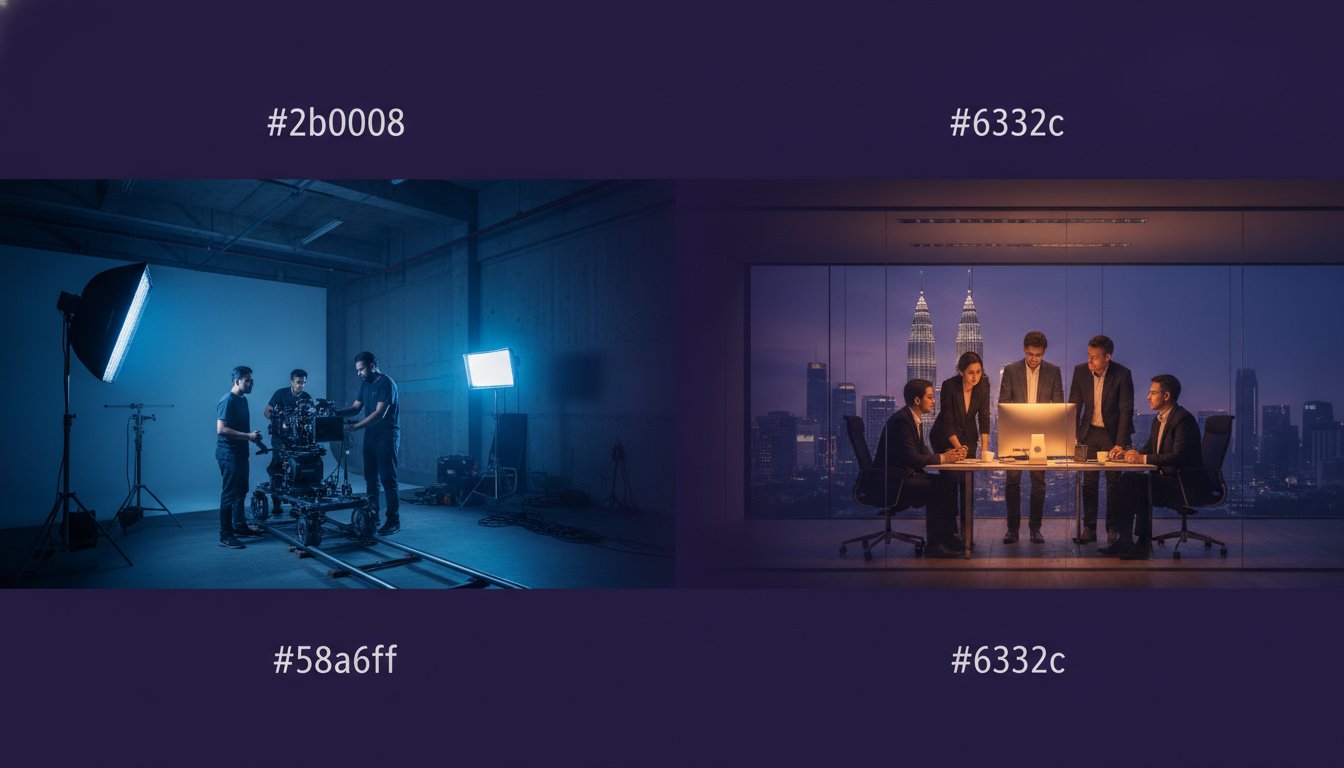
What if the true cost of your internal video department isn't the payroll, but the missed opportunities for strategic impact? As we move through 2026, many Malaysian GLCs and MNCs find themselves at a crossroads. You've likely invested heavily in high-end gear and dedicated staff, yet the output often lacks the polish required for high-stakes stakeholder engagement. It's a common tension. You want the agility of an internal unit. You need the cinematic authority of a specialist.
Deciding between an in-house video team vs hiring an agency is no longer a binary choice; it's a strategic architecture of resources. We agree that managing rising equipment costs and talent turnover is exhausting. This guide provides the definitive framework for 2026 to help you navigate this complexity. You'll discover how to balance internal frequency with external expertise to drive measurable corporate impact. We'll break down the ROI of production models, explore talent retention strategies, and show you how to scale capacity without bloating your headcount.
• Master the strategic framework for evaluating an in-house video team vs hiring an agency to ensure your corporate messaging maintains high-impact visual standards.
• Identify the hidden CAPEX and talent retention challenges that often undermine the long-term efficiency of internal production units.
• Learn why specialized projects like ESG storytelling and construction documentation require the editorial clarity and advanced gear of a strategic partner.
• Implement the 2026 hybrid model to balance internal agility for daily content with external expertise for high-stakes brand films.
• Establish a clear ROI framework that aligns video production capacity with stakeholder expectations without increasing permanent headcount.
Video isn't a luxury anymore. In 2026, it serves as the primary language of corporate Malaysia, accounting for 82% of global internet traffic. For GLCs and MNCs, the challenge has shifted from simply "producing video" to architecting a communication ecosystem that survives the noise. The debate between building an in-house video team vs hiring an agency often centers on speed, yet the real metric is strategic alignment. High volume doesn't equate to high impact if the narrative is diluted by internal echo chambers.
The core tension lies in the divide between frequency and value. Internal teams are built for the daily pulse: social updates, town hall recordings, and rapid-response comms. Strategic agencies are built for the milestones: ESG reports, safety training protocols, and brand documentaries. While an internal unit handles the tactical, a strategic partner functions much like a specialized advertising agency, focusing on high-level narrative architecture and technical precision that internal staff often lack the bandwidth to master.
MNCs are increasingly establishing small, agile internal hubs to manage "always-on" content. These teams possess a significant advantage: unmatched access. They know the brand's DNA. They understand the internal politics. They move with the speed of a Slack message. This proximity allows for a consistent presence on social platforms where authenticity beats high production value.
However, this model has a ceiling. Internal teams frequently face creative burnout, trapped in a cycle of repetitive tasks that stifle innovation. Without an outside perspective, the content risks becoming "corporate-centric" rather than "audience-centric." They often lack the specialized gear and high-end software required for complex 3D animations or cinematic visual effects, leading to a quality plateau that fails to impress high-level stakeholders.
Modern agencies have evolved far beyond the old "production house" label. They act as strategic architects who translate complex organizational goals into high-impact visual results. An agency brings more than just cameras; it brings a disciplined editorial clarity that forces a brand to look at itself through the eyes of the end-user. This external objectivity is the cornerstone of strategic corporate video production Malaysia.
Agencies maintain dedicated experts in lighting, sound design, and motion graphics who refine their craft across multiple industries.
Partnering with an agency allows you to scale production capacity for a major launch without the long-term overhead of increasing headcount.
Agencies invest in the latest 8K sensors and rendering farms, costs that are difficult for a corporate CAPEX budget to justify for occasional use.
By leveraging an agency, leadership ensures that high-stakes messages aren't just seen, but felt. Frequency requires proximity; impact requires perspective. The most successful organizations in 2026 don't choose one or the other. They build a bridge between the two.
The spreadsheet often hides more than it reveals. When evaluating an in-house video team vs hiring an agency, most organizations focus on base salaries and project quotes. This surface-level view ignores the heavy machinery of modern production. In 2026, staying relevant requires constant reinvestment in 8K sensors, LIDAR-equipped drones, and high-speed rendering farms. These are CAPEX-heavy assets with rapid depreciation cycles. An agency absorbs these costs across a broad client base, effectively providing you with high-end infrastructure on a per-project basis.
Talent follows a similar trajectory. Top-tier 3D animators and cinematic directors crave diversity in their portfolios. They thrive on the variety that agency life provides. For a GLC or MNC, retaining this level of specialized creative talent is a constant battle against boredom and better offers. Using a proven framework for deciding helps leadership see that while an internal team offers proximity, an agency offers a deep bench of expertise that is impossible to replicate within a single department.
The real cost of a full-time hire extends far beyond the monthly paycheck. You must factor in EPF, SOCSO, comprehensive benefits, and the significant expense of recruitment in a competitive market. Then there is the cost of downtime. When your internal team isn't filming, their overhead remains fixed. This "invisible" leakage drains budgets that could be allocated toward high-impact campaigns. Professional growth is another hurdle. In 2026, visual trends move fast. Keeping staff trained on the latest AI-assisted editing and virtual production techniques requires a dedicated budget for upskilling.
Agencies shift the financial risk from your balance sheet to theirs. You pay for the final deliverable, not the hours spent troubleshooting a technical glitch or a broken camera. This outcome-based model ensures that deadlines are met and quality is guaranteed. It's about buying certainty in a high-stakes environment. When choosing a video production agency in Malaysia, the ROI is found in the strategic impact of the visual narrative. You aren't just hiring a crew; you're securing a result. For organizations ready to move beyond basic execution, it's time to explore strategic production partnerships that prioritize results over headcount.
Technical limitations often define the boundary between functional content and strategic impact. While an internal unit handles basic interviews with ease, high-stakes storytelling requires a different level of editorial clarity. For projects like ESG video production Malaysia, the challenge isn't just filming; it's translating dense sustainability data into a narrative that resonates with global investors. This level of sophisticated messaging often exceeds the capacity of generalist internal staff. When debating an in-house video team vs hiring an agency, leadership must consider whether they are buying a service or a result.
Industrial sectors face even steeper technical hurdles. Documenting a multi-year project requires more than a standard camera. It demands the specialized precision found in construction progress video Malaysia, where long-term timelapse and drone LIDAR provide essential data for stakeholders. These aren't just visual assets; they're strategic records. Internal teams rarely have the bandwidth or the specialized gear to maintain these systems over years of development. An academic and research-based perspective on bringing expertise in-house suggests that while control is gained, the depth of specialized technical execution often suffers.
Modern corporate communication in 2026 relies on immersive technology. Creating a virtual product launch production Malaysia requires a complex stack of hardware and software that internal departments don't typically own. High-end 3D animation and motion graphics also present a significant barrier. These disciplines require dedicated rendering power and specialized artists who focus solely on visual effects. In the boardroom, "good enough" equipment fails because it lacks the cinematic authority needed to command attention during a national summit or a global launch.
Proximity breeds familiarity; familiarity often breeds blindness. Internal teams can easily become trapped by stale visual tropes because they're too close to the brand. They see the same offices and the same faces every day. An agency brings the benefit of cross-industry experience, having served diverse MNCs, GLCs, and government agencies. This external lens is vital for high-impact launching videos that require a level of production discipline that internal teams don't have the opportunity to develop. Agencies don't just follow the brand guidelines; they challenge them to ensure the final output feels fresh, modern, and energized.
A two-person internal team cannot effectively cover a national summit with multiple simultaneous tracks.
High-end montages and complex sound design require specialized suites that internal hubs rarely prioritize.
Agencies provide the necessary distance to cut through internal jargon and focus on what the audience actually needs to hear.
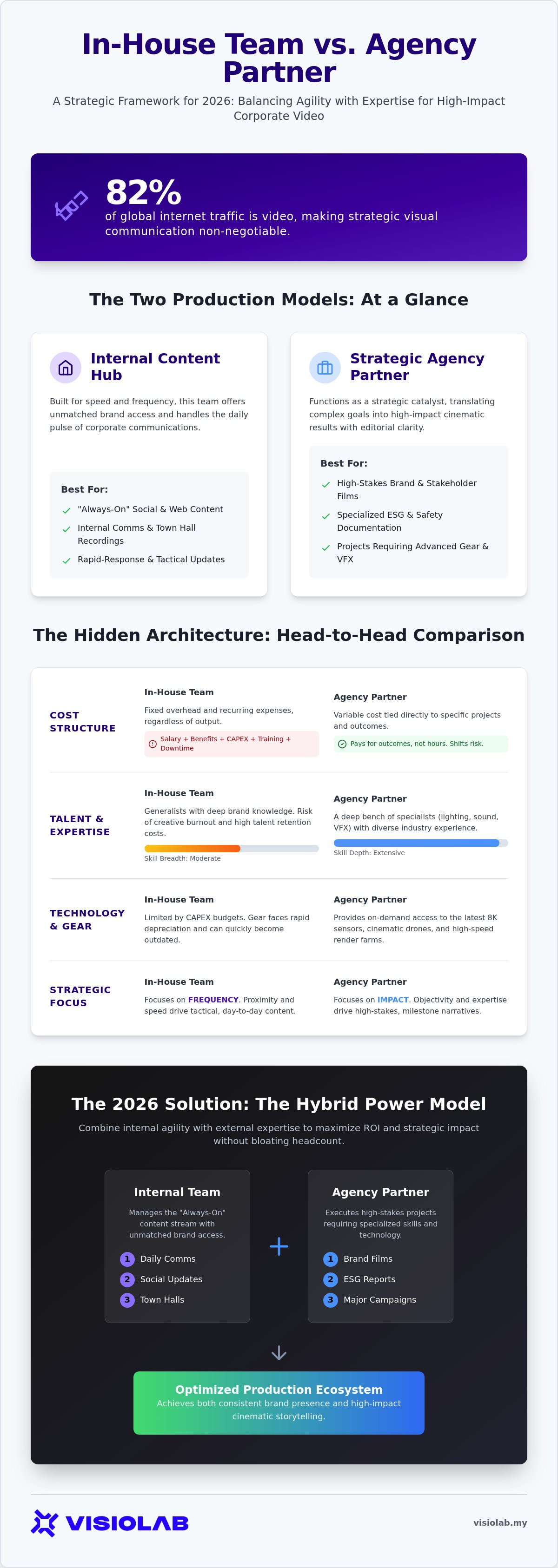
The 2026 standard for high-performing GLCs and MNCs is no longer a simple binary choice. It is a hybrid architecture. Leading organizations recognize that the debate over an in-house video team vs hiring an agency is actually a question of content tiering. By integrating both, you secure the agility of an internal unit alongside the cinematic authority of a strategic partner. This model doesn't just divide labor; it multiplies impact.
The 'Internal Liaison' strategy transforms your in-house staff from mere executors into strategic brand guardians. They manage the agency relationship: ensuring the external partner has the context they need while maintaining the central visual library. This shared asset ecosystem prevents brand drift. It ensures that cinematic footage from a high-end shoot can be repurposed by your internal team for rapid social updates. Communication protocols become the bridge: internal teams handle the pulse, while agencies handle the milestones.
Speed is the primary currency for internal teams. They are best suited for rapid-response social media updates and CEO announcements where the message's urgency outweighs its production value. Confidential internal training sessions also belong in-house, keeping sensitive protocols within the corporate firewall. Finally, use your internal resources for simple event documentation intended for archive purposes. If the goal is volume and proximity, the internal hub is your most efficient tool.
Complexity demands an external lens. When the goal is high-stakes communication, an agency provides the necessary editorial discipline. You need a partner for explainer video production Malaysia when launching intricate products to a global market. Similarly, a high-value corporate documentary Malaysia requires a narrative depth that only an outside perspective can craft for a brand legacy.
Industrial safety and training content for the energy and industrial sectors also require agency intervention. These films demand a level of technical precision and visual clarity that ensures compliance and protects lives. High production value isn't just about aesthetics: it is about engagement and retention in high-risk environments. When the stakes are high, the agency brings the discipline required to deliver results.
Ready to architect your own hybrid production model? Partner with VISIOLAB to elevate your strategic corporate films while empowering your internal team to manage the daily pulse.
VISIOLAB operates at the intersection of high-level strategy and technical execution. We understand that the tension between an in-house video team vs hiring an agency is often a search for clarity. Since our founding in 2016, we've functioned as the visionary architect for Malaysia's most influential organizations. Our approach moves beyond passive production; we act as a catalyst for transformation. We translate complex industrial requirements into high-impact visual results that command attention in the boardroom and far beyond.
Serving the pillars of Malaysia requires more than just a camera crew. It demands a partner who understands the unique pressures of GLCs, MNCs, and government sectors. We specialize in the high-stakes messaging that internal teams often find daunting. Whether it's the rhythmic precision of 3D motion graphics or the long-term documentation of national infrastructure, we bring a disciplined production environment to every project. We don't just capture footage: we architect perspective. Our mastery of both the creative and the technical ensures that your message is never lost in translation.
Complexity is the enemy of engagement. Our editorial process focuses on simplifying organizational narratives to ensure they deliver tangible stakeholder value. We maintain a high level of digital fluency, using modern visual language to reach audiences who are increasingly desensitized to standard corporate content. By bridging the gap between abstract ideas and tangible results, we ensure your visual assets work as hard as your strategy. VISIOLAB is the premier strategic partner for national-scale projects, delivering editorial clarity and technical precision to Malaysia's most influential organizations.
2026 is the year to move beyond the "good enough" plateau. As audience expectations evolve, your visual storytelling must match the ambition of your corporate goals. The transition from the conceptual "why" to the technical "how" is seamless with our team. We provide the scalable capacity you need without the permanent overhead of an expanded internal unit. Our production discipline ensures that every frame serves a purpose and every narrative drives a result. Elevate your perspective: secure your legacy. Partner with VISIOLAB to transform your corporate narrative today.
The choice between an in-house video team vs hiring an agency is no longer a trade-off; it's a strategic synthesis. We've established how internal hubs provide essential proximity, yet strategic agencies deliver the cinematic authority required for high-stakes corporate messaging. By adopting a hybrid model, your organization balances daily frequency with long-term strategic depth. You move beyond basic documentation toward intentional storytelling that resonates with global stakeholders. Proximity provides speed; perspective provides power.
Since 2016, VISIOLAB has specialized in this delicate balance, serving Malaysia's GLC and MNC sectors with unmatched editorial clarity. From complex 3D motion graphics to industrial long-term timelapse, we bring the technical discipline your narrative deserves. The future belongs to those who communicate with precision. Don't let your strategy be limited by your internal bandwidth. Elevate your corporate communication with VISIOLAB's strategic video production. Your vision is ready for its next transformation.
Cheaper depends entirely on your content volume. For daily social updates, an internal unit is efficient. However, the hidden costs of an in-house video team vs hiring an agency include gear depreciation and expensive software subscriptions. Recruiting specialized talent in 2026 involves significant benefits packages. Most GLCs find that for high-stakes projects, the agency model offers better cost predictability and shared infrastructure overhead without the long-term CAPEX burden.
Agencies primarily lack the immediate physical presence of a desk-side team. You can't walk over to an agency's desk for an unplanned CEO announcement at 5 PM. Lead times are generally longer due to the necessary pre-production discipline. Agencies also require a deeper briefing process to grasp internal cultural nuances. It's a trade-off between cinematic impact and the immediate tactical availability that an internal employee provides.
Readiness depends on your "always-on" content volume. If your marketing department requires more than three social media videos per week, an internal hub makes sense. You're ready when the cost of outsourcing small, repetitive tasks exceeds the salary of a generalist videographer. However, keep your strategic brand films with a partner. This ensures your internal staff doesn't hit a creative ceiling or suffer from the rapid obsolescence of high-end equipment.
The most successful 2026 models involve an agency acting as the strategic arm for an internal team. Your in-house staff acts as brand guardians, providing context and raw assets, while the agency handles high-end 3D animation and cinematic storytelling. This integration ensures brand consistency across all tiers. It allows your internal team to focus on agility while we focus on industrial-grade precision and editorial clarity for major stakeholders.
It's not about the ability to buy, but the logic of the investment. Agencies invest in 8K cinema sensors, LIDAR-equipped drones, and high-speed rendering farms that are difficult to justify on a corporate balance sheet. We use specialized optics and sound design suites that require dedicated operators. For high-stakes launching videos, these tools provide a level of visual authority that consumer-grade or mid-range gear simply cannot replicate in the boardroom.
ROI is measured through stakeholder resonance and strategic alignment. In Malaysia, this translates to improved investor confidence for ESG videos or reduced incident rates from safety training. You also measure the avoided costs of gear depreciation and talent churn. When evaluating an in-house video team vs hiring an agency, look at the impact-per-view. A cinematic brand film that secures a government contract delivers far more value than fifty low-quality social posts.
In-house teams excel at 24-hour turnarounds for tactical updates. Agencies prioritize the production discipline required for high-stakes results, which typically takes four to eight weeks. This timeline includes deep research, script refinement, and complex post-production like 3D motion graphics. While an agency is slower, the output is architected for longevity and brand legacy. It's the difference between a daily news report and a landmark documentary that defines your corporate history.
Yes, VISIOLAB specializes in safety video and ESG storytelling for the energy and industrial sectors. We understand the technical demands of the Malaysian energy landscape, providing the editorial clarity needed for complex documentation. Our expertise includes 3D animations for safety protocols and long-term timelapse for large-scale infrastructure projects. We act as your visionary architect, ensuring high-risk information is translated into high-impact, compliant visual content for your global stakeholders.
Let’s create and collaborate
We’re versatile multitaskers, and we thrive on a lot of projects. You've seen a few of our works that we are most proud of, and your project could be next in line.

Empowering brands with captivating visual stories, creating strong connections and growth.
