
What if a corporate film could carry one global brand voice without sounding like it was made for everywhere and nowhere? That’s the challenge behind a corporate video for multinational companies in Malaysia: keep the brand consistent while making its story meaningful to local employees, customers a...

What if a corporate film could carry one global brand voice without sounding like it was made for everywhere and nowhere? That’s the challenge behind a corporate video for multinational companies in Malaysia: keep the brand consistent while making its story meaningful to local employees, customers and stakeholders. A strong film needs more than polished visuals. It needs a defined audience, a message decision-makers can support and an objective tied to a business need.
Global messaging can feel generic in a local setting. When regional, corporate and local teams all shape the brief, approvals can also blur the central idea. Even a well-produced video can miss the mark if the team hasn’t agreed on what it should communicate or how to judge its effectiveness.
This guide explains how to bring those priorities together. You’ll learn how to align decision-makers around a focused message, adapt corporate storytelling for Malaysian audiences without losing brand consistency, and choose a format that suits your objective. It also covers how to set useful success measures, so your video can support a clear communication outcome.
• Define the communication objective and audience before choosing a corporate video format.
• Keep global brand essentials consistent while using Malaysian examples and voices to make the story relevant to local viewers.
• Match the format, from corporate films to explainers or ESG stories, to the message and intended audience.
• Plan a corporate video for multinational companies in Malaysia around one clear message, aligned decision-makers and meaningful success criteria.
• Use focused story development to turn complex organizational messages into clear, purposeful video.
A corporate video is a planned visual communication asset that uses story, sound and images to help an organization explain its purpose, priorities or work to a defined audience. It can support internal alignment, stakeholder understanding, reputation and organizational change. As this overview of corporate film explains, the format can take many forms. Its value depends on the communication job it is designed to do, not simply on how polished the final film looks.
For a multinational company, that job might be helping employees understand a new direction, making a complex initiative clearer to stakeholders or showing how the organization acts on its commitments. A focused film gives people a shared reference point. It can connect leadership language, local experience and organizational priorities in one coherent story, helping viewers understand not just what the company says, but why it matters to them.
In Malaysia, the story also needs to work across contexts. A regional brand may set the central promise, while local teams understand which people, examples and channels will make it relevant. The aim isn’t to create a separate identity for every audience. It’s to preserve the shared direction while adapting details for the people watching, whether they’re employees, customers, partners or the wider public.
A video may be shaped by regional, corporate and local teams, each with valid priorities. That shared ownership can strengthen the story, but it can also introduce competing messages if the audience and purpose aren’t clear. Language needs, cultural context and viewing environment matter too. A film shown to employees internally may need a different pace or level of explanation from one intended for external stakeholders.
A strategic corporate film focuses on the organization, its people, purpose or priorities. A product-led commercial centres on a specific offer and its appeal to potential buyers. Knowing the difference helps teams decide what belongs in the story and what could distract from its communication goal.
Before discussing locations, interview setups or visual style, ask what the intended audience should understand, feel or do after viewing. The answer is the communication objective. It gives decision-makers a shared test for creative ideas and keeps production choices connected to a business need rather than personal preference.
What information or organizational priority should be clear?
What perspective or confidence should the story build?
What next step, conversation or behaviour should follow?
Separate the objective from the execution. “Explain the company’s approach to change” describes a communication need; “use a fast-paced montage” is a creative preference. This distinction makes approvals more purposeful: stakeholders can assess whether each scene, voice and message supports the agreed outcome. For a corporate video for multinational companies in Malaysia, that clarity creates a stronger foundation for balancing shared brand direction with local audience needs.
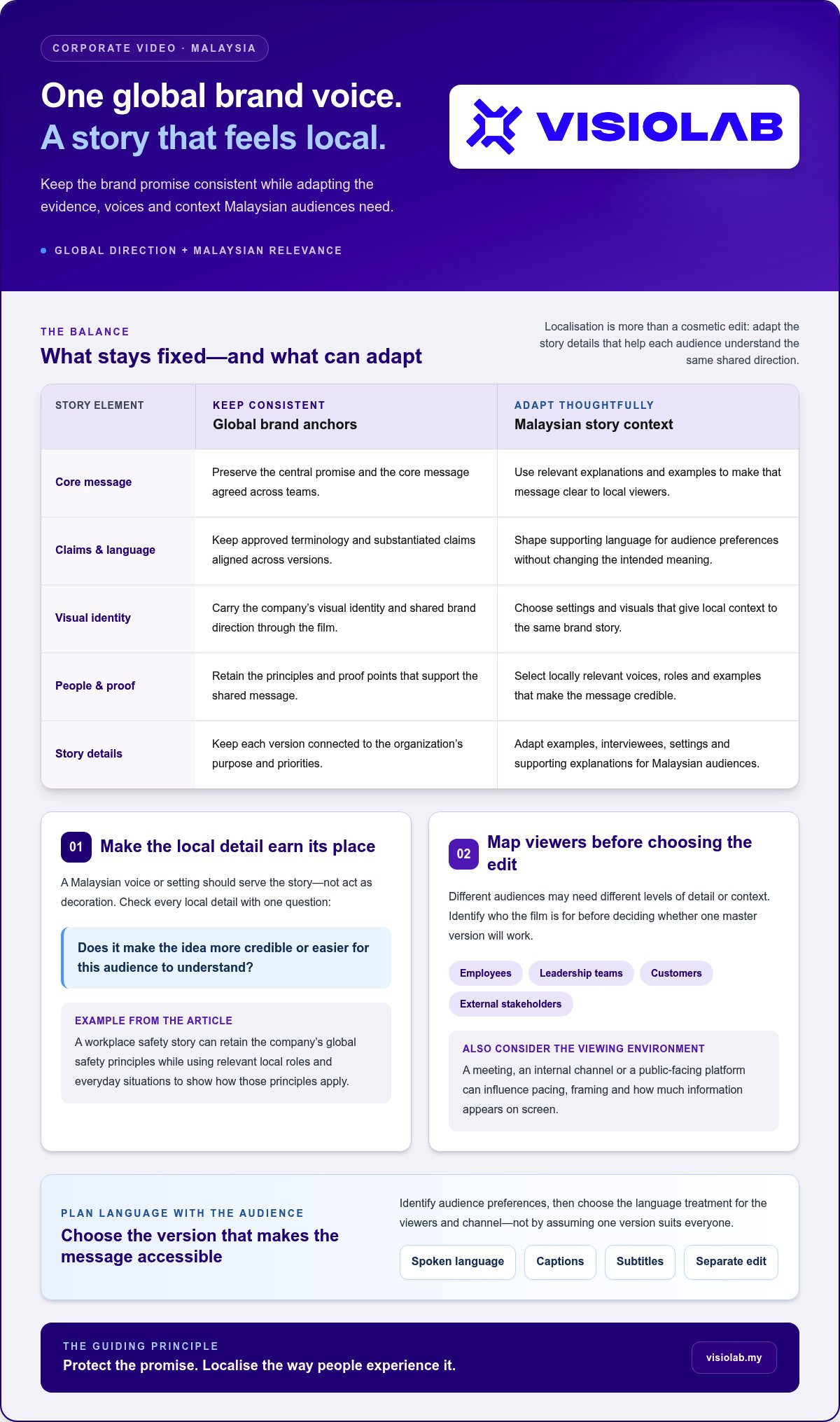
Global consistency doesn’t mean telling the same story in exactly the same way everywhere. It means protecting the brand promise while adapting the evidence, voices and context that help each audience understand it. This distinction turns localisation from a cosmetic edit into a deliberate storytelling decision.
Start by separating fixed brand elements from flexible story choices. The central promise, approved terminology, visual identity and substantiated claims may need to remain consistent across markets. Examples, interviewees, settings and supporting explanations can reflect Malaysian audiences when they make the message clearer. A workplace safety story, for instance, can retain the company’s global safety principles while using relevant local roles and everyday situations to show how those principles apply.
Give regional, corporate and local stakeholders a concise message framework before script development begins. It should state the core message, the proof points that support it and the visual principles that should carry through each version. Then test every local detail with one question: does it make the idea more credible or easier for this audience to understand?
A Malaysian voice or setting should serve the story, not act as decoration. For more perspective on the relationship between brand direction and local nuance, see this overview of branding in the Malaysian market. The same principle underpins strategic corporate video production: establish a clear communication framework, then shape the story around the people it needs to reach.
Map the audiences before deciding whether a single master film will work. Employees, leadership teams, customers and external stakeholders may share an interest in the subject but need different levels of detail or context. Include viewing circumstances in the map: will people watch in a meeting, through an internal channel or on a public-facing platform? These choices can affect pacing, framing and how much information appears on screen.
Plan language at the same stage. Identify audience preferences, then decide whether spoken language, captions, subtitles or a separate edit will make the message more accessible. Choose based on the viewers and channel, rather than assuming one version will suit everyone.
Preserve approved claims, key terminology and the brand’s central promise.
Use locally relevant examples and voices when they strengthen understanding.
Keep subtitles, captions and alternate edits aligned with the approved script and claims.
For a corporate video for multinational companies in Malaysia, this framework makes adaptation manageable: establish one strategic foundation, then decide what each audience needs. VISIOLAB brings message development and production discipline together to help organizations translate complex priorities into clear visual stories through strategic video storytelling.
The right format helps a particular audience understand a particular message. A corporate film can introduce an organization’s identity and direction, while an explainer can make a complex process easier to follow. Choose according to the communication need, not a production trend. Each format has different strengths, limits and opportunities for reuse.
| Communication goal | Primary audience | Suitable format |
|---|---|---|
| Explain organizational identity, direction or culture | Employees, partners and external stakeholders | Corporate film |
| Clarify a process, product concept or complex topic | Customers, employees or other groups learning something specific | Explainer video |
| Support consistent learning or communicate safe practices | Employees and teams carrying out relevant tasks | Training or safety video |
| Make sustainability commitments and work easier to understand | Stakeholders interested in the organization’s ESG story | ESG video |
| Capture key moments, speakers or perspectives from a gathering | Attendees and stakeholders who couldn’t take part | Event coverage |
A corporate film can connect leadership perspectives, organizational work and employee voices in a broader story. Its scope suits communication about identity or change, but it may be too broad when viewers need one specific instruction. An explainer narrows the focus, often using a clear sequence to unpack a process or idea. Training and safety videos centre on what viewers need to learn or apply, so the content should be precise and relevant to the task.
ESG stories need a different balance: they should make commitments and actions understandable without reducing them to general claims. If sustainability is the objective, the ESG video production guide explores how to shape that story. Event coverage can preserve presentations and capture stakeholder perspectives. Its value depends on whether the event contains stories worth sharing beyond the day itself.
Animation or motion graphics can make systems, sequences and abstract ideas visible. An animated diagram may clarify how information moves through a process; a live-action interview may be more effective when trust depends on hearing directly from a real person. Let the subject and audience guide the choice. Animation isn’t automatically clearer, and live action isn’t automatically more authentic.
Consider reuse as part of the decision. A focused explainer may be adapted into shorter segments for different internal channels, while a corporate film may need a distinct edit for audiences with different information needs. Reuse works best when the central message stays intact and each version has a clear purpose. For a corporate video for multinational companies in Malaysia, format is a strategic choice: match the story to the audience, then select the visual approach that serves it best.
A video serving several markets doesn’t have to become a compromise that says little to everyone. Start with one shared communication purpose, then decide whether audiences need the same film, adapted versions or supporting edits. A practical workflow helps regional and local teams make those choices before production decisions and review cycles gather momentum.
State the communication need in a sentence, such as helping employees understand a company-wide change or explaining an initiative to stakeholders. Keep it separate from creative preferences such as style, music or location.
Identify who needs the message, what they already know and what context they may need. Note relevant internal and external groups, including differences between Malaysian audiences and those in other markets.
Agree on the central point, supporting information and intended response. Record which claims, terminology and brand elements must remain consistent across markets.
Choose a corporate film, explainer, training video or another format according to the message and viewing context. Decide whether one master film can serve the audience or whether specific groups need a tailored edit.
Choose evidence that indicates whether the audience received the intended message. Set the measurement approach before release, so evaluation isn’t reduced to whichever platform numbers are easiest to find.
Turn those decisions into a brief that names the objective, audience groups, core message and intended action. Document brand requirements, subject-matter contributors and approval ownership too. Assign one person to consolidate feedback, and clarify who reviews accuracy, brand consistency and final approval. This helps prevent contradictory notes from reopening settled decisions.
List required versions, channels and accessibility considerations before production planning. For example, specify whether teams need captions, subtitles or separate edits for different audiences, and identify the language preferences that will guide those choices. If multiple markets are involved, distinguish the master content from market-specific adaptations. This approach helps teams decide whether a single corporate video can carry the core message or whether audience needs call for purposeful versions.
Views alone can’t show whether a video achieved its objective. Match indicators to the intended outcome: completion or engagement data can help assess viewing behaviour, while audience feedback can reveal whether people understood the message. For an internal change film, ask relevant employees what they understood and what remains unclear. For an external stakeholder story, gather feedback from the audience the film was designed to reach.
Combine platform data with direct feedback, then use the findings to guide future communication. The MNC video production buying guide covers broader partner-evaluation considerations. To build a brief around clear objectives, aligned stakeholders and meaningful success measures, start a conversation with VISIOLAB.
Complex organizations rarely lack information. The challenge is deciding what the audience needs to understand first, what evidence supports the message and how to present it without losing essential meaning. VISIOLAB brings strategic messaging, editorial clarity and production discipline together to shape corporate video around a defined communication objective.
That approach matters for a corporate video for multinational companies in Malaysia, where regional priorities, local audience needs and stakeholder input must come together in one coherent story. The work starts with the communication challenge, not the equipment or a visual trend. Once the audience and intended message are clear, creative choices can support understanding rather than compete with it.
Strategy shapes the story before production begins. VISIOLAB identifies the central idea, supporting points and audience perspective, then develops a narrative that gives viewers a clear route through the information. If an organization needs to explain a sustainability initiative, for example, an ESG story can connect its commitments with relevant actions and perspectives. If the subject is a process or concept, an explainer using motion graphics can make relationships easier to follow.
Format follows purpose. Corporate films can express organizational identity or direction; safety training can focus on practical guidance. The aim isn’t to fit every message into one treatment. It’s to make editorial choices that keep the story focused, the terminology clear and the level of detail right for its audience.
Production discipline carries that clarity through the agreed deliverables. A well-defined message and review process help keep the story consistent across planned edits or versions, while giving stakeholders a clear basis for assessing the work. This is useful when subject-matter contributors need to protect accuracy and decision-makers need to maintain a shared direction.
Start with three points: who needs to see the video, what they need to understand and which message must stay with them. Then add the context that will shape the story: relevant stakeholders, brand requirements, subject-matter input, intended channels and audience or version considerations. A focused brief gives creative development a strong foundation and makes decisions easier to align.
VISIOLAB is a Malaysia-based strategic video agency working with corporate, GLC, MNC and government sectors. Its work spans corporate films, ESG stories, safety training, explainers and motion graphics, connecting communication goals to clear visual narratives and disciplined production.
Ready to shape a complex message into a focused corporate video? Discuss your corporate video project with VISIOLAB, starting with your audience, objective and essential message.
Turn a broad organizational priority into a focused brief: identify the audience, the message they need to take away and the response the video should support. That foundation gives creative decisions a purpose and helps teams move forward with greater clarity.
For a corporate video for multinational companies in Malaysia, local relevance and global direction can work together when the story is built around what audiences need to understand. VISIOLAB helps organizations shape complex messages into purposeful visual communication. Its work spans corporate, GLC, MNC and government sectors.
Bring your communication objective, key stakeholders and intended audience into the conversation. Start a strategic corporate video conversation with VISIOLAB and take the first step toward a story with clear direction and purpose.
Make it only as long as the message needs. A concise leadership update may work as a short piece, while a detailed organizational story may need more room for context and evidence. Consider where people will watch and what they need to retain. If one film must serve different channels, plan a main version alongside shorter edits, so viewers can access the right level of detail without crowding one cut.
Yes, if both audiences need the same central message and the content is suitable for each. A leadership film about a company priority might work for employees and external stakeholders, but internal viewers may need operational detail that external viewers don’t. Review examples, sensitive information and calls to action for each audience. If needs diverge, keep the shared story and create audience-specific edits rather than forcing every detail into one version.
Employees should understand the interview’s purpose, who will see it and the key points they’re expected to explain. Prepare examples or facts that support those points, and flag technical terms that may need a plain-language explanation. They don’t need to memorise a script; natural, direct answers are easier to follow. Check internal terminology and claims with the relevant team before filming, so the interview remains accurate and consistent.
The cost depends on the project’s scope, including the chosen format, story development, filming needs, animation or motion graphics, and the number of versions required. Approval complexity and distribution requirements can also shape the work involved. An MNC brief may range from a focused interview to a multi-audience corporate film, so a useful estimate needs a defined scope. Set priorities first, then assess production choices against the communication need.
There isn’t one fixed production timeline for every MNC project. The schedule depends on the brief, filming and editing requirements, number of versions, and how quickly stakeholders can review each stage. Build review periods into the plan, especially when subject-matter experts, brand teams and regional approvers all need input. Consolidated feedback at each review helps limit conflicting revisions and gives the production team a clearer path to final delivery.
Yes, when the story gives prospective employees a credible view of the organization and its working culture while reinforcing the wider brand. Employee perspectives can add a human dimension to a company story, while an external version may focus more on organizational identity. Be clear about the intended audience and avoid promising a candidate experience the film can’t substantiate. Separate edits can foreground recruitment or brand context as needed.
Pause creative decisions and resolve the disagreement at message level. Ask stakeholders to distinguish essential facts and approved brand language from preferences about tone, visuals or emphasis. Then name one decision-maker to settle unresolved points, with subject-matter reviewers checking accuracy in their areas. If audiences genuinely need different information, document that difference and plan distinct edits. This keeps the project moving without blending competing priorities into an unclear script.
Let’s create and collaborate
We’re versatile multitaskers, and we thrive on a lot of projects. You've seen a few of our works that we are most proud of, and your project could be next in line.

Empowering brands with captivating visual stories, creating strong connections and growth.
