
What if the most polished corporate film is still the wrong film? A search for “production house Malaysia” may begin with visuals, budgets, and deliverables. The more useful question is whether a production partner can turn your communication goal into a story your audience understands. A video can...
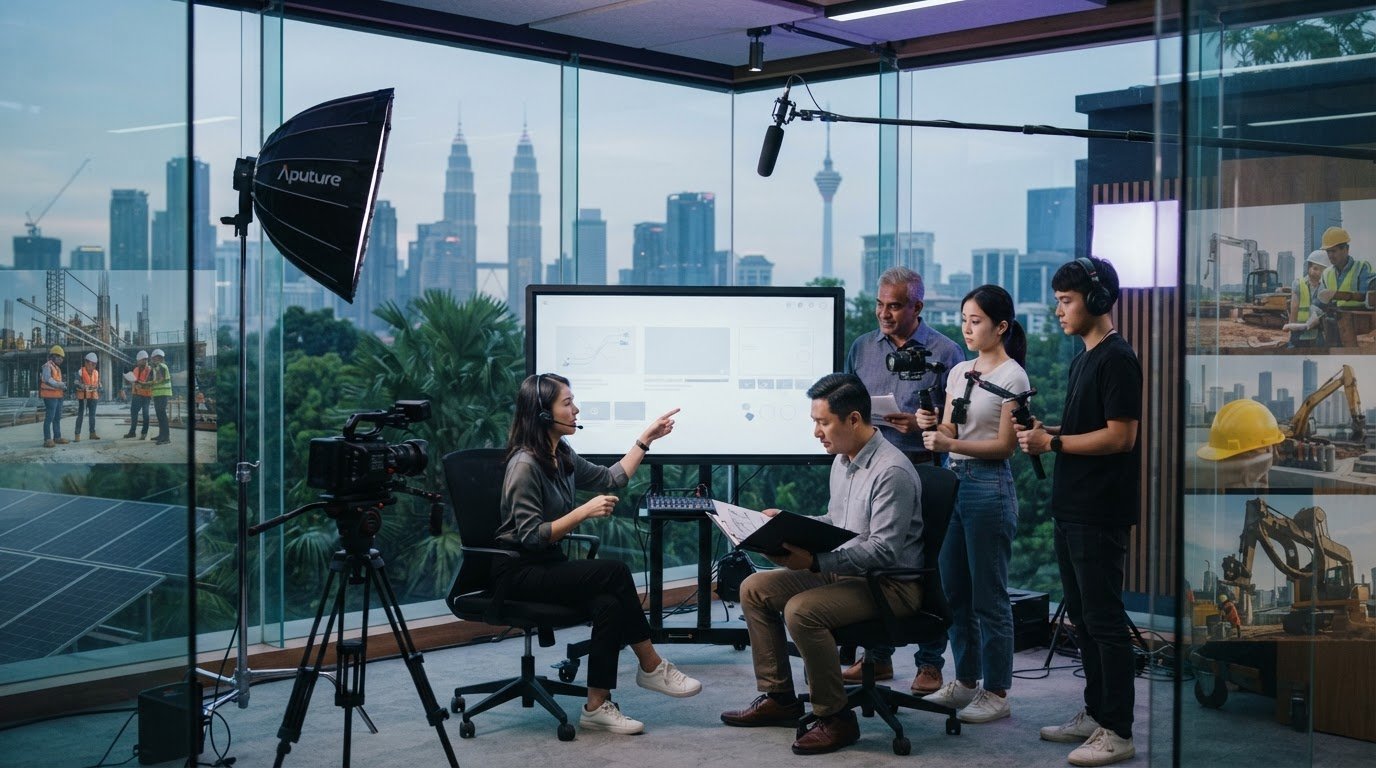
What if the most polished corporate film is still the wrong film? A search for “production house Malaysia” may begin with visuals, budgets, and deliverables. The more useful question is whether a production partner can turn your communication goal into a story your audience understands.
A video can look impressive yet leave its message unclear. When the subject is complex, from company priorities to ESG initiatives or safety procedures, strong visuals alone aren’t enough. The strategy, story, and production need to work together.
VISIOLAB is a Malaysia-based strategic video agency founded in 2016. This article explains what a production house can deliver, how to shape a useful brief, and how to select a format that fits your audience and purpose. It also shows how strategic thinking can connect an organisational message to corporate films, training and safety videos, ESG stories, animations, and project documentation. The aim is to turn information your organisation needs to share into visual communication people can follow.
• Start your video brief with the audience, purpose, and message you want people to understand, not just a list of shots.
• Match the format to the communication need: an organisational film, training video, and project documentation each serve different purposes.
• When comparing a production house malaysia partner, look beyond visual polish to message strategy, relevant formats, and production planning.
• Align stakeholders and creative direction early so the message stays clear from the initial brief through the finished film.
• Experience with corporate, GLC, MNC, and government organisations can inform how a strategic video agency approaches complex communications.
A production house brings together the planning, creative work, and production needed to make video content for a defined audience and purpose. For corporate teams, that involves more than arranging cameras and recording footage. The work begins by clarifying what the organisation needs to communicate, who needs to understand it, and how video can make the message clear.
A corporate production house connects communication goals to storytelling and production, shaping information into a visual narrative for a specific audience and use.
That distinction matters when searching for a production house malaysia organisations can work with. A directory can help teams find providers and compare categories. A strategic video partner connects the communication objective to editorial choices, creative direction, and production execution. Each decision should help keep the finished content relevant to its audience.
Video can help when a message needs context, structure, or a human perspective. A business announcement may need to explain a change. A stakeholder film may need to bring priorities into focus. Training or safety content may need to demonstrate a process. A public-facing story may need to make an organisation’s work more tangible.
For corporate, GLC, MNC, and government teams, information can span departments, projects, and stakeholder groups. A carefully structured visual narrative guides viewers from the central idea to supporting details, using interviews, demonstrations, animation, or project footage where they fit. The wider Cinema of Malaysia offers context on the country’s film landscape, while corporate video serves distinct organisational communication needs.
Corporate video is shaped by its audience, message, intended use, and organisational context. A training film for employees has a different purpose from an ESG story for stakeholders or a corporate film introducing an organisation’s capabilities. Choose the format to serve the communication task, rather than letting the format dictate the story.
Strong visuals and sound can hold attention, but clarity gives them direction. Viewers should be able to follow the main point, understand why it matters to them, and see how the details connect. That requires decisions about what to include, what to simplify, whose perspective to show, and what tone fits the organisation. Thoughtful production makes complex information easier to follow without losing its substance.
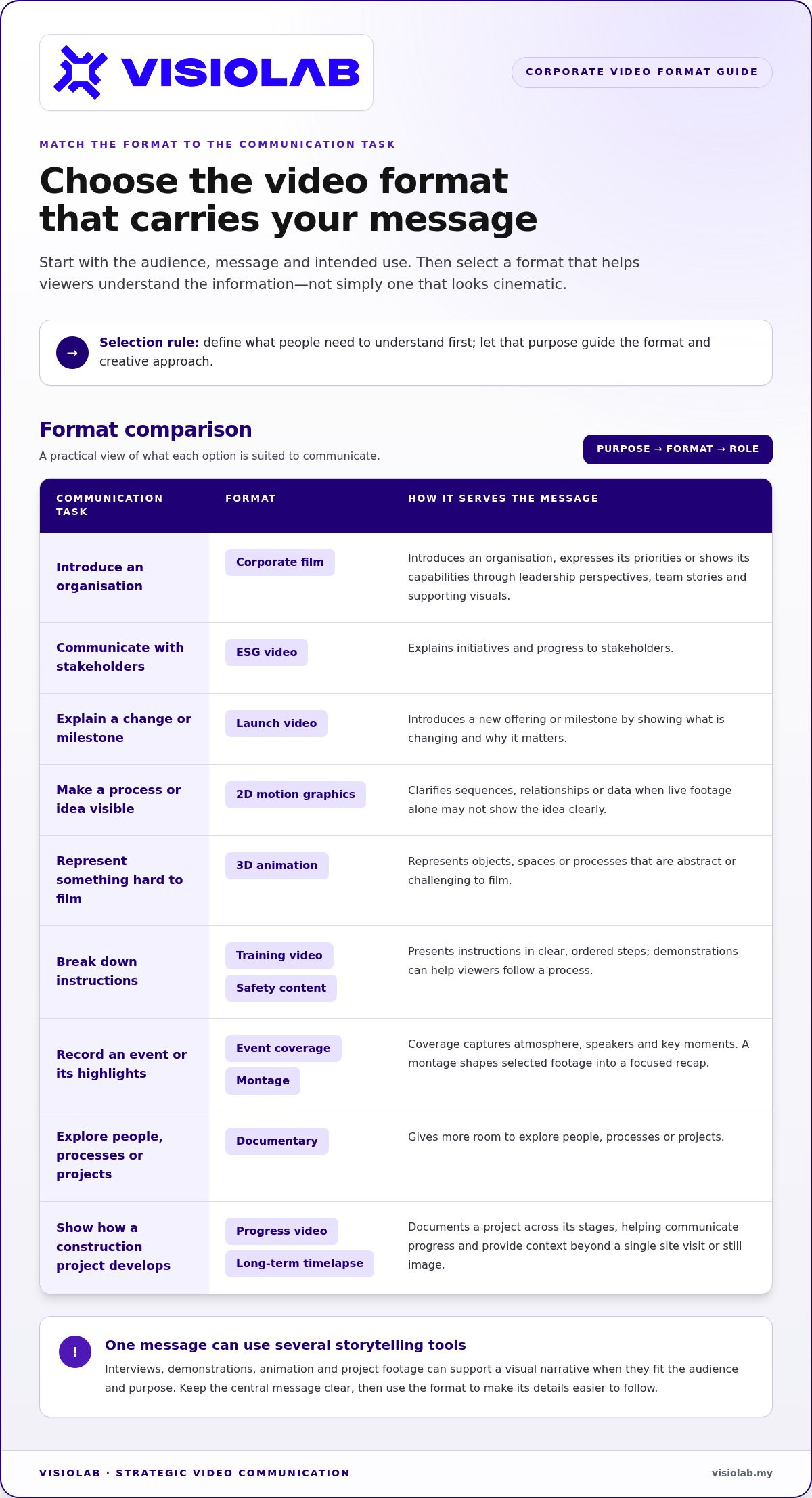
Choose the format by the communication task, not by what looks most cinematic. A corporate film can introduce an organisation, express its priorities, or show its capabilities through leadership perspectives, team stories, and supporting visuals. An ESG video can explain initiatives and progress to stakeholders. A launch video can introduce a new offering or milestone by showing what is changing and why it matters.
Other formats serve different needs. Event coverage captures key moments and voices, while a montage shapes selected footage into a concise recap. A documentary gives more room to explore people, processes, or projects. For a production house malaysia corporate team, the right choice depends on the audience, message, and intended use.
When a process or idea is difficult to show with live footage alone, animation can make it visible. 2D motion graphics can clarify sequences, relationships, or data. 3D animation can represent objects, spaces, or processes that are abstract or challenging to film. Explainer videos can bring these elements together, while training and safety content can break instructions into clear, ordered steps. Explore explainer video production in Malaysia for more on structuring complex information for viewers.
Construction progress videos and long-term timelapse document how a project develops, creating a visual record across its stages. They can help teams communicate progress and provide context that a single site visit or still image may not capture. See how construction progress video documentation can support project storytelling.
Event coverage suits conferences, launches, and organisational gatherings where the atmosphere, speakers, and key moments matter. A montage can bring selected highlights into a focused narrative. The goal is not simply to record everything, but to preserve the moments most relevant to the intended audience.
Start with the communication need, then match it to a format and creative approach. Explore VISIOLAB’s corporate video work to see how strategic storytelling and production can come together.
A visually impressive film can still miss the mark if viewers don’t understand its point. Assess a production house by how it connects your communication objective to the story, format, and production plan, not by polish alone. Compare how well each proposed approach fits your audience and project requirements.
| What to assess | What a strong fit looks like |
|---|---|
| Message strategy | The central message and audience are clear before creative choices take shape. |
| Relevant formats | The proposed format suits the purpose, such as training content for instruction or an ESG story for stakeholder communication. |
| Production planning | Story, people, locations, and essential content are considered in relation to the project’s requirements. |
| Intended audience | The tone, detail, and visual approach reflect who will watch and what they need to understand. |
For a production house malaysia search, this framework helps distinguish a project-fit assessment from a general list of services. VISIOLAB focuses on strategic messaging and editorial clarity, connecting the communication goal to the story and supporting that story through production decisions.
Give the production team a focused starting point. State the communication objective, primary audience, core message, and intended use. Identify key stakeholders and subject-matter contributors, note required formats, and list information that must appear. Separate essentials from creative possibilities so the film can engage viewers without losing its purpose.
For example, a brief for an internal safety video might identify the employees who need the guidance, the procedure they need to understand, and the actions the video should explain. That direction is more useful than a broad request for a “cinematic” video because it gives the story a clear job.
An agreed message gives the project a decision-making anchor. It informs the story structure, format, interview questions, visuals, and production planning. As creative ideas develop, assess whether they make the message clearer for the intended audience and fit the project requirements. Learn more about strategic corporate video production in Malaysia and how strategy connects to execution.
Review proposed work and approaches against your objectives. The strongest fit is the one that brings the message, audience, and production into alignment.
A clear production workflow keeps a video’s purpose visible from the first conversation to the final edit. The approach depends on the project, but the main stages are consistent: define the communication objective, shape the brief, develop the story, plan and produce the content, then review it against the intended message.
A production house turns a communication objective into a focused story, then brings that story to life through planned production and considered editing.
Early alignment matters. When stakeholders agree on the audience, essential information, and creative direction before production begins, the team has a shared reference point for decisions. This helps prevent a polished scene or attractive idea from pulling the film away from its purpose.
Define what the video needs to communicate and to whom.
Organise the message into a narrative and select a format that supports it.
Capture or create the material needed to tell that story.
Shape the content so it remains clear and aligned with the brief.
Bring together source information, stakeholder perspectives, audience needs, and messages that must be included. Distinguish essential content from supporting detail. This gives story development a clear foundation and helps production planning account for the selected format, contributors, and project requirements. Shape schedules and approval steps around the brief, since each project has its own needs.
A useful starting question is: what should the intended audience understand after watching? The answer can guide the story without dictating every creative choice.
The agreed approach determines how the story is made. A project may use filmed interviews, animation, motion graphics, or visual documentation, depending on its message and format. During editing, the team selects and orders material to preserve clarity, tone, and consistency with the brief. See how strategic impact versus basic video execution can shape production decisions.
For a production house malaysia project, disciplined execution means keeping creative choices connected to audience needs and communication goals, rather than treating production as a sequence of technical tasks alone.
Explore VISIOLAB’s strategic video production to see how communication objectives can guide a project from brief to finished film.
VISIOLAB is a Malaysia-based strategic video agency founded in 2016. It works with corporate, GLC, MNC, and government organisations, where communication often needs to serve different stakeholders while keeping a clear central message. The focus is not simply on polished footage. It is on connecting the communication objective to editorial clarity and disciplined production.
That approach matters when a subject has many layers. A corporate film can bring an organisation’s identity, priorities, or capabilities into focus. An ESG story can help stakeholders understand initiatives. Training and safety videos can organise information for employees, while construction progress documentation can show how a project develops. The format changes, but the need for a clear, relevant story remains.
Clarity starts with identifying what the audience needs to understand. VISIOLAB turns complex organisational messages into visual content, shaping information into a story that fits the format and intended use. For a corporate film, that may mean bringing organisational priorities and capabilities together. For training or safety content, it means structuring information so viewers can follow the subject step by step.
ESG stories call for a different editorial focus: selecting details and perspectives that help stakeholders understand an organisation’s initiatives. Across these formats, strategic messaging guides creative decisions, while production discipline keeps the work connected to its communication purpose. For organisations comparing a production house malaysia option, the value lies in how well the story and its execution serve the audience.
For multinational teams, communication may need to address varied stakeholder contexts. For GLC and government organisations, messages may involve complex programmes, priorities, or public-facing information. The approach starts with the specific audience and subject, rather than assuming one format or style suits every project.
Explore video production for MNCs in Malaysia for more perspective on shaping video projects around organisational communication needs.
Start with four essentials: who needs to watch, what the video should communicate, which message matters most, and where the content will be used. Those answers give the project a useful foundation. From there, the creative direction and suitable format can take shape around the objective.
Bring VISIOLAB your corporate video project to discuss its audience, message, and intended use. Discuss your video project with VISIOLAB.
The right production house malaysia partner does more than capture polished visuals. It connects your audience and communication objective to a story, format, and production approach that make the message easier to follow. A focused brief and early alignment help keep that purpose clear from planning through the finished video.
VISIOLAB brings strategic messaging and production discipline together, working with corporate, GLC, MNC, and government organisations. Its approach is shaped around each project, whether the subject is organisational priorities, ESG, training, safety, or project documentation.
Start with what your audience needs to understand, then shape the story and production around that goal. Shape your next corporate video with VISIOLAB and turn a complex message into purposeful visual communication.
A production house develops and produces video content for a defined audience and purpose. For corporate teams, that can mean shaping a message into a story, planning production, filming or creating visuals, and editing the content into a finished video. VISIOLAB works with corporate, GLC, MNC, and government organisations, connecting communication goals with formats such as corporate films, ESG stories, training content, and project documentation.
Choose a partner whose approach connects your message, audience, format, and production plan. A production house Malaysia search should go beyond visual style: consider whether the proposed story serves your communication objective and whether relevant work reflects your project’s needs. Before comparing options, define what viewers should understand, where the video will be used, and which details are essential. These points make project fit easier to assess.
A corporate production house can create different formats for different communication needs. These include corporate films, explainer and training videos, safety videos, ESG stories, launching videos, commercials, documentaries, event coverage, montages, animations, construction progress documentation, long-term timelapse, and virtual experiences. The best fit depends on the audience and intended use. For example, animation can help illustrate an abstract process, while event coverage records key moments and perspectives.
Corporate video production costs depend on the project’s scope, so there isn’t one universal price. The work may involve filming, animation, motion graphics, project documentation, or a combination of formats. The story, production requirements, and content needed also shape the project. A clear brief helps define the scope before costs are discussed. Compare proposals by checking that their scope and production approach address the same objectives.
Include the communication objective, primary audience, core message, and intended use. Add essential information, relevant source materials, stakeholder perspectives, and the people who can provide subject-matter input. Specify required formats or content, then separate must-have details from creative opportunities. For instance, a safety video brief should identify the procedure viewers need to understand and the key instructions the story must cover. This gives the production team a clear foundation for planning.
Production time varies with the brief, format, project requirements, and review process. A filmed corporate story, an animation, and long-term project documentation involve different kinds of planning and production. Stakeholder input and approval steps also affect the schedule. Define the intended content and the people involved early so the production plan and schedule reflect the actual project.
Yes. A production house can develop training and safety videos that organise instructions into a clear visual sequence. Depending on the subject, the content may use filmed demonstrations, interviews, animation, or motion graphics to explain procedures and concepts. VISIOLAB produces explainer, training, and safety content for organisational audiences. A focused brief helps identify who needs the guidance, what they need to understand, and which information the video must communicate.
The terms can overlap. “Production house” often describes a team focused on developing and producing video, while “video agency” can signal a broader emphasis on communication strategy alongside creative and production work. The label alone doesn’t determine the approach. VISIOLAB combines strategic messaging with production discipline, connecting an organisation’s communication objective to editorial choices and video execution.
Let’s create and collaborate
We’re versatile multitaskers, and we thrive on a lot of projects. You've seen a few of our works that we are most proud of, and your project could be next in line.

Empowering brands with captivating visual stories, creating strong connections and growth.
