
In Malaysia, the video marketing trends in Malaysia 2026 favour a two-part approach: use short, vertical videos of 15 to 45 seconds to earn discovery, then give interested viewers a more detailed video to support their decision. The format matters, but so does the message: make it useful, relevant a...

In Malaysia, the video marketing trends in Malaysia 2026 favour a two-part approach: use short, vertical videos of 15 to 45 seconds to earn discovery, then give interested viewers a more detailed video to support their decision. The format matters, but so does the message: make it useful, relevant and easy to follow.
It makes sense to want one video to do everything. But a clip designed to stop a scroll has a different job from a film that explains a complex offer or builds confidence. Treat them as connected moments in the same viewer journey, not competing formats.
This article explores how platform recommendations shape discovery, how short-form video can lead viewers to longer content, and what Malaysian audiences look for in informative, personally relevant stories. It also considers where AI can support video creation, why human direction still matters, and how multilingual content can clarify a message for Malaysia’s diverse audiences. The aim is to help you decide what to create, where each format fits, and how to connect attention with action.
• Match each video’s format and purpose to the platform: design for discovery first, then guide interested viewers toward deeper content.
• Build a connected short-to-long video journey, with a clear next step that helps viewers move from attention to consideration.
• Lead with useful information and personal relevance; shape the story around the audience’s needs rather than the brand’s talking points.
• Use AI to accelerate parts of production, such as captioning, while keeping human review responsible for accuracy, tone and context.
• Choose BM-first or multilingual versions according to the audience and message, so each viewer can follow the story with ease.
Platform recommendations now shape how Malaysian audiences encounter video. Among surveyed consumers aged 18-34, 51% discovered content through recommendations; across surveyed consumers, the figure was 37%. Treat recommendation feeds as a discovery channel: make each opening clear, keep the subject focused, and match the format to the platform.
TikTok reaches 30.7 million users aged 18 and over in Malaysia, while YouTube reaches 23.6 million users. Another estimate puts TikTok at approximately 17 million active users, a differently defined audience measure. Choose TikTok for vertical, feed-native discovery and YouTube for searchable video and deeper viewing; select by audience and campaign objective, not reach alone.
For Malaysian B2B campaigns, use a 15 to 45-second video to introduce a topic, a 60 to 90-second piece for consideration, and a 3 to 8-minute landscape video as a decision-stage anchor. YouTube Shorts can run up to 60 seconds. Adapt aspect ratios: use 9:16 for mobile vertical video, 1:1 for Instagram placements, and 16:9 for YouTube landscape content.
Distribution works best as adaptation, not identical reposting. Build platform versions from a shared master, then tailor the first frame, captions, thumbnail and call to action. A LinkedIn cut can foreground a business problem; a TikTok cut can open with the practical payoff. Plan these versions before editing: retrofitting platform-specific vertical cuts after locking the master can add roughly 30 to 50 per cent in edit time.
Measure each channel by its role. For discovery, track reach, views and retention. For consideration, examine completion, saves and meaningful clicks. For conversion, connect calls to action with qualified enquiries. Optimise thumbnails and captions to earn clicks, then see whether viewers take the next step. Compare like with like: a short feed clip and a long YouTube film serve different purposes.
Malaysia’s 2026 rules include the Online Safety Act 2025, effective January 2026, and the Content Code 2022, made under the Communications and Multimedia Act 1998. Part 3, section 6.3 of the Content Code addresses disclosure for sponsored content; the Consumer Protection Act 1999 is also named in the framework for influencer-led sponsored content. FINAS regulates film and video production, distribution and exhibition under the Finas Act 1981.
Privacy, copyright and brand safety need practical controls. HubSpot found that 84 percent of consumers view data privacy as a basic right. Obtain permission for identifiable people and locations, use licensed music and visuals, and review placements and comments for brand fit before publishing. These checks help protect trust while platform-specific edits improve discovery.
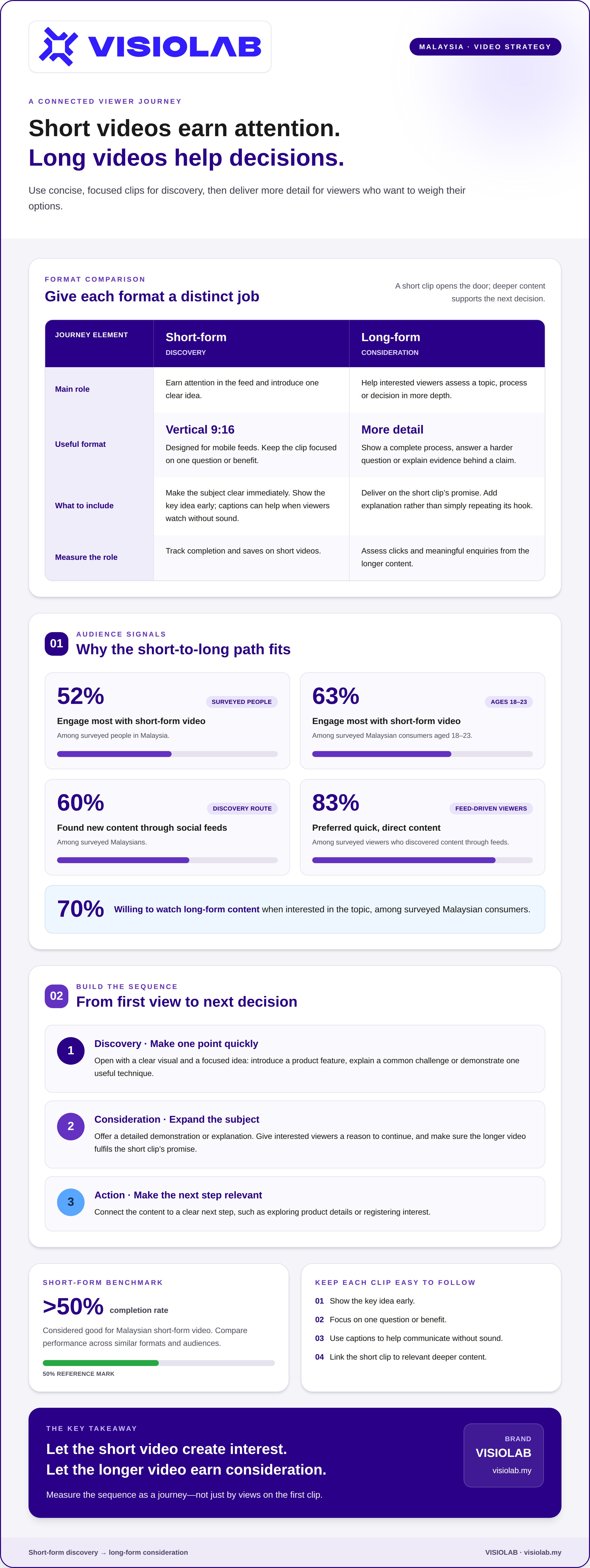
Short-form video earns attention; longer content can help interested viewers weigh a decision. In Malaysia, 52% of surveyed people said they engage most with short-form videos. Among surveyed consumers aged 18-23, that rose to 63%. These figures point to a strong discovery role for concise clips, especially when the opening makes the subject immediately clear.
Social feeds are a major discovery route: 60% of surveyed Malaysians found new content through them. Among those feed-driven viewers, 83% preferred quick, direct content. Use a vertical 9:16 frame for mobile viewing, show the key idea early, and keep each clip focused on one question or benefit. Captions also help communicate the point when viewers watch without sound.
Short-form video should open a path, not carry every detail. A clip can introduce a product feature, explain a common challenge or demonstrate one useful technique. Then direct interested viewers to a deeper video, a relevant page or a clear next step. Make the transition specific: a short process demonstration can lead into a longer explanation of how the process works.
Interest doesn’t end with the feed. Seventy per cent of surveyed Malaysian consumers said they were willing to watch long-form content when interested in the topic. Give them a reason to continue: answer a harder question, show a complete process or explain the evidence behind a claim. The longer piece should deliver on the short clip’s promise, not simply repeat its hook.
For brands using creator content, livestream shopping and short clips, assign each format a distinct task. A creator can show a product in a familiar setting; a livestream can demonstrate features and respond to viewer questions; edited clips can bring the clearest moments back into feeds. Disclose sponsored relationships, and give each format a consistent message and next step.
Use a concise vertical clip with a clear visual opening and one message.
Extend the topic with a detailed demonstration or explanation.
Give viewers a relevant next step, such as exploring product details or registering interest.
Measure whether the sequence works, not just whether a clip attracts views. Track completion and saves on short videos, then assess clicks and meaningful enquiries from the longer content. A completion rate above 50% is considered good for Malaysian short-form video, but compare performance across similar formats and audiences. To shape connected edits for different platforms, plan platform-ready video content around the viewer’s next decision.
Useful information gives a video a reason to hold attention. In a survey of Malaysian adults, 79% said useful or informative content strongly influences their engagement. For brands, that means starting with a real audience need: explain a confusing process, answer a recurring question, or show how a decision works. A polished image can earn a pause, but a clear takeaway gives viewers a reason to stay.
Relevance matters as much as usefulness. Seventy-six per cent of surveyed Malaysian adults said personally relevant content strongly influences their engagement. A message feels more pertinent when it reflects the viewer’s role, situation or knowledge. For example, an introductory video can explain a process in plain language, while a specialist version focuses on technical decisions and evidence.
Make the audience’s context visible in the script. A Malaysian employer communicating a safety procedure could show a recognisable workplace scenario, then demonstrate the correct response. A financial services brand could explain a product term through a familiar customer decision. Specific situations help viewers see why the information matters to them, rather than having to apply general claims to their own lives.
Structure useful content for quick comprehension. Begin with the question the video answers, then present essential information in a logical order. Use on-screen labels for key terms, show processes as they happen, and close with a practical next step. For a workplace procedure explainer, for instance, show the issue, the correct sequence and the outcome viewers should recognise.
Explain one concept, such as a technical term or common process.
Show each stage of a task instead of relying on abstract claims.
Use a scenario that reflects the viewer’s role or decision.
End with a relevant action, such as learning more or discussing the topic.
Educational storytelling can work across formats. TikTok’s recommended content mix for Malaysian brands assigns 60% to educational content. That does not mean every video needs a classroom tone. A concise demonstration, an expert explanation, or a behind-the-scenes look at a process can teach while keeping the story human and direct.
Audience knowledge can shape the level of detail. Among surveyed Malaysian adults with bachelor’s degrees, 83% said useful or informative content strongly influences their engagement. This supports building substance into the story: define specialist language, explain why a step matters, and show supporting context. Avoid assuming that a professional audience wants jargon without explanation.
Personalisation doesn’t require a separate story for every viewer. Build a strong central message, then adapt examples, opening lines, captions or emphasis for distinct audiences. A business video might address employees through practical implications and decision-makers through operational context. The core facts stay consistent; the framing changes. This makes content more relevant without fragmenting the brand’s message.
AI can speed up video tasks, but it works best inside a clear production process. In Malaysia, AI-powered tools for content creation, editing and personalisation are described as reducing production costs by up to 40%. Treat that figure as a possible efficiency, not a reason to remove planning, creative direction or review. Start by choosing a repetitive task that slows production, then define what a good result must retain.
Captioning offers a practical example. A first pass that previously took half a day can now be completed in 30 minutes, plus a human review pass. Use automation to draft captions, then review names, technical terms, punctuation and timing against the spoken content. This keeps the work moving while protecting accuracy, especially in corporate or training videos where a misheard instruction can change the meaning.
AI can also help transform existing material into short content. A Malaysian fintech startup, for example, can use app screenshots and feature descriptions to create 15-second product demos. The production steps are simple: choose one feature, provide accurate source material, generate a draft, and review the visuals and wording. Keep the result grounded in the real product experience; generated scenes should not imply features the service does not provide.
Automation can support variation without replacing the core story. Develop several opening lines for different audience needs, adapt captions or prepare platform-specific versions from approved footage. Test one variable at a time, such as the opening visual or call to action. Compare views, completion and qualified responses among equivalent audiences, rather than assuming that more versions will improve performance.
Use AI to organise source notes into a draft, then check every factual claim.
Generate a storyboard or layout concept before committing to production.
Automate repetitive captioning and rough-cut tasks, with human review.
Prepare subtitle drafts, then review language, names and context carefully.
In 2025, AI-powered content automation tools launched by major platforms reportedly reduced production time by 50% and costs by 30%. Those efficiencies depend on the task and workflow. Build an approval stage into each production: a subject expert checks facts, an editor checks clarity, and the final reviewer checks brand tone and rights. Do not upload sensitive customer or employee material into an AI tool without appropriate permission and safeguards.
AI is most useful when it frees up time for better storytelling. Give each tool a specific role, retain human accountability and assess results against the video’s purpose. A faster draft is valuable only if the final video remains accurate, distinctive and useful to its intended Malaysian audience.
A Bahasa Malaysia-first approach starts with the audience, not a translation file. For a Malaysian campaign, decide whether Bahasa Malaysia should lead the narration, opening text or both. Then choose additional language versions based on who needs to understand the message. A public-facing introduction may call for different language choices than an internal safety explanation for a specific workforce.
Plan language before production. Write the central message in the lead language, identify terms that must stay consistent, and prepare a script that can be adapted without changing its meaning. For example, a service video can use Bahasa Malaysia narration with English subtitles for viewers who prefer to read along. A separate Mandarin or Tamil version may suit another audience. Let the communication goal guide the choice, rather than assuming every viewer prefers the same language.
Translation alone doesn’t make a video feel local. Adapt idioms, examples, names and on-screen text so they sound natural in the intended language. A workplace instruction, for instance, should use clear, direct wording and familiar labels. A brand story can preserve its key message while adapting examples that depend on cultural context. Keep product names and technical terms consistent across versions.
Subtitles and voice-over serve different needs. Subtitles preserve the original speaker’s voice and can support muted viewing; voice-over provides a fully narrated version. Choose based on the content. A leadership message may benefit from retaining the original speaker, while a detailed process demonstration may need narration that follows each step. Review subtitle timing, line breaks and on-screen text together, especially for mobile screens.
Name the primary audience and the language that best serves its purpose.
Localise examples and phrasing while preserving approved facts.
Select narration, subtitles or both for each version.
Have a fluent reviewer check meaning, tone, names and timing.
Multilingual production also affects editing. Build pauses around key points, allow enough screen time for subtitles and keep graphics easy to replace. Create a master version with text and audio elements separated, rather than baking every caption into a final file. This makes language adaptations easier to manage and reduces the risk of narration and text falling out of sync.
Evaluate each language version against the same purpose. Compare completion, audience responses and next-step actions by version, while accounting for differences in placement and audience. If a Bahasa Malaysia cut attracts attention but prompts few enquiries, review its message and call to action. If viewers drop off during dense subtitled sections, simplify the wording or divide the information into clearer beats. Consistent measurement helps refine language choices without treating Malaysia as one uniform audience.
VISIOLAB helps Malaysian organisations turn complex messages into clear, purposeful video content. If you need to connect platform discovery with a stronger story, VISIOLAB can shape the message, format and audience journey around your communication goal.
A Corporate Video can communicate an organisation’s wider story, while an Explainer and Training Video can make a process easier to understand. ESG Video and Safety Video can present important commitments and workplace information visually. The right approach depends on what viewers need to learn, feel or do next.
Share your audience, key message and intended outcome with VISIOLAB to start shaping a video strategy for discovery and conversion. Contact VISIOLAB to discuss your project.
The video marketing trends in Malaysia 2026 offer a prompt to refine your approach, not a checklist to follow blindly. Choose one business objective for your next project, then make each creative decision serve it. Who needs to understand the message? What should they remember? What action should feel like the natural next step?
Those answers provide a clear foundation for production and evaluation. After publishing, use audience responses to guide your next decision: retain elements that support the objective and refine parts that create friction. Keep the core message consistent while adapting how it reaches different viewers. This makes each release a purposeful step forward, rather than another isolated asset.
If you’re ready to shape a video strategy around your message and audience, contact VISIOLAB about video. A clear starting point can lead to a stronger story, and a stronger story can move your organisation forward.
The biggest video marketing trends in Malaysia in 2026 centre on making video easier to discover, understand and act on. Brands are building connected content journeys instead of relying on one standalone campaign film. For example, a company introducing a complex service can pair a clear introductory story with practical answers to audience questions. Strong planning links each video to a specific viewer need and business objective.
AI tools can help teams draft, adapt and organise video materials, while people remain responsible for accuracy and judgment. A marketing team might use AI to generate alternative script openings for different customer groups, then check each version for factual consistency and appropriate tone. This makes personalisation more deliberate: adapt the framing to the audience, but keep product claims and the organisation’s central message consistent.
Responses depend on whether viewers understand the language and recognise their needs in the message; language alone doesn’t determine effectiveness. A campaign for a broad audience might use Bahasa Malaysia narration with English subtitles, while a targeted version could use language and examples suited to its intended viewers. Compare relevant audience responses and enquiries for each version, rather than assuming one language will work equally well for everyone.
Start by defining the audience, the decision the video should support and the action viewers should take. Match the message and creative treatment to that purpose, then decide how each version will be distributed. Before launch, set success measures that reflect the campaign goal, such as qualified enquiries for lead generation. After publishing, review audience behaviour and enquiry quality, then use those findings to refine the next campaign.
Let’s create and collaborate
We’re versatile multitaskers, and we thrive on a lot of projects. You've seen a few of our works that we are most proud of, and your project could be next in line.

Empowering brands with captivating visual stories, creating strong connections and growth.
