
What if the deciding factor in your next tender wasn't your price point or your credentials, but simply how well you told your story? In a competitive landscape where evaluators review submission after submission, video production for tender presentations is fast becoming the edge that separates the...
What if the deciding factor in your next tender wasn't your price point or your credentials, but simply how well you told your story? In a competitive landscape where evaluators review submission after submission, video production for tender presentations is fast becoming the edge that separates the shortlisted from the overlooked. The businesses winning contracts aren't always the most qualified on paper. They're the ones who communicate their value with clarity, confidence, and impact.
You already know that a standard written proposal rarely captures the full weight of what your organisation brings to the table. That frustration is real, and it's shared by countless teams who pour weeks into a submission only to hear nothing back. The good news? There's a smarter way to present.
This guide walks you through exactly how to harness video as a strategic tool in your tender submissions. From understanding what makes tender video content compelling, to learning how it integrates seamlessly into your proposal package, you'll leave with a clear picture of what effective video looks like and how to make it work for your next bid.
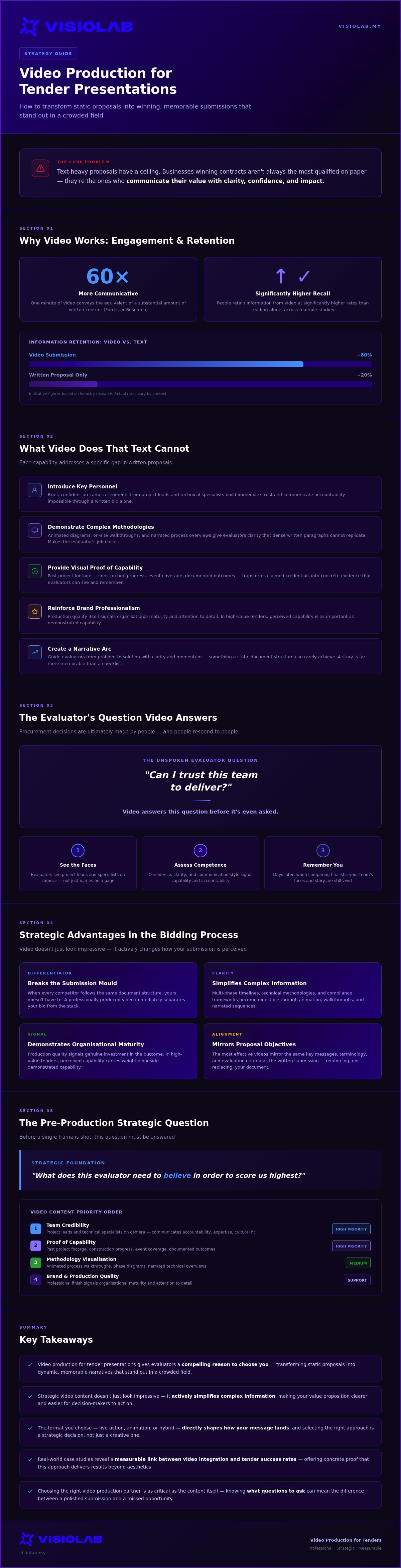
• Video production for tender presentations gives evaluators a compelling reason to choose you - transforming static proposals into dynamic, memorable narratives that stand out in a crowded field.
• Strategic video content doesn't just look impressive - it actively simplifies complex information, making your value proposition clearer and easier for decision-makers to act on.
• The format you choose - live-action, animation, or hybrid - directly shapes how your message lands, and selecting the right approach is a strategic decision, not just a creative one.
• Real-world case studies reveal a measurable link between video integration and tender success rates, offering concrete proof that this approach delivers results beyond aesthetics.
• Choosing the right video production partner is as critical as the content itself - knowing what questions to ask can mean the difference between a polished submission and a missed opportunity.
Text-heavy proposals have a ceiling. No matter how precisely you articulate your methodology or how impressive your credentials look on paper, words alone struggle to convey presence, capability, and trust. Video removes that ceiling entirely. It transforms a static document into a living, breathing representation of your organisation, and in a procurement environment where evaluators are time-poor and attention is scarce, that distinction is everything.
The human brain processes visual information fundamentally differently from written text. Research from Forrester has found that one minute of video can communicate the equivalent of what would take considerable written content to convey, though the exact figure varies by context and format. What's consistent across studies is this: people retain information from video at significantly higher rates than from reading alone. For tender evaluators who review multiple submissions in a single sitting, that retention gap becomes a competitive advantage you can deliberately engineer.
Consider what this means practically. A panel member who watched your video submission two days ago will likely recall your key differentiators far more vividly than the written proposal sitting in their stack. That recall shapes scoring. It shapes shortlisting. It shapes the conversation when decision-makers compare notes in the room.
Strategic video production for tender presentations isn't just about looking polished. It's about making your value proposition stick when it matters most.
Procurement decisions, even in highly regulated environments, are ultimately made by people. And people respond to people. Video gives you the ability to introduce your project lead, your technical specialists, and your on-the-ground team in a way that no written bio ever could. A confident, articulate team member speaking directly to camera communicates competence, accountability, and cultural fit simultaneously.
This is where emotional connection becomes a legitimate strategic asset. When evaluators see the faces behind a proposal, they're not just assessing qualifications. They're asking: Can I trust this team to deliver? Video answers that question before it's even asked.
Organisations with a proven track record in the government and corporate sectors, like VISIOLAB, understand that this human dimension is precisely what separates a memorable submission from a forgettable one. The goal isn't sentimentality. It's credibility, communicated visually.
with brief, confident on-camera segments that build immediate trust
through visual walkthroughs rather than dense written descriptions
through production quality that signals attention to detail
that guides evaluators from problem to solution with clarity and momentum
Done well, video doesn't supplement your tender. It elevates the entire submission.
A well-crafted tender proposal tells evaluators what you can do. A well-crafted video shows them. That distinction is the foundation of every strategic advantage video brings to the bidding process. It's not about adding a visual layer on top of your submission. It's about restructuring how your entire value proposition lands.
Complex technical methodologies, multi-phase project timelines, and compliance frameworks are notoriously difficult to communicate in written form without losing the reader. Video solves this by converting dense information into structured, digestible sequences. Animated diagrams, on-site walkthroughs, and narrated process overviews give evaluators clarity that no paragraph of text can replicate. When your submission makes the evaluator's job easier, it earns goodwill before a single score is entered.
Differentiation is the other critical lever. When every competing proposal follows the same document structure, yours doesn't have to. A professionally produced video signals organisational maturity, attention to detail, and a genuine investment in the outcome. Those signals carry weight, particularly in high-value government and corporate tenders where perceived capability is as important as demonstrated capability.
The most effective tender videos aren't produced in isolation. They're built in direct alignment with the proposal's core objectives, mirroring the same key messages, terminology, and evaluation criteria that structure the written submission. Before a single frame is shot, the strategic question must be answered: what does this evaluator need to believe in order to score us highest?
From there, the video content should prioritise the elements that written proposals struggle to convey:
Brief, confident segments from project leads and technical specialists that communicate accountability and expertise
Visual evidence from past projects, including construction progress footage, event coverage, or documented outcomes
Animated or narrated walkthroughs that simplify your methodology into a logical, easy-to-follow sequence
Authentic moments that reflect your organisation's values and working style
Integrating video into your tender strategy means treating it as a core deliverable, not an afterthought. It should be referenced within the written proposal itself, positioned as supplementary evidence that reinforces your narrative rather than duplicating it.
The investment in video production for tender presentations is real, and it deserves honest evaluation. Production costs in Malaysia vary depending on scope, duration, and complexity, but the relevant comparison isn't video versus nothing. It's video versus the cost of losing a contract you were qualified to win.
A single successful tender can generate returns that dwarf the production budget many times over. Beyond the immediate contract, professionally produced video assets have a longer shelf life than most tender documents. The same footage, with targeted edits, can support capability statements, client presentations, and brand-building across digital channels. The investment compounds.
Organisations that work with experienced partners like VISIOLAB for corporate video production also benefit from a structured production process that reduces internal time costs, ensuring your team stays focused on the proposal itself while the visual storytelling is handled with precision.
The question isn't whether video is worth the cost. It's whether you can afford to keep submitting without it.
Knowing that video works is one thing. Knowing how to build video content that actually moves evaluators is another. The gap between a generic corporate video and a submission-ready tender video comes down to two things: message discipline and production intentionality. Get both right, and your video doesn't just complement your proposal - it carries it.
Start with a single, non-negotiable question: what does this evaluator need to believe in order to score you highest? Every creative decision flows from that answer. Before scripting a single line, map your video's content directly against the tender's evaluation criteria. If the scoring matrix weights methodology at 40%, your video should dedicate proportional time to making that methodology tangible and credible.
Distilling complex information into clear messages isn't about simplifying your capability. It's about sequencing it. Use a three-layer approach:
Acknowledge the client's challenge in their own language, not yours
Present your approach as the logical, evidence-backed response to that specific challenge
Anchor your claims with visual evidence from past projects, whether that's construction progress footage, event coverage, or documented outcomes
Resist the instinct to cover everything. A focused three-minute video with two or three memorable takeaways will outperform a sprawling eight-minute reel every time. Evaluators don't reward volume. They reward clarity.
Choosing the right format reinforces this clarity. Live-action footage builds trust through human presence and authentic environment. Animation excels at visualising processes, timelines, and data that would otherwise require dense written explanation. A hybrid approach, combining on-camera team segments with animated process diagrams, is often the most effective structure for video production for tender presentations where both credibility and complexity need to be addressed.
Production quality is a signal. Evaluators read it, consciously or not, as a proxy for how your organisation operates. Shaky footage, inconsistent audio, or poorly timed cuts communicate carelessness - the opposite of what a tender submission should project.
A few non-negotiables:
Poor sound quality is the fastest way to lose a viewer. Use directional microphones or lapel mics for all on-camera talent, and treat any space with echo before filming
Natural light is workable, but uncontrolled. A basic three-point lighting setup removes the guesswork and keeps your subjects looking professional across every shot
Industry-standard tools like Adobe Premiere Pro or DaVinci Resolve give editors the control needed to match pacing to narrative momentum, keeping evaluators engaged through every segment
Branded lower thirds, animated data visualisations, and clean title cards elevate the submission's perceived professionalism and reinforce key messages visually
Working with a production partner experienced in corporate and government sector video, like VISIOLAB, removes the technical risk from the equation entirely. The result is a submission asset that reflects the same precision and attention to detail you're promising to bring to the contract itself.
Theory only takes you so far. What actually shifts perspective is seeing the pattern repeat across real submissions: organisations that invested in video production for tender presentations consistently outperformed comparable competitors who submitted written-only proposals. The examples below aren't outliers. They're a blueprint.
One infrastructure firm bidding for a government-linked construction contract in Malaysia restructured their submission around a three-minute hybrid video. The first minute featured their project director speaking directly to camera, addressing the client's specific operational concerns by name. The following two minutes used animated sequencing to map their phased delivery timeline against key milestones. The panel later noted that their methodology was the clearest they'd reviewed across all submissions, despite the written proposal being comparable in length to competitors.
What made it work wasn't production extravagance. It was alignment. Every visual choice served the evaluation criteria. The animated timeline directly addressed a scoring category around project management clarity. The on-camera segment resolved the trust question before the panel could raise it. Nothing was decorative. Everything was deliberate.
A facilities management company pursuing a corporate sector contract took a different approach, leading with social proof. Their video opened with brief, on-site footage from three completed projects, each paired with a single data point: completion date, scope delivered, and client outcome. No narrated preamble. No lengthy introductions. Just evidence, sequenced for impact. They were shortlisted within 48 hours of submission.
The lesson across both examples is consistent: evaluators reward submissions that make their job easier. Video that's built around the scoring matrix, not around the submitting organisation's preferences, is the kind that earns marks.
Several patterns emerge when you study submissions where video genuinely moved the needle:
Use the tender's own terminology in your video script. It signals that you've read the brief carefully and signals alignment before a single credential is mentioned.
Successful videos open by framing the challenge the evaluator is trying to solve, not with a company overview reel.
Every case study where video contributed to a shortlist involved a runtime of four minutes or less. Discipline in editing reflects discipline in delivery.
Treat it as evidence, not an add-on. Cite it at relevant sections so evaluators know exactly where to look for visual proof of written claims.
Evaluators notice. Authentic site footage, real team members, and documented project outcomes carry credibility that stock libraries simply can't replicate.
The common pitfall? Producing a video that showcases the organisation broadly rather than answering the specific tender. A capabilities reel is not a tender video. The distinction is strategic, and getting it wrong costs more than the production budget.
If you're ready to build a submission that evaluators remember long after the review session ends, work with VISIOLAB to develop a tender video strategy built around your specific brief and scoring criteria.
Deciding to use video is the easy part. Finding the right agency to execute it is where the real strategic thinking begins. The production partner you choose will shape not just the final asset, but the entire process leading up to it. Get this decision right, and your submission gains a collaborator who understands what's at stake. Get it wrong, and you're managing a vendor instead of building a competitive advantage.
Industry experience isn't a bonus criterion. It's a baseline requirement. An agency that has produced corporate video for government and corporate sector clients understands procurement language, compliance sensitivities, and the specific pressures of a tender timeline. That context changes everything from how they approach your brief to how they structure your script.
When evaluating agencies, look beyond the showreel. Ask specifically for examples of video production for tender presentations or similar high-stakes corporate submissions. A portfolio of wedding videos or brand commercials signals creative capability, but it doesn't tell you whether an agency can align visual storytelling to a scoring matrix. Those are different skills, and you need both.
Construction, facilities management, government procurement, or professional services experience is directly transferable to your submission context
Ask how they approach a brief. An agency that leads with creative concepts before understanding your evaluation criteria is working in the wrong order
Motion graphics, animation, and branded lower thirds are indicators of a full-service capability, not just a filming crew
Agencies that assign a dedicated point of contact and provide structured project updates reduce your internal management burden considerably
VISIOLAB's track record across government and corporate sectors reflects exactly this kind of sector-aware approach. Their work spans corporate video, animations, construction progress documentation, and event coverage, giving them the range to build tender assets that are both technically precise and visually compelling.
The quality of your final video is directly proportional to the clarity you bring to the briefing stage. Before your first agency meeting, define your non-negotiables: submission deadline, key messages, evaluation criteria weighting, and any compliance requirements around branding or content. Ambiguity at this stage costs time and money later.
Establish a realistic timeline from the outset. A professionally produced tender video typically requires pre-production planning, scripting, filming, editing, and review cycles. Compressing this into a few days produces a rushed asset that undermines the very credibility it's meant to project. Build the video production timeline into your overall bid schedule, not as an afterthought once the written proposal is nearly complete.
Agree on milestone checkpoints: script approval, rough cut review, and final delivery. These aren't bureaucratic steps. They're the mechanism that keeps the final asset aligned with your submission strategy from start to finish. The right agency will welcome this structure because it protects the quality of the outcome for both parties.
If you're ready to move from strategy to execution, connect with VISIOLAB to develop a tender video approach built around your specific brief, your timeline, and the contract you intend to win.
The gap between shortlisted and overlooked often comes down to one thing: how clearly your value lands with the people scoring your submission. Video production for tender presentations closes that gap by transforming complex capabilities into clear, memorable narratives that evaluators can act on with confidence.
Three things to carry forward: align every visual decision to your scoring criteria, keep your runtime disciplined, and treat your video as core evidence rather than a creative add-on. Those principles separate submissions that win from submissions that simply look good.
The contracts you're qualified to win shouldn't be lost to a competitor who simply communicated better. VISIOLAB brings proven expertise across government and corporate sectors, combining strategic storytelling with production precision to build tender assets that reflect the quality of work you deliver.
Your next submission can be the one evaluators remember. Contact VISIOLAB to elevate your tender presentations with professional video production and start building the competitive edge your proposal deserves.
Several formats work well in tender submissions, and the right choice depends on what you need to communicate. Corporate videos introduce your team and organisational culture. Explainer animations break down complex methodologies or phased timelines. Construction progress footage and project documentation provide visual proof of past delivery. A hybrid approach, combining on-camera segments with animated sequences, often covers the most ground within a single submission asset.
The format should serve the scoring criteria, not the other way around. If your tender weights technical methodology heavily, animation is likely your strongest tool. If trust and team credibility are the deciding factors, live-action footage of your key personnel will carry more weight.
Video production for tender presentations elevates a submission by converting written claims into visible, verifiable proof. Where a written proposal describes your capability, video demonstrates it. Evaluators who can see your team, your past project outcomes, and your process in action are better positioned to score with confidence, and that clarity directly benefits your submission.
Beyond content, production quality itself signals organisational maturity. A professionally produced video communicates that your organisation invests in precision and detail, which is exactly the message you want a procurement panel to carry into their scoring discussion.
The more useful framing is return on investment. A single contract win can generate returns that significantly exceed the production budget. Video assets also have a longer shelf life than most tender documents, with targeted edits making them reusable across capability statements, client presentations, and digital channels.
Government tender requirements vary by agency and procurement framework. Some tender briefs specify acceptable submission formats, file size limits, or delivery methods, such as USB, shared drive, or embedded links. Before producing any video asset, review the tender documentation carefully for technical submission requirements. If the brief is silent on video, it's worth clarifying with the issuing authority whether supplementary media is permitted.
Content-wise, government evaluators tend to prioritise submissions that directly address stated evaluation criteria. A video that mirrors the brief's own language and maps visually to the scoring matrix will consistently outperform one that showcases general capability without that alignment.
Keep it under four minutes. Evaluators are time-poor and reviewing multiple submissions; a disciplined runtime signals that your organisation respects that constraint. The most effective tender videos typically run between two and four minutes, with enough structure to address key evaluation criteria without overstaying their welcome.
If your submission requires covering multiple complex areas, consider producing a primary video of three minutes supported by shorter supplementary clips, each under ninety seconds, that address specific technical sections. This gives evaluators focused evidence at the relevant points in your written proposal rather than one extended reel they may not watch in full.
Yes, and done well, it's an effective approach for presentations delivered in person or via screen share. Embedding short video clips directly into PowerPoint keeps your narrative flow intact and removes the awkward transition of switching between applications mid-presentation. Ensure your video files are embedded rather than linked, so playback doesn't depend on an internet connection or external file path during the actual presentation.
For written tender submissions rather than live presentations, video is typically delivered as a separate file or via a shared link referenced within the proposal document. Check the tender's submission format requirements before deciding on your delivery method, as some procurement portals have strict file type and size restrictions.
The most costly mistake is producing a general capabilities reel instead of a submission-specific video. A video that showcases your organisation broadly, without addressing the specific tender brief, misses the strategic purpose entirely. Every segment should connect to an evaluation criterion. If it doesn't, cut it.
Other pitfalls include poor audio quality, which evaluators notice immediately and which undermines credibility; running times that exceed four minutes; using generic stock footage instead of authentic project documentation; and failing to reference the video within the written proposal itself. Treat the video as evidence, cite it at relevant sections of your submission, and ensure it's produced with enough lead time to allow proper review cycles before your deadline.
Let’s create and collaborate
We’re versatile multitaskers, and we thrive on a lot of projects. You've seen a few of our works that we are most proud of, and your project could be next in line.

Empowering brands with captivating visual stories, creating strong connections and growth.
