
The most polished customer video is not always the one that gives B2B buyers confidence. Buyers need more than praise: they want to understand the problem a customer faced, why they chose a solution, and what changed in their experience. That is what makes video testimonials for B2B companies persua...
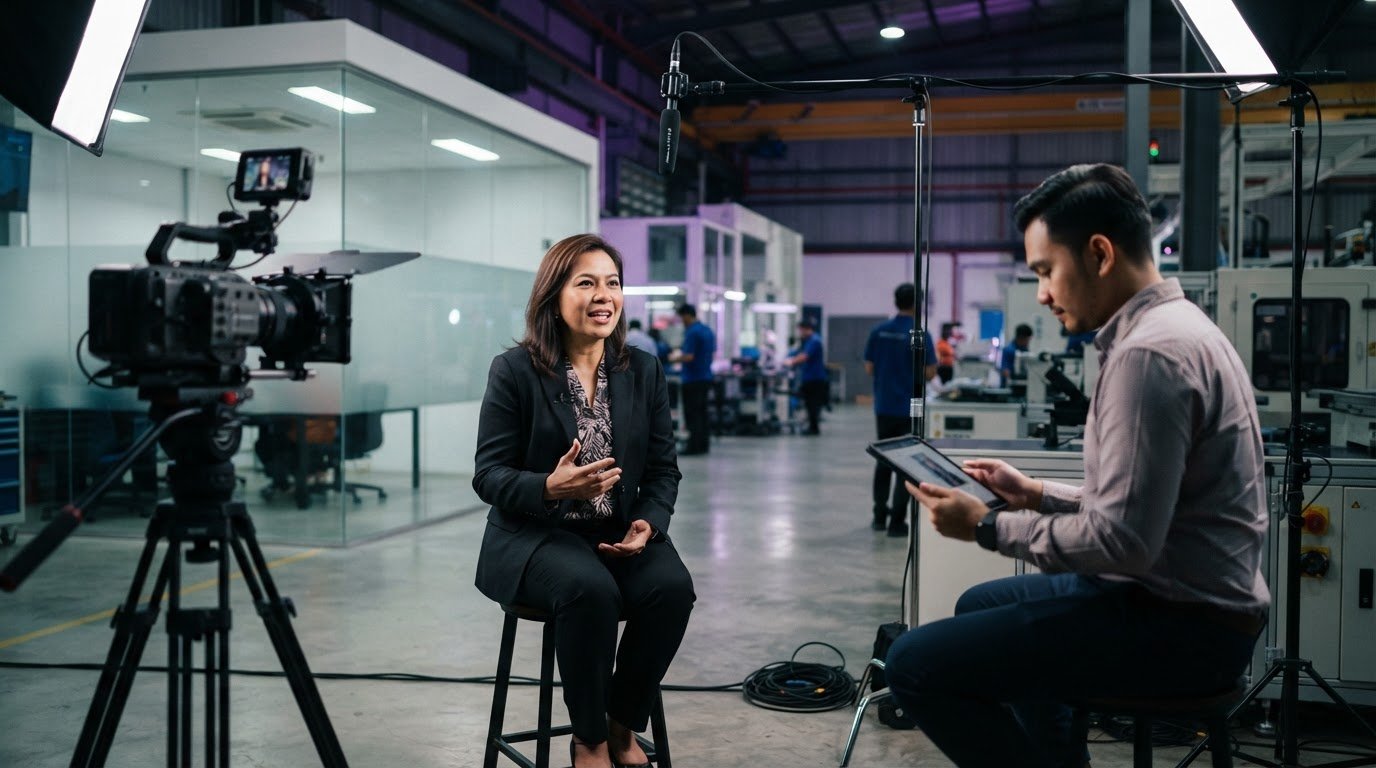
The most polished customer video is not always the one that gives B2B buyers confidence. Buyers need more than praise: they want to understand the problem a customer faced, why they chose a solution, and what changed in their experience. That is what makes video testimonials for B2B companies persuasive: relevant evidence, shared in a customer’s own voice.
Choosing a format can be challenging. A concise testimonial, a deeper customer story, and a case study can each serve a different purpose, while a stiff interview or generic answer can weaken the message. Start with the evidence your audience needs, then shape the interview around the customer’s actual experience. This article explores B2B testimonial video formats, what makes each useful, and how to plan a customer story buyers can assess. You’ll also see how strategic messaging and disciplined production can shape one narrative into useful versions for marketing and sales.
• Match the testimonial format to the buyer’s question, from a concise customer interview to a fuller case-study film.
• Use video testimonials for B2B companies to show relevant customer experience, not just positive comments.
• Assess examples by their specificity, evidence, customer voice, and intended use, not by visual polish alone.
• Prepare open-ended interview prompts that help customers share concrete details in their own words.
• Plan how one customer story can serve different sales and marketing needs without losing its context or credibility.
A customer saying “we’re very happy” sounds positive, but gives a prospective buyer little to assess. A useful testimonial starts with a question the buyer is already considering: Can this approach address a challenge like ours? What did the experience involve? Which factors shaped the decision? The customer’s account puts the business proposition in context. Rather than asking viewers to accept a broad promise, the story shows how another organisation encountered a problem and assessed its experience.
A B2B video testimonial is a customer’s account, shaped around a relevant buyer challenge and experience to offer specific, credible evidence. The format builds on the concept of testimonials, but business-to-business stories need more than endorsement. They need enough context for viewers to judge whether the account is relevant to their own situation.
That distinction matters. “The service was excellent” is praise, not evidence of a particular business value. “Our operations team needed to consolidate a reporting process, and we chose this approach after comparing our requirements” gives viewers details to consider. Even then, the account represents one customer’s reported experience. It is not a universal guarantee or independent verification of a result by itself.
A business decision often involves people with different responsibilities. A department lead may focus on the initial problem, a technical reviewer on implementation, and a senior decision-maker on organisational priorities. One customer story can help these viewers understand the same experience, but it should identify who is speaking and what they can credibly describe.
Role, industry context, and challenge help viewers assess relevance. A finance leader discussing a reporting workflow offers a different perspective from an operations manager describing a handover process. Giving this context makes the story more useful without suggesting that another organisation will have the same experience.
Specific details also help preserve the customer’s voice. Invite them to explain what they faced, what shaped their decision, and what happened in their case. Attribute outcomes to the speaker or organisation, and make the scope of any evidence clear. Avoid turning one person’s account into a sweeping claim.
At the awareness stage, a story can help viewers recognise a challenge. Focus on the situation and the customer’s perspective rather than opening with a detailed product pitch. A clearly explained problem gives prospective buyers a reason to keep watching.
During consideration, include practical details about the decision: the criteria the customer used, the implementation context they can discuss, or the questions they needed answered. These specifics help viewers compare the story with their own requirements without implying that every project follows the same path.
Closer to a decision, viewers may want concrete evidence. If the customer describes an outcome, identify whose experience it represents and keep relevant limitations clear. A documented example can explain what was reported and in what context, but should not suggest that another organisation is assured the same result. The strongest video testimonials for B2B companies address the buyer’s question and let specific, carefully framed customer experience do the work.
The best format depends on what a buyer needs to understand, not on which video looks most cinematic. A short interview can establish a customer’s perspective; a deeper story can show how a decision unfolded. Use the formats below to shape the narrative, and review each original video before making claims about its structure or evidence.
A direct interview keeps the customer’s point of view in focus through a small number of questions. A challenge-to-outcome story adds a clear sequence: the original situation, the decision, the customer’s experience, and any outcome they report. Dock’s example collection can help you find candidate videos. Watch each original before describing its format or the evidence it presents.
A customer responds to a focused prompt, such as what led them to explore a solution. This format suits viewers looking for a personal perspective or a quick introduction. Broad questions can produce generic praise, so include enough context to make each answer meaningful.
The narrative moves from a defined challenge through the decision and experience to an outcome reported by the customer. It can help prospective buyers compare the situation with their own. A tidy story arc may hide complexity, so include relevant context and avoid implying that one customer’s outcome is universal.
More layered formats can answer detailed questions, but they also need careful editing. Academic insights into video marketing effectiveness can add perspective on audience reception. Use research to inform your choices, rather than assuming that every viewer responds in the same way.
Combine an interview with relevant process context, such as how a decision was made or how the work was carried out. This suits viewers who need a fuller account. Attribute figures and outcome claims to their source, and explain any relevant limits.
Shape one complete idea into a concise cut for a specific audience or channel, then direct interested viewers to fuller context. This format is useful when attention is limited. Without a clear source or context, however, a strong-sounding line can lose its meaning.
Capture a customer’s perspective in connection with a relevant event. This may suit an audience already interested in the event or topic. The setting alone does not make a comment authentic: clear questions and a genuine customer account still matter.
Use strategic corporate video production to connect a customer’s perspective with the wider message while keeping the story audience-focused. For a customer narrative within a broader corporate video, VISIOLAB’s corporate video work brings strategic messaging and production discipline together.
A polished frame, confident speaker, and smooth edit can hold attention. They do not show whether a story answers a buyer’s concern. Compare examples by what the customer communicates: their context, reasoning, experience, and the basis for any claims. Apply the same scorecard to each video, including your own drafts, so production quality does not become a substitute for credibility.
A persuasive B2B testimonial connects a defined buyer concern to clearly attributed customer evidence. That evidence might be the customer’s description of their decision or an outcome they report. Viewers should be able to tell what was experienced, by whom, and in what context.
Score each criterion from zero to two: zero means absent or unclear, one means present but incomplete, and two means specific and easy to understand. The score is not a scientific measure of truth. It is a consistent way to spot what a video explains well and where buyers may still have questions.
| Criterion | Strong signal | Partial or weak signal |
|---|---|---|
| Audience relevance | The intended viewer and business challenge are apparent early. | The audience is implied, or the challenge stays broad. |
| Story specificity | The customer describes their context and decision process in concrete terms. | The story mentions a problem but skips why or how the decision was made. |
| Evidence | Claims are attributed to the customer or another clear source, with relevant context. | A result is mentioned without explaining its source, scope, or meaning. |
| Customer voice | The speaker sounds natural and explains the experience in their own language. | Answers feel over-rehearsed, generic, or detached from the speaker’s role. |
| Clarity | The story is understandable without specialist knowledge or unexplained terms. | Jargon, fast transitions, or missing context make the account hard to follow. |
| Intended use | The video’s message and depth fit its audience and viewing context. | The purpose is unclear, or the edit removes context needed to assess a claim. |
Look at the pattern, not just the total. A video may score well for clarity and customer voice but poorly for evidence. That points to a specific improvement: explain where a claim comes from instead of adding more visual effects. For video testimonials for B2B companies, credible storytelling depends on both a clear message and a customer account viewers can interpret.
Generic praise is the first warning sign. “Great team” or “excellent service” could describe almost any relationship. Ask whether the customer explains what mattered to them and why. Without that detail, the video may sound positive but give a buyer little help in evaluating its relevance.
Look for metrics without a stated source or context, and edits that turn one customer’s reported experience into a promise for everyone. A percentage or before-and-after claim needs enough explanation to show what it refers to and who reported it. A confident delivery does not verify a result.
Finally, listen for the customer’s natural phrasing. If meaningful qualifications disappear or polished copy makes the speaker sound unlike themselves, the story can lose credibility. Strong production should sharpen the account, not overwrite it.
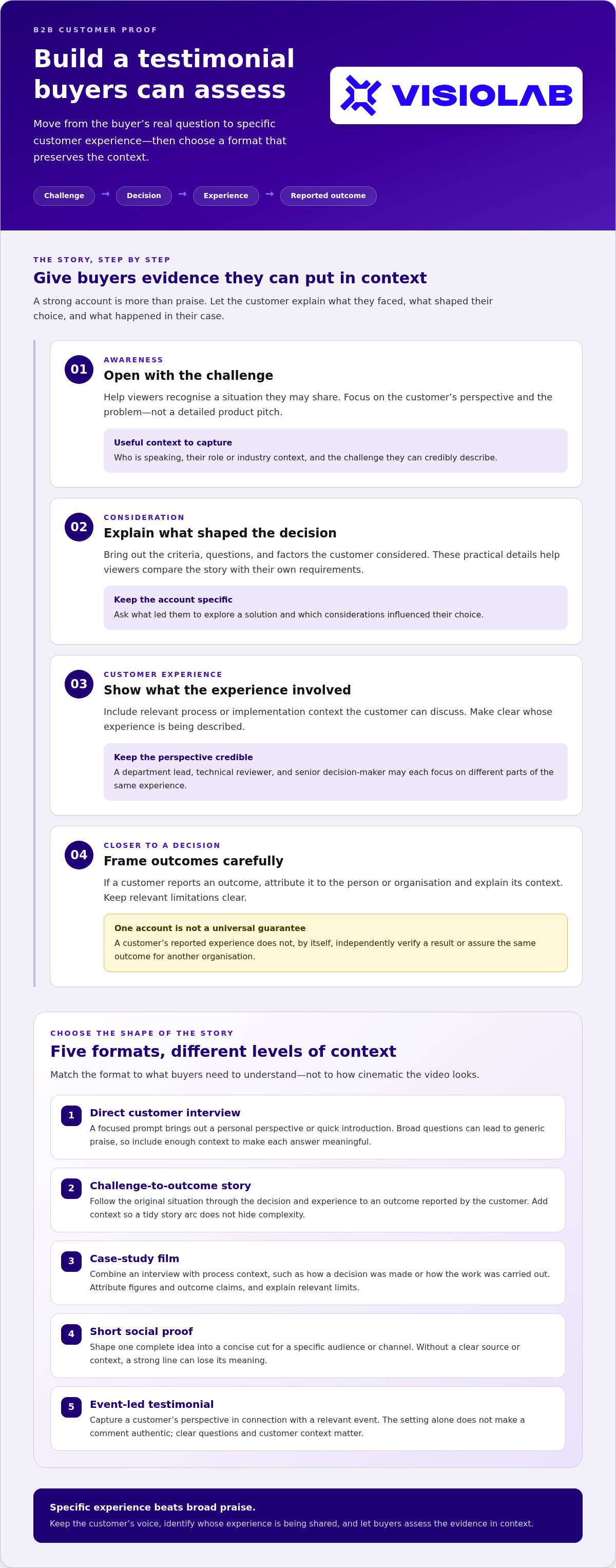
A strong customer story starts before the camera rolls. A focused brief prepares the customer, gives the production team a clear narrative direction, and makes the final video more useful to its intended audience. For video testimonials for B2B companies, plan the evidence, permissions, review process, and distribution together rather than treating them as separate tasks.
Identify who needs to watch and what they need to understand. A story for a technical evaluator may need to explore implementation, while a leadership audience may be more interested in the decision’s organisational context.
Look for a participant whose role, challenge, and experience align with the intended viewer. Relevance matters more than an especially enthusiastic endorsement.
Agree on the topic boundaries, interview format, intended channels, permissions, and review process. Share themes in advance, not a script that dictates the customer’s answers.
Use open-ended prompts about the original challenge, decision factors, experience, and lessons. Follow up when an answer is broad, but let the customer describe events in their own words and include qualifications.
Check the customer’s name and role, factual details, and attribution of any evidence with the relevant stakeholders. Make sure edits preserve the meaning and context of what the customer said.
Match the full story or a shorter adaptation to its use, such as a sales conversation, website page, or professional channel. Keep a route to fuller context when a brief cut leaves out important detail.
Preparation should make the conversation comfortable without making it predictable. Explain who the video is for, what the interview will cover, what sits outside the topic, and how review will work. Questions such as “What shaped your decision?” or “What did you learn during the process?” invite specifics without asking for praise. If the customer refers to a result, ask what they mean and what context would help viewers understand it. Give them room to qualify their account.
In the edit, give the story a clear beginning, meaningful detail, and an ending that reflects the customer’s perspective. Do not remove qualifications that change the meaning of a claim. Plan adaptations from the same interview, but make sure each version stands on its own: a shorter sales clip can focus on one buyer question, while the full-length narrative retains the context around it. Review names, roles, facts, and attributed claims before publication.
For a longer customer narrative, corporate documentary storytelling can connect an individual experience to a wider organisational story. To plan a strategically clear corporate video with disciplined production, work with VISIOLAB on your customer story.
The strongest customer story begins with a buyer’s question, not a camera setup. Choose the format that fits that question, then shape the narrative around a relevant customer perspective and evidence viewers can understand. A concise interview may suit a focused concern; a fuller case-study-style story may better explain a complex decision. The format serves the story, and the story serves the audience.
This approach helps customer experience contribute to wider corporate communication without turning a testimonial into a self-congratulatory brand message. Its value lies in the customer’s account, presented with enough context for stakeholders to judge what it means to them.
Before production, align the audience, stakeholder needs, and communication objective. A story intended to explain a technical process needs different detail from one designed to help leadership understand a decision. When teams agree on the central question, they can decide what to include, what evidence supports the narrative, and what falls outside its scope.
VISIOLAB brings strategic messaging and production discipline to corporate video, translating complex organisational messages into clear visual content. Applied to a customer story, this means structuring the film around the customer’s experience and the viewer’s needs. The brand has a role, but it should not overpower the person whose perspective gives the story meaning.
Turn your chosen example into a brief that gives marketing, sales, and customer stakeholders a shared foundation. Capture the essentials before production begins:
What does the intended viewer need to understand?
Does the story call for a direct interview, a challenge-to-outcome arc, or a more developed case-study film?
Which role and experience can speak meaningfully to the question?
What can the customer describe or substantiate, and which qualifications should remain clear?
Where will the story be used, and what should viewers take away?
Bring the relevant teams together around those points. Sales can surface the questions buyers raise; marketing can shape the audience and intended use; the customer can ground the story in their own experience. That alignment gives production a clearer direction and helps different versions remain faithful to the same account.
For organisations planning video testimonials for B2B companies, strategic clarity connects customer experience to a wider message without overstating what one story can prove. VISIOLAB’s corporate video approach pairs clear messaging with disciplined production to make complex ideas easier to follow.
Explore strategic corporate video with VISIOLAB and discuss your audience, story objective, and production direction.
Your next customer story can do more than document a positive experience. It can help your team address questions that come up in real buyer conversations. Start by identifying one question worth answering, then build a story that lets viewers understand the customer’s perspective and judge its relevance for themselves.
That focus can guide future storytelling too. As customer conversations reveal new priorities, your video content can evolve with them, keeping each story connected to an audience need rather than a passing campaign message.
VISIOLAB is a Malaysia-based strategic video agency serving corporate, GLC, MNC, and government organisations. Bring your audience, story objective, and production direction into focus with a team that shapes complex organisational messages into clear visual content.
Explore strategic corporate video with VISIOLAB and take the next step toward a customer story buyers can evaluate with confidence. The strongest video testimonials for B2B companies begin with a thoughtful question and a customer voice worth hearing.
A good B2B video testimonial gives viewers enough context to judge why the customer’s experience matters to them. Identify the speaker’s role and the kind of organisation or business process they are discussing. Let the customer explain the experience in natural language, and distinguish their observations from any supporting records. Strong video testimonials for B2B companies offer concrete, attributable detail, not broad praise or a promise of identical results.
There is no single ideal duration for a B2B customer testimonial video. A short social edit may focus on one useful point, while a complex implementation story may need more room for background and explanation. Decide where the video will appear and what viewers need to take away. Cut repeated points, not the context that makes a claim understandable. If the interview supports it, create a full story and shorter, purpose-built edits.
Ask open-ended questions that let the customer choose what matters: “What prompted you to look for a change?” “Which factors shaped your decision?” and “What do you understand differently now?” Follow up with prompts such as “Can you give an example?” or “What was happening at the time?” Avoid questions that assume satisfaction or a particular result. A brief conversation about topics and boundaries can help the customer prepare without scripting their answers.
A testimonial video usually centres on a customer sharing their perspective, while a case-study video gives the experience a more structured frame, such as the business context, approach, and reported outcome. The labels can overlap: an interview may sit within a case-study film, for example. Choose based on what viewers need to know. If they need to understand how a decision unfolded, additional context may be more useful than a standalone endorsement.
Agree on the subjects and boundaries, not exact sentences for the customer to memorise. Ask one question at a time, allow pauses, and keep wording that sounds natural instead of polishing every answer into corporate language. Before publishing, check that edits preserve the speaker’s meaning and important qualifications. Authenticity does not require an unplanned recording; preparation can make the conversation clearer without manufacturing praise or steering the customer toward a preferred conclusion.
Place each version where its intended audience can use it: a relevant website page for people researching a topic, a sales presentation for a specific buyer conversation, or a professional social channel for a focused message. Internal stakeholder communications can also help teams understand a customer’s perspective. Add context beside the video, such as the speaker’s role and the challenge discussed, so viewers can assess why the account is relevant.
One interview can support a longer customer story and shorter adaptations if the recorded material, permissions, and communication goals allow. Plan intended versions before recording so the conversation covers the details each audience may need, rather than relying on one answer to serve every purpose. As you edit, preserve the customer’s meaning and relevant context. A short clip should not make a qualified statement sound absolute or detach an outcome from its original account.
Let’s create and collaborate
We’re versatile multitaskers, and we thrive on a lot of projects. You've seen a few of our works that we are most proud of, and your project could be next in line.

Empowering brands with captivating visual stories, creating strong connections and growth.
