
The best video team isn’t always the one on your payroll. When deciding when to outsource video production, look beyond whether your team can press record. Ask whether it has the time, skills and capacity to deliver the quality and story the project demands. Routine updates may be a natural fit for...

The best video team isn’t always the one on your payroll. When deciding when to outsource video production, look beyond whether your team can press record. Ask whether it has the time, skills and capacity to deliver the quality and story the project demands. Routine updates may be a natural fit for in-house production. A complex corporate, training, ESG or safety video may call for specialist strategy and execution.
It’s reasonable to want creative control and to worry that an external partner could add more coordination than they remove. A clear brief, agreed decision-makers and structured review points help collaboration sharpen the story without sidelining your team. This guide explains how to choose the right production model, identify where external expertise adds value, and prepare the materials and feedback a partner needs. It also covers ways to keep scope, sign-off and communication focused from the first idea to the finished video.
• Decide when to outsource video production by matching the project’s complexity, specialist skill needs and internal capacity to the right production model.
• Keep subject-matter expertise and approvals in-house while using an external team for defined strategy or production needs.
• Compare in-house and outsourced options across frequency, repeatability, creative control and coordination, not just production tasks.
• Before production begins, align on the audience, communication goal, key message, deliverables and intended use.
• VISIOLAB supports organisations with strategic visual storytelling for corporate, ESG, explainer, training, safety and event videos.
Outsourcing isn’t a rule for every video. It’s a response to what a specific project needs. Your team may be equipped to make regular internal updates, yet lack the time or specialist skills for a complex corporate film or a safety video where the message must be clear to a high-stakes audience. The question isn’t simply whether you can produce a video. It’s whether your current setup can deliver this one effectively.
Occasional demand can also make it impractical to keep every production skill in-house. One project might need scripting, animation, location production and editing, while the next requires only a straightforward update. Map the work across the stages of video production, from planning through delivery, and identify where your team needs added capacity. A gap in one part of the workflow can be enough to justify external support.
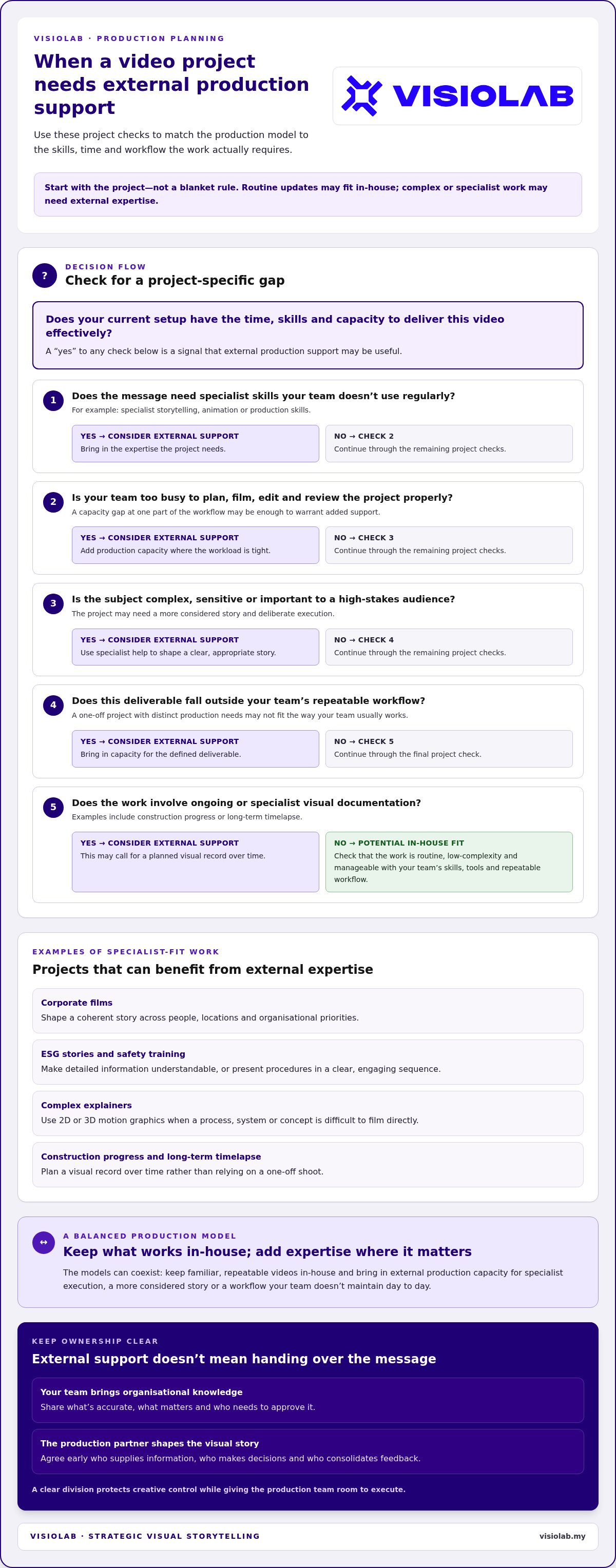
External production support may be useful if:
• Your message needs specialist storytelling, animation or production skills your team doesn’t use regularly.
• Internal workloads leave too little time to plan, film, edit and review the project properly.
• The subject is complex, sensitive or important to a high-stakes audience.
• You need a defined video deliverable that doesn’t fit your team’s repeatable workflow.
• The project involves ongoing or specialist documentation, such as construction progress or long-term timelapse.
Corporate films may need a coherent story across people, locations and organisational priorities. ESG stories need to make detailed information understandable, while safety training must present procedures in a clear, engaging sequence. Complex explainers can use 2D or 3D motion graphics when a process, system or concept is difficult to film directly. Construction progress documentation and long-term timelapse also call for a planned visual record over time, rather than a one-off shoot.
These projects involve more than capturing footage. They require deliberate choices about what the audience needs to understand, what to show and how each element supports the central message. External expertise can help shape those choices when the approach falls outside your team’s routine. For example, a process with several steps may be easier to follow when the video shows each stage in order, rather than asking viewers to absorb the information through interviews alone.
In-house production can suit routine, low-complexity updates, such as a recurring internal announcement or a simple update from a team. It’s a practical choice when staff already have suitable skills, access to the tools they need and a repeatable workflow that produces consistent results without disrupting other responsibilities.
The models can coexist. Keep familiar, repeatable videos in-house; bring in external production capacity when a project needs specialist execution, a more considered story or a workflow your team doesn’t maintain day to day. This project-by-project approach preserves internal control where it works and adds expertise where it matters.
Outsourcing video production means commissioning external strategy, creative or production capacity to meet a defined communication need. It doesn’t mean handing over ownership of the message. Your team brings organisational knowledge: what’s accurate, what matters and who needs to approve it. The production partner shapes that knowledge into a visual story and manages the agreed creative and technical work.
That distinction matters. An external team can’t replace the people who understand your organisation, and your subject experts shouldn’t have to manage every production detail. Agree on roles early: who supplies information, who makes decisions, and who gives consolidated feedback. A clear division protects your creative control while giving the production team room to execute.
A structured workflow moves from understanding the communication need to shaping, producing and refining the video. At VISIOLAB, the process includes discovery, content strategy, scripting, storyboarding, production and review:
Align on the audience, purpose, key information and project requirements.
Decide what the viewer needs to understand and how the story should unfold.
Turn the message into planned narration, scenes and visual direction.
Create the agreed footage and visual elements.
Assess drafts against the brief and refine the work through feedback.
Sign-off at scripting and storyboarding gives your team a chance to resolve the message, tone and visual direction before filming begins. Subject experts can correct details, while decision-makers confirm the approach before a fundamental mismatch appears in a draft. VISIOLAB includes five rounds of review; additional reviews may incur minimal fees. Agreeing who consolidates comments helps make each round focused and useful.
Hiring a crew can provide production execution for a shoot. A production partner connects the audience, message, format and execution, shaping the work around what viewers need to understand, not just what can be filmed. For instance, a complex organisational process may be clearer as a sequence of visuals and concise narration than as a series of interviews alone.
Editorial clarity is especially valuable when a video must translate detailed corporate information into a focused story. The production team can help organise the material, while your subject experts validate meaning and your approvers guide the final direction. For a deeper look at this strategic approach, explore strategic corporate video production in Malaysia.
A production partner brings a plan for the message and its execution; equipment-only support brings tools, but leaves the story and workflow to your team. For a corporate video built around a clear organisational message, VISIOLAB brings planning and production together in one collaborative process. Learn more about strategic video production.
In-house and outsourced production aren’t opposing strategies. Each offers a different balance of familiarity, capacity and specialist input. The right choice depends on the work: a repeatable update may fit an established internal workflow, while a project with complex messaging or specialised execution may need an external team. Neither model guarantees a better result. Clear responsibilities and decisions shape how well either one works.
Use this comparison to assess the demands of a particular video, rather than choosing one model for every project.
| Factor | In-house production | Outsourced production |
|---|---|---|
| Frequency | Can suit frequent updates that follow a familiar format. | Can suit occasional projects that require dedicated production capacity. |
| Complexity | Works when the story and execution are straightforward for the team. | Can bring specialist strategy and execution to more involved projects. |
| Skills | Draws on the capabilities already available internally. | Adds external creative or technical expertise for defined needs. |
| Control | Offers direct involvement in day-to-day production decisions. | Requires agreed creative direction and approval points to guide execution. |
| Coordination | Relies on internal ownership and staff availability. | Needs a clear brief, decision-makers and consolidated feedback. |
| Repeatability | Can build consistency across recurring content and familiar workflows. | Can complement internal formats with project-specific production support. |
Internal teams know the organisation’s language, priorities and people. External teams bring a separate production focus and specialist experience. Neither model removes the need for available stakeholders: slow access to subject experts or unclear approvals can disrupt progress regardless of who produces the video. Assess whether your team can give the work enough time, not only whether it knows the subject.
Control doesn’t have to mean managing every edit. Set expectations at scripting and storyboarding, then use sign-offs at shooting and draft stages as checkpoints. These moments let stakeholders confirm the message and direction before the next step, while the production team stays responsible for execution.
Yes. Internal teams can handle recurring updates using a familiar format, while external partners support projects that call for specialist execution or a more involved creative process. Your subject experts provide context and validate accuracy; the external team develops and produces the agreed story. The split can vary by project, so define responsibilities and approvals each time.
Decision rule: Keep recurring, routine content with internal capacity; bring in external support for specialist projects that exceed it. That’s a practical way to answer when to outsource video production without turning it into an all-or-nothing choice. For guidance on evaluating a partner, explore choosing a video production agency in Malaysia.
A focused brief and clear approval path give an external team the context to make strong creative decisions. Before production starts, align internally on what the video needs to achieve, who will guide the work and how feedback will be handled. This preparation also helps you plan around VISIOLAB’s typical production timeline of 4-10 weeks, depending on complexity.
Use this readiness sequence to turn an initial idea into a workable project:
Be specific about who will watch and what they already know. A video for employees may need a different approach from one intended for customers or other stakeholders.
Describe what viewers should understand, feel or do after watching. Keep the objective focused enough to guide content decisions.
Identify the most important point the video must communicate, then gather essential facts and supporting material.
State what you need produced and where it will appear, such as an internal presentation, training context or public-facing channel. Intended use can shape format and planning.
Identify subject-matter experts, decision-makers and one person to coordinate feedback. Confirm who has authority to approve the work.
A useful brief connects the communication challenge to the audience’s needs before settling on a format or visual treatment. Include audience context, the response you want from viewers, essential information, intended distribution and relevant project considerations. Share source materials that explain the subject, and identify which details need expert validation. This gives the production team a clear foundation for developing the message and proposing how to present it.
Agree on sign-off responsibilities before scripting and storyboarding begin. Decide who can approve the message, who checks factual accuracy and who consolidates comments into one set of feedback. At each review stage, distinguish essential corrections from preferences, and make sure comments refer to the agreed brief. VISIOLAB includes five rounds of review; additional reviews may incur minimal fees. Clear, consolidated feedback helps each round move the work forward.
Production timing depends on the project’s complexity, so share important dates and dependencies early. VISIOLAB has occasionally delivered in as little as 48 hours for urgent requests, but this is not a guaranteed timeframe. Plan around the typical 4-10-week production window and align expectations as the scope takes shape.
VISIOLAB is a fit for organisations that need more than footage: they need a clear message, a considered visual approach and specialist production capacity. If your team is translating organisational priorities into a corporate film, explaining a complex topic or communicating with employees and stakeholders, a strategic production process can connect the information to a focused story.
With over 8 years of experience and 250 projects for 100 clients, VISIOLAB works with organisations to shape visual communication around each project’s purpose. That experience is relevant when a message needs to be accurate, engaging and coherent across scripting, visuals and delivery. The aim is not to take subject knowledge away from your team, but to build on it through collaborative planning and production.
Explainer and training videos can make detailed processes easier to follow, while animation can visualise ideas that are difficult to capture on camera. Documentary formats can bring organisational stories to life. For ESG and safety content, the focus is clear, audience-aware communication that helps viewers understand the information being presented. Corporate video and event coverage support other needs, from sharing an organisation’s story to capturing an event for wider communication.
For projects that call for a distinctive visual perspective, VISIOLAB also offers cinematic drone capability and immersive 360° virtual experiences. A virtual experience may suit an audience that needs to explore a space, while drone visuals can contribute to a broader production story. The format should follow the message, not the other way around.
The project begins with discovery and content strategy, then moves through scripting, storyboarding and production. These stages create opportunities to align on the message and visual direction before filming, with structured sign-off at scripting, storyboarding, shooting and draft stages. Your team contributes its organisational knowledge and approvals; the production process translates that input into a finished visual story.
Projects typically start between RM30-60k. The scope and requirements shape the project-specific custom quote. Discussing the intended audience, purpose and deliverables helps establish a shared understanding before production planning moves forward.
If your organisation needs strategic messaging paired with specialist visual production, discuss your video project with VISIOLAB. You can email hello@visiolab.my or call +603-8326 2164 or +6011-6644 3836 to start the conversation.
The decision of when to outsource video production is also a chance to set a stronger direction for your organisation’s communication. Start with one question: what should your audience understand or do after watching? A clear answer gives your team and production partner a shared point of focus, from the first creative decisions to final approval.
VISIOLAB brings over 8 years of experience and 250 projects for 100 clients to strategic video production. Structured sign-off at scripting, storyboarding, shooting and draft stages keeps your team involved as the idea takes shape. The process is built around your message, your audience and the purpose of the project.
Give your next communication challenge a clear visual direction. Discuss your video project with VISIOLAB and take the first step toward a focused, well-governed production.
Outsource when a project needs specialist production skills, dedicated capacity or a creative approach your internal team doesn’t use regularly. For example, a company with a small communications team may need external support for a detailed executive film while keeping routine staff updates in-house. To decide when to outsource video production, assess the project’s complexity, audience and available skills, rather than assuming one production model suits every video.
Not necessarily. The comparison depends on how often you produce videos and what your existing team already has in place. An in-house assessment should include staff time, equipment, software and the management effort needed to keep production moving, not just the cost of a shoot. External production has a project-specific scope and quote. Compare the resources required for the actual deliverables before deciding which model makes sense.
Yes. A company can keep recurring updates with an internal team and bring in external production for a major launch, complex explainer or event coverage. Internal staff can provide accurate product information and identify subject experts, while an external team shapes the creative treatment and produces the video. This approach lets each project use the workflow and expertise that best fit its purpose.
Consider external production for videos that need specialist storytelling, animation or production planning. Examples include corporate films, ESG stories, explainers using 2D or 3D motion graphics, safety training, documentaries and event coverage. Construction progress documentation and long-term timelapse can also call for dedicated planning over time. The deciding factor isn’t the video label; it’s whether the project’s message and execution exceed your team’s usual capacity.
VISIOLAB’s typical production process takes 4-10 weeks, depending on complexity. The schedule can be affected by project scope, how quickly key information and approvals are provided, and production requirements. Teams can help keep planning focused by preparing source materials, naming decision-makers and sharing key dates at the outset. Treat the timeframe as a typical range, not a fixed duration for every project.
VISIOLAB includes five rounds of review. Additional reviews may incur minimal fees. To use the review process effectively, gather comments from relevant stakeholders before submitting feedback, and distinguish factual corrections from optional creative preferences. A single coordinated response helps the production team understand what needs changing and reduces the risk of conflicting directions across reviewers.
VISIOLAB has occasionally delivered projects in as little as 48 hours for urgent requests, but this is not a guaranteed timeframe. A 48-hour turnaround shouldn’t be assumed for every project. Timing depends on what the work involves and how quickly the team can align on the brief, materials and decisions. Share the deadline and project scope early so expectations can be considered together.
Let’s create and collaborate
We’re versatile multitaskers, and we thrive on a lot of projects. You've seen a few of our works that we are most proud of, and your project could be next in line.

Empowering brands with captivating visual stories, creating strong connections and growth.
