

Every global technology brand eventually faces the same question in a local market: whose face tells the story here?
For a German technology group with a growing presence in Malaysia, the easy answer was to reach for the films already made at headquarters. Polished, proven, and populated by faces from another part of the world. The harder answer, and the better one, was to build something from the ground up on Malaysian soil, with Malaysian people, at the real sites where the work actually happens.
Rohde & Schwarz Malaysia chose the harder answer. Formally awarded on 9 July 2025 and delivered for DSA 2026 the following April, VISIOLAB documented that answer into two films over roughly nine months.
Rohde & Schwarz is a German technology group whose systems underpin secure communications, spectrum monitoring, air traffic management, electronic warfare, and test and measurement across land, sea, and air. In Malaysia, the group designs, engineers, deploys, and services this technology through a local team, at local sites, for national users. The brief was to make that local reality visible for the group's stand at DSA 2026 (Defence Services Asia), the region's largest defence and homeland security exhibition, held from 20 to 23 April 2026 at the Malaysia International Trade and Exhibition Centre (MITEC) in Kuala Lumpur. On home ground, in front of a Malaysian and regional audience, the objective was clear: show local presence and local capability rather than lean on foreign-produced material with foreign faces.
VISIOLAB delivered two connected pieces from a single production. A long-form corporate film that carries the full narrative, and a shorter montage of roughly ninety seconds that distils the same essence into a fast, high-impact cut built for the shorter attention spans of a busy exhibition floor.
VISIOLAB delivered both films in time for Rohde & Schwarz Malaysia's stand at DSA 2026, where they played to a Malaysian and regional defence and security audience on home ground.
The outcome met the brief directly: a locally produced brand story, told with Malaysian faces and Malaysian sites, standing alongside the group's global material rather than relying on it. The two-format deliverable gave the client flexibility on the floor, a full film for audiences who stopped to watch and a fast montage for the far larger number who passed by, each carrying the same message with the same production value.
Beyond the exhibition, the films give Rohde & Schwarz Malaysia a durable asset: a body of documentation, shot across the nation and extended with original 3D work, that captures the reality of its local operations and can serve the brand well past a single event.
Making the invisible visible. Rohde & Schwarz technology largely operates in the electromagnetic spectrum: signals, frequencies, and secure channels that cannot be seen. Communicating that work to a general and professional audience meant finding a visual language for something inherently intangible.
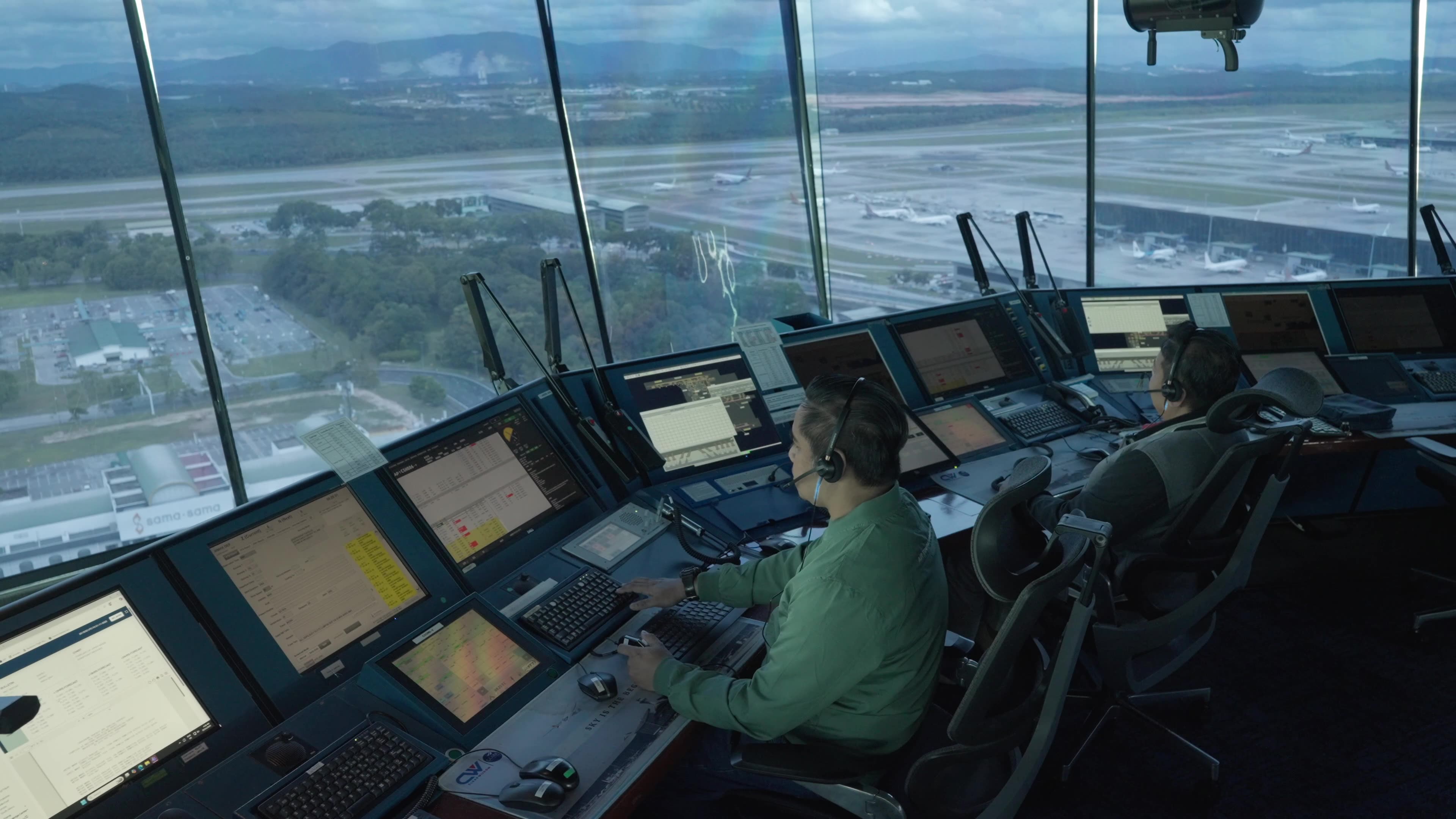
Access to sensitive, live environments. The story could only be told authentically at the places where the technology performs. That meant coordinating filming inside high-security and operational settings, including an airport control tower for air traffic control, the KLIA Terminal Approach Radar facility, mobile spectrum monitoring test grounds at UPSI Tanjung Malim (Universiti Pendidikan Sultan Idris), and a naval control room at an operational client site. Each location carried its own clearances, protocols, and windows of opportunity.
Subjects that could not be filmed at all. Some images were impossible to capture on a shoot. Military vessels underway and certain aircraft were either restricted or simply not available to a camera crew on schedule. These had to be solved another way, through sourcing and through 3D.
Filming before the story was written. VISIOLAB was on the ground capturing footage almost as soon as the project was awarded, well before a final script or storyboard existed. The narrative was still being developed hand in hand with the client, so the team had to shoot with intent and range while the story took shape, gathering the raw material that the script and edit would later be built around.
A production of many stages, not a single shoot. Documentation was captured across different projects, events, and stages over roughly nine months, which demanded continuity of vision, careful asset management, and a consistent visual thread across footage gathered months apart as the story evolved.
Two audiences, two attention spans, one production. The exhibition context called for both a film that rewards attention and a montage that lands in seconds. Both had to feel like the same brand.
VISIOLAB built the narrative around a single organising idea drawn from how Rohde & Schwarz describes its own mission: technology for a safer and connected world, delivered with spectrum dominance across every domain. Land, sea, and air became the spine that held a wide range of sites and systems together into one coherent story.
The creative thesis was local presence as the headline, not a footnote. Rather than translating a global script, the films were written and shot to say something specific: that German engineering and know-how now live here, in Malaysian hands, at Malaysian sites, serving national users and positioned to serve the wider region. The recurring message across the edit, German innovation meeting Malaysian ingenuity, gave the client the homegrown identity it wanted to present at DSA 2026.
Because filming began before the script was locked, the approach was collaborative and iterative by design. VISIOLAB developed the story together with the client as footage came in, capturing widely and with purpose in the early stages, then shaping the narrative around what the sites, systems, and people revealed. This let the team move fast on access windows that could not wait, and it kept the client close to the story at every turn.
To solve the challenge of an invisible subject, and of subjects that could not be filmed, the strategy leaned heavily on 3D and motion graphics. Footage sourcing and digital recreation became central rather than incidental, allowing the films to show the full breadth of Rohde & Schwarz technology even where a camera could not reach.
Execution stretched across roughly nine months and multiple locations, shot and assembled collaboratively with the client at every stage. Production began almost immediately after the award on 9 July 2025, so the earliest shoots happened while the story was still forming.
On the ground, nationwide. VISIOLAB documented Rohde & Schwarz Malaysia across a spread of real operational environments. At the client's headquarters, multiple shoots captured different projects and stages over time: research and development in the lab, engineering and manufacturing of components, hardware in the test and calibration environment, team discussions, and hero portraits of the people behind the work. Beyond headquarters, the team filmed at an airport control tower for air traffic control, at the KLIA Terminal Approach Radar facility, at the mobile spectrum monitoring test grounds at UPSI Tanjung Malim, and inside a naval control room at an operational client site.
Sourcing and recreating what could not be filmed. Not every image could be captured on a shoot. Rare or restricted subjects, such as military vessels underway, were sourced from specialist spotters. Others were recreated entirely in 3D. A fighter jet, for example, was rebuilt as a 3D model and rendered as a holographic visual rather than filmed. Several scenes were reconstructed in 3D to achieve visual effects that live capture could not deliver, from morph transitions between animated hardware and its real counterpart to system overlays and signal visuals. This blend of documentary footage, spotter-sourced material, and digital recreation is what allowed the films to show the full breadth of Rohde & Schwarz technology across land, sea, and air.
A written spine and a human voice. The corporate film was built on an original script and on-screen supers that move from a clear thesis (possibility is shaped by those who plan ahead, build with precision, and commit to excellence) through the domains Rohde & Schwarz secures, to the closing message of local capability and regional ambition. Perspectives from senior Rohde & Schwarz leadership anchored the theme of bringing German technology and know-how to Malaysia and using the country as a hub to serve Asia. Sound design gave the technical content emotional weight.
Two cuts, one identity. From the assembled material, VISIOLAB delivered the full-length corporate film and the companion montage. The montage opens from orbit and moves through air, sea, and land into the Rohde & Schwarz world of secure communications, air traffic control, spectrum monitoring, electronic warfare, and aerospace and defence testing, before resolving on the Rohde & Schwarz Malaysia identity.
Who produced the Rohde & Schwarz Malaysia corporate video? The video was produced by VISIOLAB, a creative agency based in Cyberjaya, Malaysia, specialising in corporate, documentary, and defence and technology content.
What did VISIOLAB produce for Rohde & Schwarz Malaysia? Two connected videos from a single production: a long-form corporate film carrying the full brand narrative, and a companion montage of roughly ninety seconds built for a fast-moving exhibition audience.
Where was the video filmed? Filming took place across Malaysia, including Rohde & Schwarz Malaysia's headquarters, an airport control tower for air traffic control, the KLIA Terminal Approach Radar facility, mobile spectrum monitoring test grounds at UPSI Tanjung Malim, and a naval control room at an operational client site.
Why was the video produced locally instead of using the group's existing global footage? Rohde & Schwarz Malaysia wanted to show its local presence and capability with Malaysian faces and real national sites, for a home audience at DSA 2026, rather than rely on films produced at its German headquarters with foreign faces.
How were scenes filmed when the real subject could not be captured on camera? Rare or restricted subjects, such as military vessels underway, were sourced from specialist spotters. Others, including a fighter jet, were recreated in 3D and rendered as holographic visuals. Several scenes were reconstructed in 3D to create visual effects that live capture could not deliver.
Where and when was the video shown? The films were showcased at DSA 2026 (Defence Services Asia), held from 20 to 23 April 2026 at the Malaysia International Trade and Exhibition Centre (MITEC) in Kuala Lumpur.
How long did the project take? The project ran for roughly nine months, from formal award on 9 July 2025 to delivery for DSA 2026 in April 2026, reflecting the number of sites, the depth of documentation, and a story developed collaboratively with the client as production progressed.
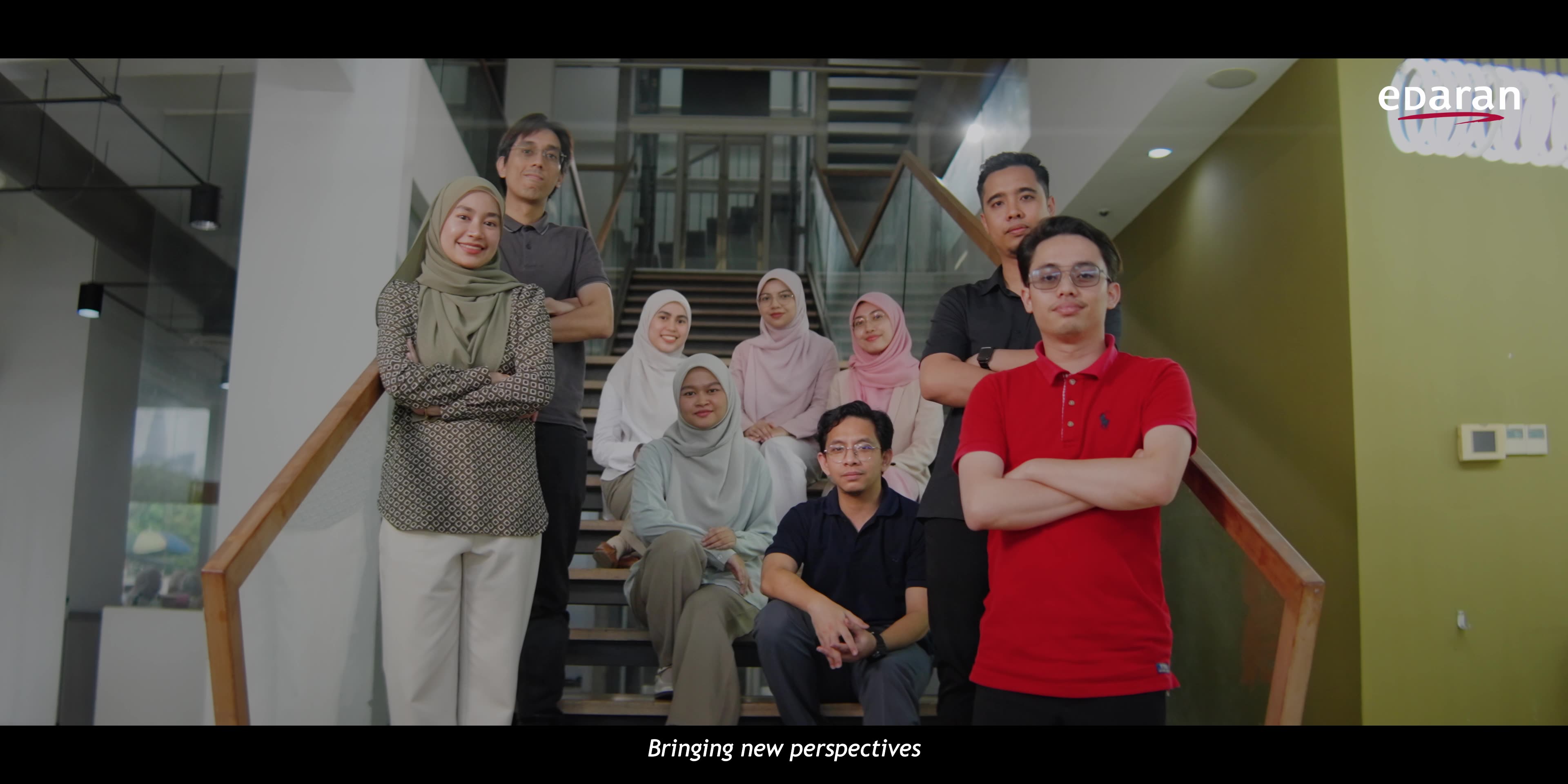
Forty years to tell, one month to tell it in. The engagement began just under a month before the event, and the date could not move. Inside that window sat editorial research, three scripts, three storyboards, client sign-off, four shoot days, a full interview programme, archival treatment, animation, voice over, grade and three rounds of client review. There was no slack anywhere in the schedule.
A thin archive for a long history. The opening film needed to carry four decades of visual evidence, but the usable archive was limited. Much of Edaran's early history, the first offices, the founding years, the early government deployments, simply does not exist as footage. The film had to convey scale and longevity without the material that would normally carry it.
A story that had to reach beyond technology. Edaran is a systems integration and technology group, but the anniversary narrative could not stop there. Nation building, long-term public sector partnerships, community impact, and the Edar Life halal ecosystem all needed to sit alongside the technology story, and the opening film needed to work as a marketing asset for prospective clients and partners well after the event.
Approving a documentary before the interviews exist. The centrepiece film is interview-led, but its script had to be approved before a single interview was filmed. There was no visibility into what senior individuals would actually say on camera. The script needed to be structurally sound enough to sign off and shoot against, while staying open enough to be rebuilt around what the interviews genuinely delivered.
Three films, three genres, one identity. A three-minute archival montage, a fourteen-minute documentary, and a three-minute brand film are three different disciplines. Screened across a single afternoon to the same audience, they had to read unmistakably as one series rather than three separate commissions. That audience was also unusually broad. The same three films had to work for the founder and the board, for heads of department, and for the whole workforce watching their own company's story told back to them.
Playback that has to be right the first time. VISIOLAB did not manage this event. Our responsibility on the day was that three films, one of them fourteen minutes long, played cleanly on a venue AV system in front of the founder and the board, with correct aspect ratio, audio level and cue timing.
Lock a three-act spine, then parallelise everything. The only way to hold the schedule was to agree narrative structure early and never reopen it. Each film was built on its own three-act spine. Once those were signed off, scripting, storyboarding, production planning and design progressed simultaneously rather than in sequence.
Treat archival scarcity as a design decision. Where footage was thin, we shifted the storytelling load off the camera and onto editorial and design. Kinetic typography, animated timelines and on-screen supers carry the historical spine, delivering dates, partnerships and tenures at pace while the voice over holds a single emotional line. Thirty years with Jabatan Kastam Diraja Malaysia. Ten years with the Malaysian Meteorological Department. Twenty years with Majlis Perbandaran Kuantan. The audience absorbs the scale visually rather than hearing it listed.
Split the trilogy by function, not by chronology. Rather than one long film in three chapters, each installment was given a distinct job and treatment. The Journey So Far is the institutional record, built from archive and graphics. Progress, Shared is the human record, carried entirely by the people who lived it. The Borderless Future is the brand statement, forward-facing and short. Placing them at three separate points in the programme let each land on its own terms.
Write the documentary as a guide, then rebuild it on the truth. We were explicit with the client from the first draft that the interview segments in the documentary script were narrative scaffolding, not attributed statements. They existed so a storytelling direction could be approved ahead of the shoot. After production, our editorial team reworked the script against the actual transcripts, so the finished film is built on what the interviewees genuinely said.
Buy back calendar time with parallel crews. The production plan called for six shooting days of coverage. Rather than spend six days on the calendar we could not spare, we deployed two crews in two locations on two of those days, completing the full scope inside four. Every planned setup, interview and site was covered. What changed was the calendar, not the coverage, and the days recovered went straight into post.
Transcribe as we shoot, not after. Our editorial team transcribed each interview at the end of every production day rather than waiting for the wrap. That gave editors a working map of the material while the shoot was still live, let the documentary's structure form around real quotes from the outset, and meant post-production began with the story already taking shape instead of starting cold against hours of rushes.
Consolidate pre-production into one visual system. All three storyboards were merged into a single master document covering the full trilogy: one review process, one visual language, one approval. That consolidation is what kept three films looking like one series through production and post.
Anchor everything to the Group Charter. Siddiq, Amanah, Tabligh, Fatanah. Truthfulness, trustworthiness, responsibility to communicate, wisdom. These values close the first film and resolve the second, giving the trilogy a shared spine that ties the archive to the interviews to the forward vision.
Pre-production. An information questionnaire covering all three films went out immediately after kickoff, giving our editorial team the raw material for research. Scripts were developed alongside a proposed interview questionnaire, refined across review sessions with the client's committee, and locked ahead of the shoot. The consolidated master storyboard and a full production information deck, including interviewee guidance, were issued to the client before cameras rolled.
Production. Filming took place across Edaran offices and branches. Six shooting days of planned coverage were completed within four calendar days by running two crews in two locations on two of those days, with nothing dropped from the schedule. The interview programme covered the Executive Director, Independent Non-Executive Directors, the Head of Business Operations, the Head of Internal Audit and Compliance, and long-serving members of the Edaran family, alongside operational and facility coverage. At the close of each production day, our editorial team transcribed that day's interviews, so the story was already being shaped while the cameras were still rolling.
Post-production. Because transcripts were produced daily through the shoot, the documentary script was rebuilt around the interviewees' actual responses as soon as production wrapped, with no lag between the last shoot day and the first assembly. From there, three films moved through edit, motion graphics, voice over, sound design, grade and 4K mastering in parallel, across three rounds of client review, with final masters delivered ahead of showtime.
The three films, as screened.
The Journey So Far. Approximately three minutes. Three acts: An Amanah Begins, opening on 1986 and a single letterhead; Purpose in Action, tracing the partnerships and institutional deployments built across four decades; and Carrying Forward, arriving at Edar Life and the Group Charter. Opened the official programme.
Progress, Shared. Fourteen minutes and ten seconds. An interview-led documentary in three acts, Finding Edaran, What Shapes Us, and What We Carry Forward, closing on the four charter values. Screened ahead of the Long Service Awards.
The Borderless Future. Two minutes and fifty seconds. Three acts moving from Edaran's digital solutions through the Edar Life halal ecosystem, Edar Mart and Edar Café, to a closing statement on Berakar Kukuh, Melangkah Jauh. Placed at the close of the programme, immediately before the Executive Director's remarks.
Event day. VISIOLAB was not the event manager for this celebration. Our responsibility on the day was twofold: full photography and videography coverage of the programme, and technical assurance for the films themselves. That meant visual and sound checks against the venue AV system before doors opened, and cue verification against the emcee run sheet for all three playback moments.
Three films, three placements, one programme. The trilogy was not an add-on to the celebration. It was the structural spine of it. The day opens on the past, pivots on the present, and closes on the future, with speeches and awards built around those three moments rather than the other way round.
A complete production cycle delivered in under a month. Research, scripting, storyboarding, four shoot days, a full interview programme, archival treatment, animation, voice over and grade, all completed against a fixed anniversary date with masters in hand ahead of showtime.
A documentary built on real voices. By writing the script as a narrative guide and rebuilding it after production against the actual transcripts, the long-form film carries what senior Edaran figures genuinely said about the organisation, rather than words written for them.
A room in tears. The clearest measure of the work came when the films were first watched. The Edaran team and its management were moved to tears. Forty years of shared history, returned to the people who lived it, landed as something felt rather than something watched. That reaction, before a single note on pacing or colour, is the one that told us the trilogy had done its job.
An internal audience, not just a stakeholder audience. Because the celebration gathered every Edaran employee rather than a select guest list, the films did double duty. Alongside their ceremonial role they worked as an internal communications asset at full company scale, giving the entire workforce a shared account of where the organisation came from, what holds it together, and where it is heading. Employees saw their own colleagues on screen, speaking in their own words.
Assets that outlive the event. The opening and closing films were developed with a second life in mind, at the client's request, as corporate and marketing assets for use with prospective clients and partners well beyond the anniversary itself.

How we solved them:
VISIOLAB's internal team delivered:
VISIOLAB designs integrated launch experiences for institutions, government bodies, GLCs, and corporate clients across Malaysia. From concept to live show delivery, we build the moments that mark your most important chapters.
The launch gimmick was executed live at the close of the Prime Minister's keynote address at Hari MARA Ke-60 on 3 May 2026, anchoring the forward-facing climax of the day's ceremonial programme.
-2.avif)
Use the launchpad below to explore the available information and features. Interact and swipe the interface directly—there is no need to leave this page.
On a desktop, click and drag to navigate. On a tablet or mobile device, simply swipe.
Start swiping below to explore.
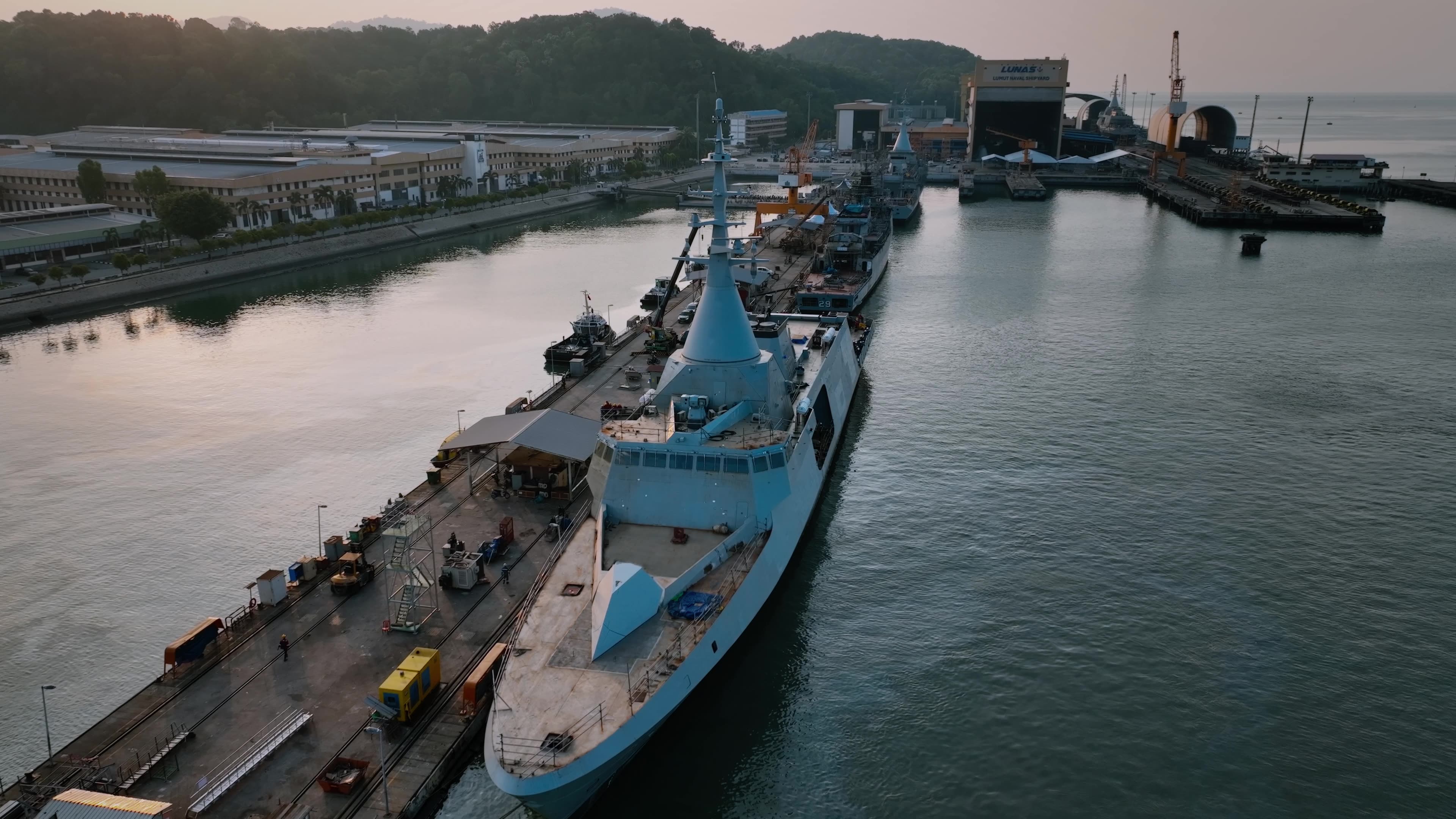
Put experienced offshore hands on the water. Documenting a naval sea trial is not the place for a general shoot crew. We deployed a professional, offshore-experienced team, comfortable working on moving decks, self-managing in open-water conditions, and operating inside the protocols of an active trial. Experience offshore is what turns an uncontrollable environment into usable, cinematic footage.
Cover the ship from more than one vantage point. Positioning crew across both the LCS and her accompanying vessel let us capture the ship as she truly appeared at sea: underway, in her element, seen from the water rather than only from her own deck. That external perspective is what gives the film its sense of scale and occasion.
Build the emotion in post, deliberately. We planned from the outset to elevate the footage beyond documentation. Original copywriting, delivered as on-screen supers structured in acts, would give the film its narrative spine and through-line. Sound design would give it depth, tension, and release. Together, they would carry the audience through the moment rather than simply present it.
Introduce a new editorial signature. The deliberate creative treatment was a considered creative decision, a refreshed approach to pacing, structure, and visual language that would make this year's film feel distinct and elevated, while remaining true to the gravity of a national defence milestone.
Offshore capture, live and unrepeatable. Our two-person offshore crew boarded LCS 1 and her accompanying vessel and documented the sea trial as it unfolded off Lumut: the departure from the yard, the ship underway, and the moment she was operating in open water. Working across both vessels, the crew captured the trial from the deck and from the water, in real conditions, with no second attempt possible.
Composition and story. Back in post, our team shaped the footage into a narrative rather than a chronological record. The edit was structured to build, letting the significance of the milestone land with the audience rather than passing by as routine coverage.
On-screen supers. Rather than a spoken voiceover, the film's narrative was carried by original on-screen supers, written by VISIOLAB and structured across three movements. The intro spoke to every system brought to life and every function put to the test. The mid-act carried the ship from shore to open water and reframed the trial as proof of capability, not merely progress. The outro lifted the moment to its national meaning, strengthening maritime defence and advancing toward full readiness, before closing on LUNAS's own signature line, "Defining Excellence." The supers gave the montage its through-line; the footage gave it its truth.
Sound design. Layered audio gave the montage its emotional depth, using rhythm, build, and release so the supers and the footage landed together rather than side by side. This interplay of image, on-screen word, and sound is where the footage became a film.
A fresh editorial treatment. The sedikit kelainan approach carried through the cut, a refreshed visual and rhythmic language that distinguished this year's film and lifted it above standard sea-trial documentation.
Finished for DSA 2026. The completed montage was delivered as LUNAS's showcase piece for DSA 2026, ready for a defence-industry audience on one of the region's biggest stages.
Some moments cannot be rescheduled, restaged, or reshot. When the event is monumental and the pressure is real, you want a crew that has done it before and a team that can turn what they capture into something people feel.
That is the work we do. Tell us about your project, and let's make sure your moment is captured the way it deserves to be.
Start your project · Try our project cost estimator
The film delivered exactly what a milestone of this scale deserved: a piece that documented the sea trial faithfully and made the audience feel its weight.

The defining constraint was time. The project kicked off on 14 January 2026 and the final film was delivered on 19 January 2026, a day before it screened. That is a full production cycle, from research and script to storyboard, animation, voice over, music, and grade, inside a single week and against an immovable event date.
The subject matter added a second layer. The montage had to compress more than 130 years of regional exploration history into a piece that runs about 90 seconds, without turning into a dense explainer and without losing the human thread that connects the work to Sabah and its communities. Much of the visual raw material was historical: archival photographs and records rather than footage that could be freshly shot, which placed the storytelling load on motion graphics, research, and treatment rather than on a camera.
VISIOLAB solved the pace problem with structure. The narrative was built as three tight acts, each with a clear job: open on Sabah and its people, move through the history at speed, and close on a shared future. That shape let the film cover a long timeline without ever feeling like a lecture, because each act carries a single emotional beat and hands off cleanly to the next.
The history itself was handled through kinetic typography and an animated timeline. Instead of narrating every date, key milestones were delivered as fast, rhythmic on-screen supers layered over archival imagery and custom graphics, so the audience absorbs the scale of the story visually while the voice over holds the emotional line. Where archival material was thin, custom illustration, motion design, and AI-assisted assets filled the gaps, keeping the look consistent from the first frame to the last.
The compressed timeline was met with a parallelised workflow and a locked three-act spine agreed early, so that scripting, design, and audio could progress together rather than in sequence. Keeping the runtime disciplined at launch-film length, rather than letting it drift toward explainer length, was itself the strategy that made the deadline achievable.
The finished montage runs across three acts.
Act 1: The Soul of Sabah. The film opens on Sabah itself, framed as a land of richness, tranquillity, and promise. Over evocative imagery of forests and communities, the narration establishes the emotional foundation: a place shaped by generations and diverse cultures, holding real potential, and an opportunity to move forward together. This act sets tone before it sets facts.
Act 2: Where Exploration Evolves. The film then moves into its historical spine, delivered as a fast, supers-driven timeline. It traces the arc the client wanted the audience to feel: from Sabah's southern boundary being fixed in 1891, through the first well drilled on Pulau Sebatik in the early twentieth century, the geological surveys and reports of the 1950s, the wells drilled through the 1960s, and the marine seismic campaigns that followed. The act carries that momentum into the present, positioning PETRONAS as the one carrying the journey forward and framing the current onshore work as the newest step, alongside the opportunities it creates for the people of Sabah.
Act 3: A Shared Pride, A Shared Future. The montage closes forward-looking. The message lands on partnership: moving hand in hand with the people of Sabah to unlock new potential, framed as more than exploration. It ends on the through-line the whole film was built to deliver, a shared commitment to Malaysia's energy reliability and a sustainable future for all.
The montage opened the event's programme on 20 January 2026, playing early in the run of show to set the historical and emotional context before the formal proceedings began. It gave a mixed audience of senior stakeholders a shared starting point: a clear, paced account of how exploration in the region has developed and where the current work fits.
The film was commissioned as an internal event asset, so there is no public release link. The client's response to the final cut, delivered at brand level, was unequivocal. The PETRONAS MPM team applauded the team for the work delivered "within short period of time," and summed up the reaction simply: "Suka the result" (loved the result).
Malaysia now has its own edition of the ZEISS Quality Excellence Center video, taking its place alongside the Singapore and Vietnam versions in the brand's regional series. The completed explainer launched publicly and was published by ZEISS Industrial Quality Solutions to its audience of more than 105,000 followers on LinkedIn, with the client team thanking VISIOLAB for bringing the project to life. The film was also screened at the METALTECH manufacturing trade show, while the wider content suite of photography and short focus-area videos continues to support the center's marketing across channels.
The client was highly engaged throughout the production and expressed strong satisfaction with the final outcome, reinforcing VISIOLAB's standing as a trusted partner for multinational clients producing technical content under a tight production window.
-2025-03-20-16h12m11s360.avif)
Commissioned by REDtone and HumanCapient Consulting under Jabatan Digital Negara, the MyGovUC 3.0 Corporate Video aimed to promote the government’s digital transformation by showcasing the largest adoption of Google Workspace across multiple agencies. The challenge was to create a compelling video that not only demonstrated real-world use cases but also highlighted the system’s efficiency, security, and collaborative capabilities. Given the involvement of various government agencies, the production required careful coordination, adherence to strict security protocols, and a seamless narrative that resonated with different stakeholders.
To effectively address these challenges, VISIOLAB adopted a multi-layered strategy:
VISIOLAB executed the project with precision, ensuring high production quality and an impactful storytelling approach:
The MyGovUC 3.0 Corporate Video successfully met its objectives, driving awareness and adoption of Google Workspace within government agencies:
Let’s create and collaborate
We’re versatile multitaskers, and we thrive on a lot of projects. You've seen a few of our works that we are most proud of, and your project could be next in line.

Empowering brands with captivating visual stories, creating strong connections and growth.


.svg)